
Skip to content
The Encyclopedia of Horology

Clock · Grandfather clock

Jugendstil Grandfather Clock

Partially verified

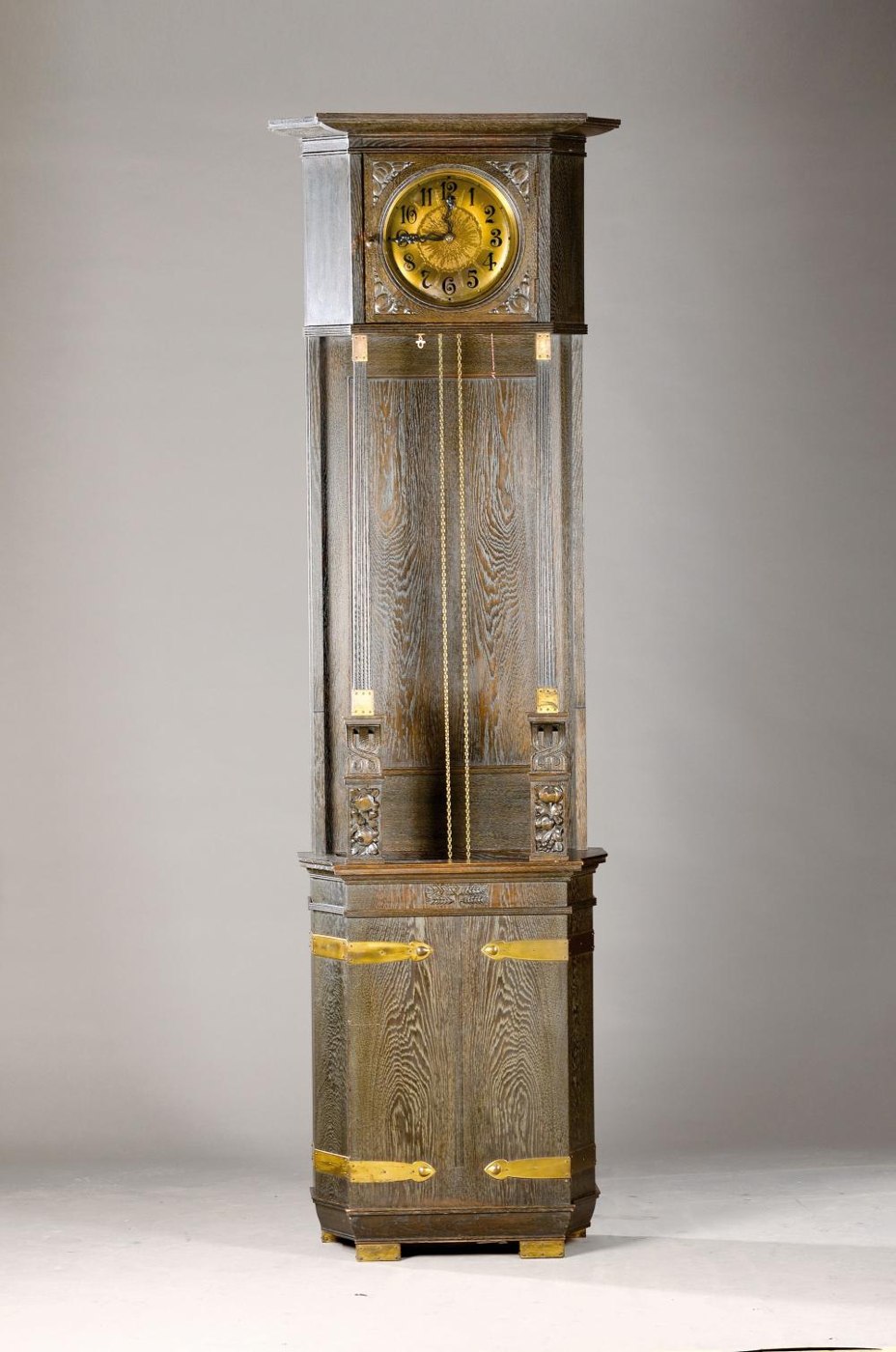
This Jugendstil grandfather clock, originating from the Darmstadt area, is dated to approximately 1900. It features a solid oak body finished with a dark stain. The cabinet construction incorporates decorative brass appliques and intricate floral wood carvings. A notable design element is the open-work section that allows visibility of the pendulum movement. The clock is fitted with an ornate brass dial featuring a raised number circle. Internally, the timepiece is powered by a massive brass plate movement, which the auction description attributes to the German manufacturer Lorenz Furtwängler & Söhne. The mechanism operates using a Graham escapement with pallets and is driven by chains and weights. It provides an approximate one-week power reserve and includes a half-hour strike function on a large gong. The total height of the piece is reported as approximately 225 cm, with a condition report of 2-3.

Full view of the dark-stained oak grandfather clock showing the brass dial, chains, and open-pendulum aperture.
Full view of the dark-stained oak grandfather clock showing the brass dial, chains, and open-pendulum aperture. — Henry's Auktionshaus (via Invaluable). Rights pending — permission not yet requested. Original source

Catalogue identity

Source
www.invaluable.com
Category
Clock · Grandfather clock
Maker / attribution
Lorenz Furtwängler & Söhne
Reference
Not recorded
Catalogue / lot identifier
5413
Source-reported date
circa 1900
Source-reported place
Germany

Source-reported attribution and specifications are not independent authentication. A listing does not establish present ownership, current display, availability or permission to reproduce.

Object description

Case and Exterior Design

The grandfather clock features a tall, vertical cabinet constructed from solid oak, which has been treated with a dark stain. The exterior is detailed with floral carvings and functional as well as decorative brass appliques. The design incorporates an open-pendulum area, which reveals the rhythmic motion of the internal components to the viewer. This design choice is balanced by the solid construction of the base and hood.

The clock face is comprised of a decorated brass dial. It features a raised number circle, providing depth and contrast against the dial surface. The overall height of the clock, recorded at approximately 225 cm, places it as a floor-standing unit consistent with large horological instruments of the late 19th and early 20th century.

Evidence for this section
  • “Korpus Eiche massiv dunkel gebeizt”
  • “feine florale Schnitzereien”
  • “Schwungbereich des Pendels offen”
  • “verziertes Messingzifferblatt mit erhöhtem Ziffernkreis”

Movement and Mechanism

The internal timekeeping mechanism is a massive brass plate movement, identified in the documentation as a product of Lorenz Furtwängler & Söhne. The movement utilizes a Graham escapement, which includes pallets to regulate the clock's accuracy. This mechanism is driven by a traditional system of weights and chains, which are visible within the cabinet.

The clock is engineered for a running time of approximately one week on a single winding. In addition to timekeeping, the movement includes a complication for a half-hour strike, which sounds against a large gong.

Evidence for this section
  • “mass. Messingplatinenwerk gem.: Lorenz Furtwängler & Söhne”
  • “Grahamgang mit Paletten”
  • “Antrieb über Ketten und Gewichte”
  • “Halbstd. Schlag auf große Tonfeder”

Attribution and Reported Condition

The origin of the piece is associated with the Darmstadt area of Germany, with an approximate date of 1900. The attribution of the movement to Lorenz Furtwängler & Söhne is based on marks documented during the inspection of the lot. This manufacturer was active during the period, providing a specific context for the internal construction.

Regarding the physical status of the clock, the auction description provides a condition assessment of 2-3 for both the movement and the housing.

Evidence for this section
  • “Umkreis Darmstadt, um 1900”
  • “mass. Messingplatinenwerk gem.: Lorenz Furtwängler & Söhne”
  • “WZ/GZ 2-3”

Open research questions

  • What specific archival records at Lorenz Furtwängler & Söhne confirm this model's production in the Darmstadt area?
  • Does the '2-3' condition rating refer to the functional status of the strike train as well as the timekeeping train?

Source evidence

Recorded claims and source quotations for Jugendstil Grandfather Clock
FieldSource-reported valueSource quotation
MakerLorenz Furtwängler & Söhne“mass. Messingplatinenwerk gem.: Lorenz Furtwängler & Söhne”
Datecirca 1900“um 1900”
MaterialDark-stained solid oak“Korpus Eiche massiv dunkel gebeizt”
Height225 cm“H. ca. 225cm”
EscapementGraham escapement“Grahamgang mit Paletten”
Power ReserveApprox. 1 week“Lfd. ca. 1 Woche”
StrikeHalf-hour strike“Halbstd. Schlag”

Visible details

  • Open-pendulum design integrated into the case structure
  • Visible brass chains suspended behind the dial area
  • Brass hinges and corner plates applied to the lower cabinet section
  • Raised chapter ring on the circular brass dial

Research qualifications

  • Attribution to Lorenz Furtwängler & Söhne is based on internal marking reports
  • General condition of the movement and housing is self-reported by the auction house as 2-3

Photograph identity and source facts were screened before import; rights clearance remains pending.

Consulted source

Grandfather clock, species Nouveau, Darmstadt area, around

Reviewed 2026-10-26 · Record accd82e8f4

Terms in this record

Glossary explanations for terms named in this object’s record.