
Skip to content
The Encyclopedia of Horology

Clock · Longcase clock

John Hills Longcase Clock

Partially verified

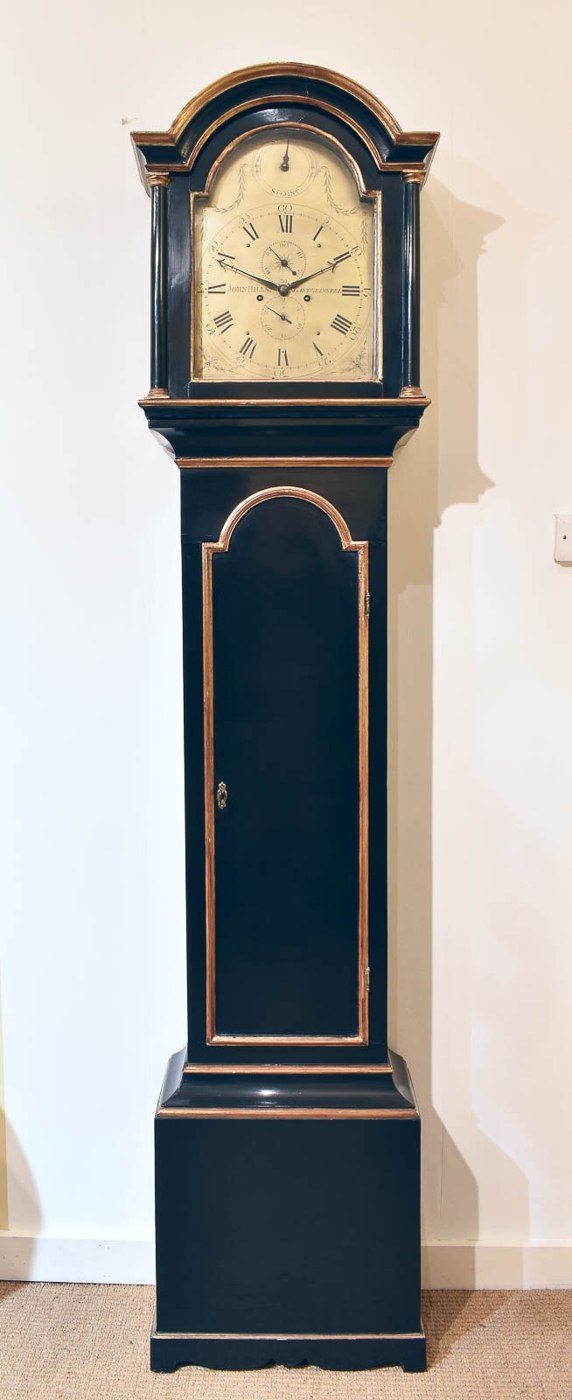
This antique English longcase clock is attributed to the clockmaker John Hills, who was active in East Grinstead during the early 19th century. The clock is housed in an ebonised cabinet featuring decorative lacquer work with gilded detailing, an arched hood, and side columns. The dial is constructed from brass, fully engraved, and displays Roman numerals for hours and Arabic numerals for minutes, accompanied by a subsidiary seconds dial and a calendar display. Positioned in the dial's arch is a strike-silent indicator. The mechanical movement has an eight-day duration and strikes on a bell. The auction description reports that the clock has been fully overhauled and is currently in working condition.

The clock dial and hood, showing the strike/silent indicator and engraved brass face.
The clock dial and hood, showing the strike/silent indicator and engraved brass face. — It's About Time (The Clock & Watch Shop). Rights pending — permission not yet requested. Original source

Catalogue identity

Source
zamanito.com
Category
Clock · Longcase clock
Maker / attribution
John Hills
Reference
Not recorded
Catalogue / lot identifier
Source URL identifies the listing
Source-reported date
circa 1810
Source-reported place
England

Source-reported attribution and specifications are not independent authentication. A listing does not establish present ownership, current display, availability or permission to reproduce.

Object description

Cabinet and Dial

The clock is presented in an ebonised cabinet, utilizing a lacquer finish to achieve its darkened aesthetic. Gilded detailing outlines the edges of the hood and the trunk, highlighting the architectural form of the piece. The hood is topped with an arched pediment supported by lateral columns that frame the clock face.

The dial is manufactured from brass and features extensive engraving. It includes Roman numeral hour markers and Arabic numeral minute markers, with additional displays for the seconds and calendar. The arch of the dial incorporates a specific indicator for the strike or silent function, providing control over the bell-ringing mechanism.

Evidence for this section
  • “کابینت ساعت دارای پرداخت لاکی تزیینی و پرداخت سیاه‌کاری‌شده به شیوه آبنوسی (Ebonised) با حاشیه‌ها و جزییات طلایی‌رنگ است”
  • “صفحه ساعت از برنج به صورت کامل حکاکی‌شده ساخته شده است”

Movement and Function

The timekeeping and striking functions are managed by an eight-day mechanical movement. This movement is designed to strike the hours on a single bell mounted within the case. The arrangement of the gear train allows for the integration of the strike-silent mechanism, permitting the user to suppress the chime as desired.

The auction description reports that the movement has been subject to a full overhaul, ensuring it is in current working order. The integration of the movement, dial, and cabinet is noted as a subject for independent inspection to confirm the lack of non-original replacement parts.

Evidence for this section
  • “موتور این ساعت مکانیکی با مدت زمان کارکرد هشت روزه (8-day duration) است و برای اعلام ساعات، نواختن زنگ را بر روی یک کاسه زنگ (Bell) انجام می‌دهد”
  • “ساعت به طور کامل اورهال (سرویس اساسی) شده و در وضعیت کاری قرار دارد”

Attribution and Maintenance

John Hills is identified as the clockmaker, with historical documentation placing his work in East Grinstead during the early 19th century. While some records suggest his active period centered around the 1820s, the current listing attributes the manufacture of this specific clock to approximately 1810.

The condition of the brass dial and the ebonised finish on the cabinet are visually reported to be in good state of preservation. Prospective collectors are advised to independently evaluate the mechanical components, specifically the springs and gear train, to verify their continued functional integrity and originality.

Evidence for this section
  • “این ساعت ایستاده آنتیک انگلیسی اثری از ساعت‌ساز John Hills است”
  • “فروشنده تاریخ ساخت این نمونه را اندکی قبل‌تر و در حدود سال ۱۸۱۰ میلادی تخمین زده است”

Open research questions

  • Can specific archival records confirm John Hills' apprenticeship or workshop dates in East Grinstead prior to 1820?
  • Is the ebonised finish original to the case or a later restoration, given the lacquer technique description?

Source evidence

Recorded claims and source quotations for John Hills Longcase Clock
FieldSource-reported valueSource quotation
MakerJohn Hills“John Hills”
LocationEast Grinstead, England“ایست گرینستد (East Grinstead) انگلستان”
DateCirca 1810“در حدود سال ۱۸۱۰ میلادی”
Mechanism8-day duration“8-day duration”
Strike systemBell strike“نواختن زنگ را بر روی یک کاسه زنگ (Bell) انجام می‌دهد”
Dial featuresStrike/Silent, calendar, seconds“نشانگر انتخاب وضعیت نواخت یا بی‌صدا (Strike / Silent) تعبیه شده است. روی صفحه، نام سازنده و موقعیت جغرافیایی وی به صورت لاتین حک گردیده و علاوه بر اعداد رومی ساعت‌شمار و اعداد عربی دقیقه‌شمار، عقربه‌های ثانیه‌شمار فرعی و نمایشگر تقویم نیز بر روی آن قابل مشاهده است.”

Visible details

  • Ebonised finish with gilded accents on the cabinet
  • Brass dial with detailed engraving and calendar aperture
  • Strike/silent selection dial in the arch of the face

Research qualifications

  • The provenance of the wooden cabinet connections remains unverified
  • The potential replacement of movement components over time requires independent assessment

Photograph identity and source facts were screened before import; rights clearance remains pending.

Consulted source

John Hills, East Grinstead

Reviewed 2026-11-02 · Record 73ab0b2968

Terms in this record

Glossary explanations for terms named in this object’s record.