
Skip to content
The Encyclopedia of Horology

Clock · Cuckoo clock

Johann Baptist Beha “Harrenhäusle” Cuckoo Clock

Partially verified

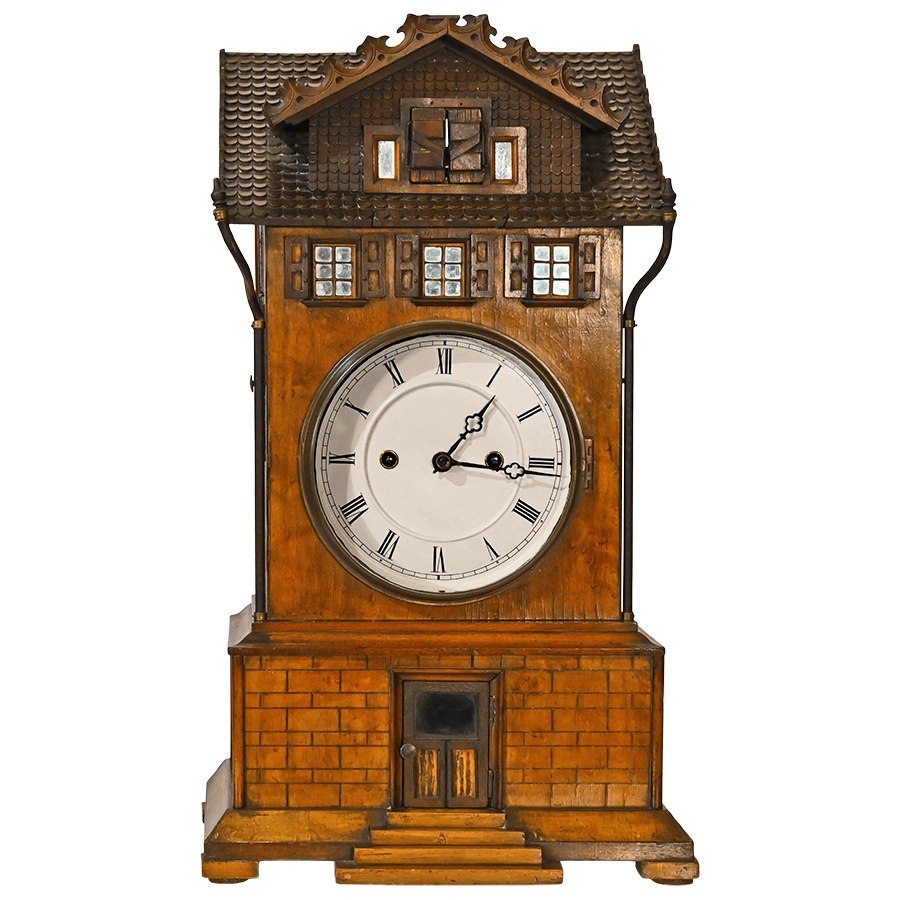
This architectural cuckoo clock, styled as a 'Harrenhäusle' or small manor house, is attributed to Black Forest clockmaker Johann Baptist Beha of Eisenbach, Germany, circa 1885. The hand-carved wooden case portrays a multi-story residence with a shingled gabled dormer roof, fretwork bargeboards, metal downspouts, mirrored windows, and a brick-patterned lower section with a stepped entrance. The circular white dial features black Roman numerals and twin winding apertures. According to the source, the interior houses a large wood-plate twin-fusee movement operating the time and striking trains alongside a gong, bellows, and whistles for an animated cuckoo automaton.

Front view of Johann Baptist Beha 'Harrenhäusle' architectural cuckoo clock
Front view of Johann Baptist Beha 'Harrenhäusle' architectural cuckoo clock — Renaissance Antiques. Rights pending — permission not yet requested. Original source

Catalogue identity

Source
www.renaissanceantiques.com
Category
Clock · Cuckoo clock
Maker / attribution
Johann Baptist Beha
Reference
AGER 20
Catalogue / lot identifier
Source URL identifies the listing
Source-reported date
circa 1885
Country
Germany

Source-reported attribution and specifications are not independent authentication. A listing does not establish present ownership, current display, availability or permission to reproduce.

Object description

Architectural Case Structure

The clock case is executed in a multi-story architectural form identified by the source as a "Harrenhäusle," an idiom reported to derive from "Herrenhaus" (roughly translating to "small manor house"). Visual observation confirms an architectural carved wood structure set on a stepped plinth, with an incised simulated brick pattern across the lower register centered by an entrance stairway and a paneled door.

The upper section features mirrored windows and an upper dormer with a shingled gabled roof flanked by curved metal downspouts. Positioned under the roofline are carved fretwork elements beneath the eaves and a pair of hinged wooden shutters through which an automaton appears.

Evidence for this section
  • “Architectural carved wood case fashioned as a multi-story building on a stepped plinth.”
  • “Lower register incised with a simulated brick facade centered by a panelled door and entrance steps.”
  • “Upper dormer features a pair of hinged wooden shutters flanked by mirrored panes underneath a shingled gabled roof with curved metal downspouts.”
  • ““Harrenhäusle” comes from the German “Herrenhaus”, which translates roughly to “small manor house.””
  • “Ornate carved fretwork appears beneath the eaves, enhanced by delicately shaped metal downspouts that accentuate the realism of the design.”

Dial and Reported Mechanism

The facade displays a large circular white dial showing black Roman numerals and two winding squares. The internal movement and acoustical components are completely enclosed within the wooden case and cannot be inspected visually.

According to the seller's description, the clock is driven by a large wood-plate twin-fusee mechanism operating the time and striking trains. The source further reports that the hour strike utilizes a gong, accompanied by bellows and whistles that produce birdsong for an animated, large carved cuckoo bird that emerges from the upper shutters.

Evidence for this section
  • “Large white circular dial with black Roman hour numerals and two winding squares.”
  • “Inside, the clock houses a large wood-plate movement with twin fusees, driving both the time and striking trains.”
  • “The gong strike marks the hours, while bellows and whistles produce the lifelike birdsong of the cuckoo, which appears through upper shutters to announce the time.”

Attribution and Source Claims

The clock is attributed by the dealer to Black Forest maker Johann Baptist Beha of Eisenbach, Germany, and given a date of circa 1885. The seller also asserts that this architectural form is extremely scarce, stating that fewer than ten examples are known to exist.

These claims of authorship, rarity, and dating originate exclusively from the dealer description; no maker's stamps, trade labels, or independent horological citations are recorded in the provided documentation. The seller additionally notes that the clock has been restored and carries a one-year warranty, though no technical report of specific alterations or replaced parts is provided.

Evidence for this section
  • “this rare “Harrenhäusle” cuckoo clock is the work of Johann Baptist Beha (1815-1898), a prestigious 19th-century clockmaker of Eisenbach, Germany.”
  • “Examples of this particular Beha architectural form are exceedingly scarce, with fewer than ten known to exist today.”
  • “Circa 1885”
  • “This exceptional clock has been restored and is offered with a one-year warranty.”

Open research questions

  • Are there manufacturer labels, wood-plate stamps, or serial markings inside the case or on the backboard verifying Johann Baptist Beha's workshop?
  • What specific conservation or restoration treatments were performed on the twin-fusee movement, bellows, pipes, or case components?
  • What published literature or museum census supports the dealer's estimate that fewer than ten examples of this model survive?

Source evidence

Recorded claims and source quotations for Johann Baptist Beha “Harrenhäusle” Cuckoo Clock
FieldSource-reported valueSource quotation
MakerJohann Baptist Beha“is the work of Johann Baptist Beha (1815-1898), a prestigious 19th-century clockmaker of Eisenbach, Germany.”
DateCirca 1885“Circa 1885”
Dimensions22″ High x 12-1/2″ Wide x 9″ Deep“22″ High x 12-1/2″ x Wide x 9″ Deep”
MechanismLarge Wood-Plate Twin-Fusee Mechanism“Large Wood-Plate Twin-Fusee Mechanism”
SKUAGER 20“SKU: AGER 20”
AutomatonAnimated cuckoo bird“Gong Strike, Bellows and Whistles for Bird Song, Animated Large Cuckoo”
Case ConstructionHand-carved architectural wood case“The case, entirely hand-carved, takes the form of an elegant multi-story house with remarkable architectural fidelity.”

Visible details

  • Architectural carved wood case fashioned as a multi-story building on a stepped plinth.
  • Lower register incised with a simulated brick facade centered by a panelled door and entrance steps.
  • Large white circular dial with black Roman hour numerals and two winding squares.
  • Upper dormer features a pair of hinged wooden shutters flanked by mirrored panes underneath a shingled gabled roof with curved metal downspouts.

Research qualifications

  • Movement, fusees, gong, bellows, and cuckoo automaton are enclosed within the case and not visible in the photograph.
  • Restoration status and operational details are reported by the source dealer without independent mechanical verification.

Photograph identity and source facts were screened before import; rights clearance remains pending.

Terms in this record

Glossary explanations for terms named in this object’s record.