
Skip to content
The Encyclopedia of Horology

Clock · Mantel clock

Jean-Paul Garnier French Figural Mantel Clock

Partially verified

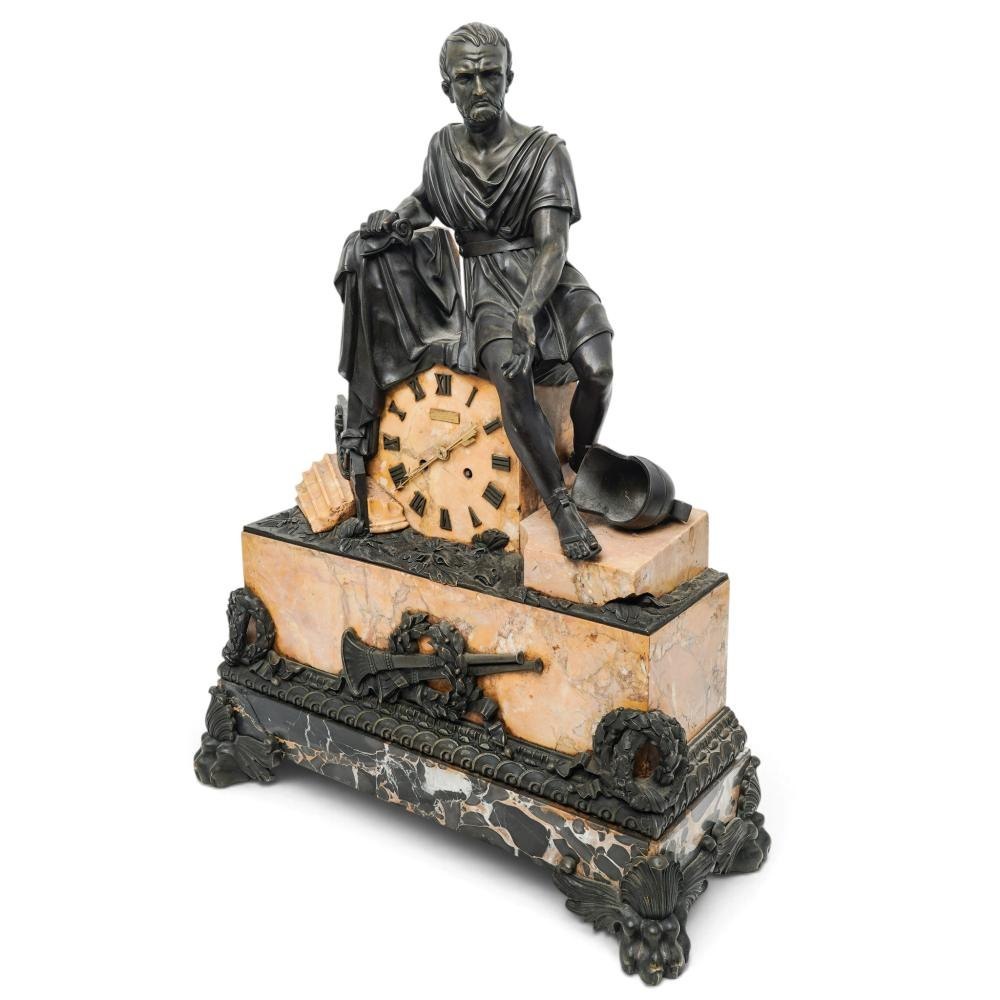
This French figural mantel clock, dating to approximately 1828–1831, features a composition by retailer and finisher Jean-Paul Garnier of Paris, who held the title of Horloger du Roi. The movement is attributed to Honoré Pons, bearing his 1827 Médaille d'Or mark and serial number 834. The clock sits on a multi-tiered base of Sienna and black-and-white Grand Antique marble, supported by ornate, scrolling patinated bronze acanthus leaf feet. A heavily cast, patinated bronze sculpture of a classical figure, positioned beside a Roman helmet, sits atop the housing. Further decoration includes Empire-style bronze appliques, notably a central front relief of an intertwined laurel wreath and crossed Roman trumpets. The clock measures 25.5 inches in height, 19 inches in width, and 7.5 inches in depth. The gilt open dial face features applied Roman numeral hour markers and an inlaid brass signature plaque.

Full view of the figural mantel clock showing the classical figure, dial, and marble base.
Full view of the figural mantel clock showing the classical figure, dial, and marble base. — Akiba Galleries, via Invaluable. Rights pending — permission not yet requested. Original source

Catalogue identity

Source
orbiscollectibles.com
Category
Clock · Mantel clock
Maker / attribution
Jean-Paul Garnier
Reference
Not recorded
Catalogue / lot identifier
Source URL identifies the listing
Source-reported date
c. 1828–1831
Source-reported place
France
Source-reported serial
834

Source-reported attribution and specifications are not independent authentication. A listing does not establish present ownership, current display, availability or permission to reproduce.

Object description

Case and Ornamentation

The clock housing utilizes a combination of two types of marble. The main housing is formed from ochre-yellow Sienna marble featuring dark veining. Below this, the multi-tiered base incorporates black-and-white Grand Antique marble, providing a visual contrast to the upper structure. The assembly is supported by scrolling, patinated bronze feet finished in an acanthus leaf pattern.

The primary decorative element is a cast, patinated bronze sculpture of a classical male figure, seated upon the clock housing. He is depicted next to a Roman-style helmet. The front of the clock base is embellished with bronze appliques, including a central relief showing a laurel wreath intertwined with crossed Roman trumpets.

Evidence for this section
  • “The housing itself is constructed from vibrant, ochre-yellow Sienna marble with dark veining.”
  • “The multi-tiered base incorporates both Sienna and black-and-white Grand Antique marble, supported by ornate, scrolling patinated bronze acanthus leaf feet.”
  • “The clock displays a heavily cast, patinated bronze sculpture of a classical figure seated atop the clock housing, positioned beside a Roman helmet.”
  • “The design is further enhanced by Empire-style bronze appliques, including a central front relief of an intertwined laurel wreath and crossed Roman trumpets.”

Movement and Dial

The timekeeping mechanism is identified as the work of Honoré Pons. The movement is marked with the 1827 Médaille d'Or, indicating the maker's recognition at the period's industrial exhibitions. The specific serial number recorded for this movement is 834.

The dial is a gilt, open-faced design. It is set with applied Roman numerals to denote the hours. A small brass plaque is inlaid into the dial surface, serving as the location for the signature of the retailer, Jean-Paul Garnier.

Evidence for this section
  • “The movement was crafted by Honoré Pons and bears his 1827 Médaille d'Or mark along with the serial number 834.”
  • “The gilt open dial face is marked with applied Roman numeral hour markers and includes an inlaid brass signature plaque.”

Attribution and History

The clock is associated with Jean-Paul Garnier, a Parisian retailer who held the royal appointment of Horloger du Roi. The piece is dated to between 1828 and 1831. The attribution of the movement to Honoré Pons is supported by the presence of his workshop's award mark from 1827.

As a retailer, Garnier's involvement signifies his role in finishing the final ensemble of the sculpture, movement, and marble housing. This combination of materials and themes is described as an example of the Empire style.

Evidence for this section
  • “features a sophisticated composition by retailer and finisher Jean-Paul Garnier of Paris, who held the title of Horloger du Roi.”
  • “The movement was crafted by Honoré Pons and bears his 1827 Médaille d'Or mark”

Open research questions

  • What is the specific inscription on the inlaid brass signature plaque?
  • Are there any identifiable foundry stamps on the bronze casting, other than the movement markings?

Source evidence

Recorded claims and source quotations for Jean-Paul Garnier French Figural Mantel Clock
FieldSource-reported valueSource quotation
MakerJean-Paul Garnier“Jean-Paul Garnier of Paris”
Movement makerHonoré Pons“The movement was crafted by Honoré Pons”
Serial number834“serial number 834”
Datec. 1828–1831“dating to approximately 1828–1831”
MaterialsSienna and Grand Antique marble, bronze“constructed from vibrant, ochre-yellow Sienna marble with dark veining. The multi-tiered base incorporates both Sienna and black-and-white Grand Antique marble”
DimensionsH. 25.5" x W. 19" x 7.5"“25.5 inches in height, 19 inches in width, and 7.5 inches in depth”
SignatureInlaid brass plaque“includes an inlaid brass signature plaque”

Visible details

  • The classical figure rests on the clock housing beside a discarded Roman helmet.
  • The front base section features a relief of crossed trumpets tied with a laurel wreath.
  • The feet of the clock are cast in a scrolling acanthus leaf design.
  • The dial is rendered in a gilt finish with individual applied Roman numerals.

Research qualifications

  • The exact dating of the object is approximate, with a provided range of 1828-1831.
  • The role of Jean-Paul Garnier as retailer and finisher is cited as a probable attribution.

Photograph identity and source facts were screened before import; rights clearance remains pending.

Terms in this record

Glossary explanations for terms named in this object’s record.