
Skip to content
The Encyclopedia of Horology

Pocket watch · Pair cased pocket watch

Jean Fazy Watch and Case

Partially verified

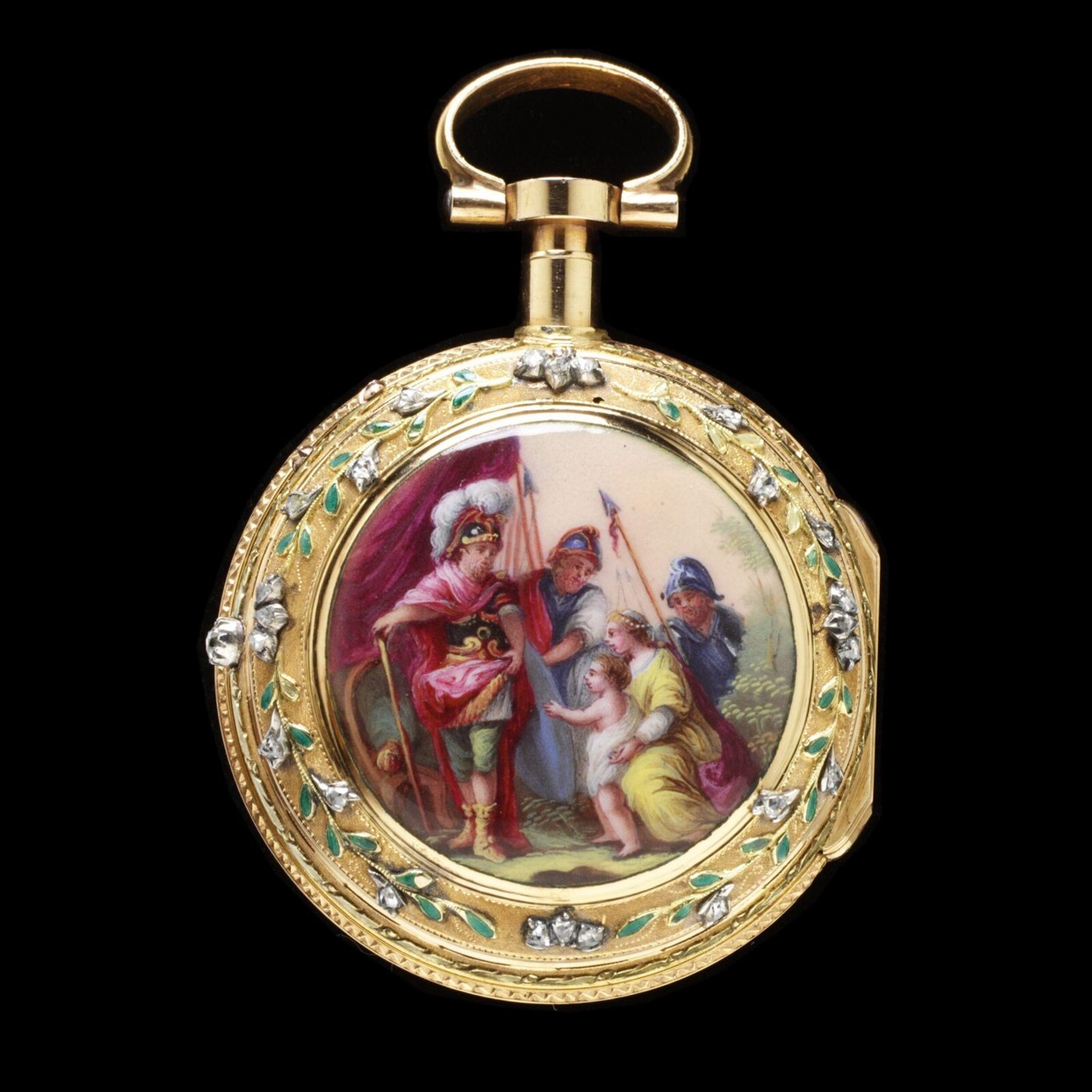
This pocket watch, accompanied by a separate outer case, features a vari-coloured gold construction. The movement is signed by the Genevan watchmaker Jean Fazy, active during the eighteenth century. The watch is decorated with enamel and diamonds, reflecting a production period dated to approximately 1765-70. The enamelled scene on the case is derived from a 1723 engraving by H. S. Thomassin, which itself was based on a painting by Charles de la Fosse depicting Veturia and Volumnia before Coriolanus. The decoration incorporates neo-classical motifs, such as laurel wreaths, alongside elements of the preceding rococo style, observable in the asymmetrical design of the movement's bridgecock and the watch's hands. The object was bequeathed to the Victoria and Albert Museum by Harriet Bolckow in 1890.

A detailed view of the watch case, showing the enamel painting of a narrative scene bordered by laurel wreaths and diamonds.
A detailed view of the watch case, showing the enamel painting of a narrative scene bordered by laurel wreaths and diamonds. — Victoria and Albert Museum, London. Rights pending — permission not yet requested. Original source

Catalogue identity

Source
collections.vam.ac.uk
Category
Pocket watch · Pair cased pocket watch
Maker / attribution
Jean Fazy
Reference
Not recorded
Catalogue / lot identifier
742&A-1890
Source-reported date
ca. 1765-70
Source-reported place
Geneva

Source-reported attribution and specifications are not independent authentication. A listing does not establish present ownership, current display, availability or permission to reproduce.

Object description

Construction and Case Decoration

The watch is housed in a vari-coloured gold case featuring a decorative enamel panel. This panel displays a narrative scene enclosed within a circular frame bordered by laurel wreaths on both the case back and the bezel. The exterior design incorporates green enamelled sprays of foliage and is set with diamonds.

The scene depicted on the case is a modified version of an earlier composition. While based on a 1723 engraving by H. S. Thomassin of Veturia and Volumnia before Coriolanus, the enamel work simplifies the figures to include only the wife and one child of Coriolanus, omitting other characters present in the original painting by Charles de la Fosse.

Evidence for this section
  • “The scene on this case derives from an engraving by H. S. Thomassin published in 1723 after a painting by Charles de la Fosse of Veturia and Volumnia before Coriolanus.”
  • “The scene is here given a neo-classical setting by being painted within a circle bordered on both back and bezel by tightly-bound wreaths of laurel.”

Movement and Stylistic Evolution

The watch features a movement signed by Jean Fazy, a Geneva-based watchmaker. The internal mechanics display details that mark the transition between stylistic periods. The bridgecock contains asymmetrical scrolls, and the hands, particularly the minute hand, feature a distinct C-curve shape.

These features are cited as indicators of a shift from the rococo style to neo-classicism. Although neo-classicism was established in Parisian gold boxes by 1763, the presence of these specific rococo decorative elements in the movement and hands suggests the watch dates to the 1760s.

Evidence for this section
  • “the hands of the watch, particularly the minute hand which has a C curve and is asymmetrical, and the asymmetrical scrolls on the bridgecock of the movement, show that the watch is in transition from the rococo style to the neo-classical.”
  • “Jean Fazy (1737-94), whose name is on the dial and the movement”

Provenance and Historical Context

The object is catalogued as a pair-cased watch, a configuration where an additional outer case protects the primary watch. This form was standard in London watchmaking during the eighteenth century, and its application here reflects the influence of the London industry on Genevan watchmakers.

The piece entered the collection of the Victoria and Albert Museum in 1890 through a bequest from Harriet Bolckow. She was the widow of Henry William Ferdinand Bolckow, an ironmaster based in Middlesbrough.

Evidence for this section
  • “Pair-cases were standard on London-made watches for much of the eighteenth century and the use of them here suggests the influence of London watchmaking”
  • “Bequeathed in 1890 by Harriet Bolckow, widow of the Middlesbrough ironmaster, Henry William Ferdinand Bolckow.”

Open research questions

  • What is the specific composition and material of the watch dial?
  • Does the movement remain in working order as of the most recent assessment?

Source evidence

Recorded claims and source quotations for Jean Fazy Watch and Case
FieldSource-reported valueSource quotation
MakerJean Fazy“the movement by Jean Fazy, Geneva, ca. 1765-70”
Accession Number742&A-1890“742&A-1890”
MaterialsVari-coloured gold, enamel, diamonds“Watch with vari-coloured gold case, enamelled and set with diamonds”
Place of originGeneva“Geneva”
Dateca. 1765-70“ca. 1765-70”
ProvenanceHarriet Bolckow“Bequeathed in 1890 by Harriet Bolckow”
Design SourceEngraving by H. S. Thomassin after Charles de la Fosse“The scene on this case derives from an engraving by H. S. Thomassin published in 1723 after a painting by Charles de la Fosse”

Visible details

  • The bezel is framed with green enamel foliage and diamond settings.
  • The watch incorporates an integral pendant and bow for attachment.
  • The enamel work is bordered by a continuous laurel wreath motif.

Research qualifications

  • The exact identification of all figures in the enamel scene relies on external engraving analysis.
  • The stylistic transition from rococo to neo-classical is an interpretive assessment.
  • The production date is an estimated range rather than a documented absolute.

Photograph identity and source facts were screened before import; rights clearance remains pending.

Consulted source

Watch and case

Reviewed 2026-11-02 · Record a7477e2b74

Terms in this record

Glossary explanations for terms named in this object’s record.