
Skip to content
The Encyclopedia of Horology

Clock · Pillar clock

Japanese Pillar Clock

Partially verified

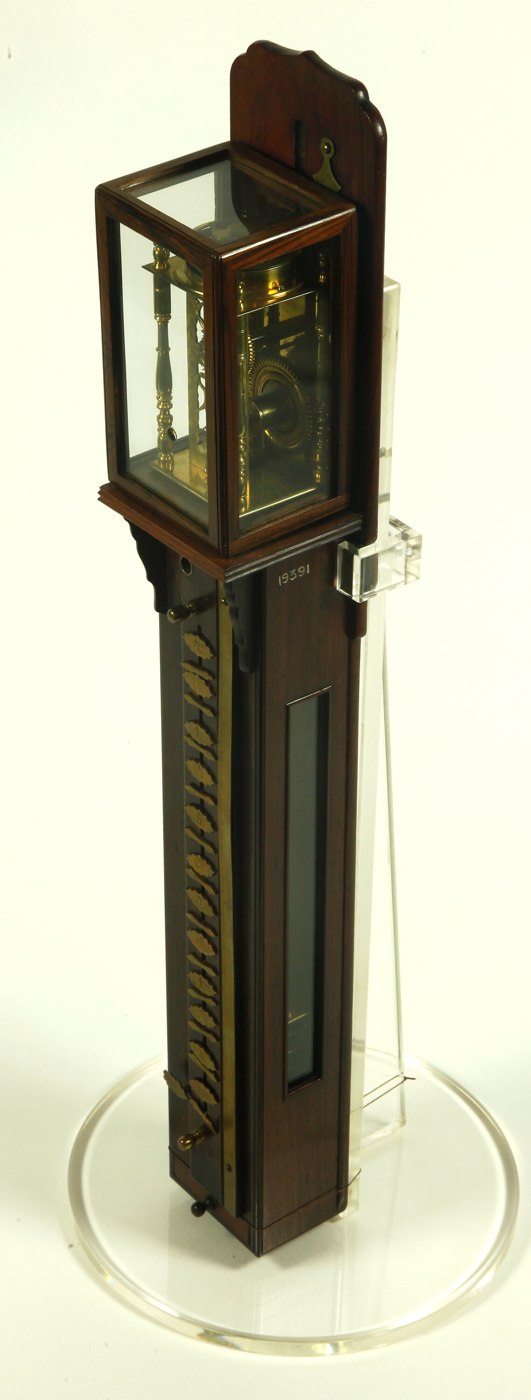
This pillar clock originated in Japan, dating to approximately the mid-19th century. It features a narrow, rectangular wooden case measuring 52 cm in height, 8 cm in length, and 7 cm in width. The movement is constructed of brass and is situated at the top of the case under a glass cover. The timepiece utilizes a weight-driven mechanism and a verge escapement. It is designed to accommodate the traditional Japanese temporal hour system, which divided the day and night into six segments each, with lengths varying by season. To facilitate this adjustment, the clock incorporates movable brass markers positioned along a vertical calibrated brass strip. A drawer is provided at the base of the housing for the winding key. The clock was acquired by the museum through a loan and subsequent bequest from Mr. John Askew in 1928.

Full view of the Japanese pillar clock, showing the wooden case, the glass-covered movement at the top, and the vertical calibrated strip with adjustable markers.
Full view of the Japanese pillar clock, showing the wooden case, the glass-covered movement at the top, and the vertical calibrated strip with adjustable markers. — Museums Victoria. Rights pending — permission not yet requested. Original source

Catalogue identity

Source
collections.museumsvictoria.com.au
Category
Clock · Pillar clock
Maker / attribution
Not established
Reference
Not recorded
Catalogue / lot identifier
ST 19391
Source-reported date
circa 1850
Source-reported place
Japan
Source-reported serial
19391

Source-reported attribution and specifications are not independent authentication. A listing does not establish present ownership, current display, availability or permission to reproduce.

Object description

Case Construction and Design

The pillar clock is characterized by a narrow, rectangular wooden casing that serves as both the housing for the movement and the display for the timekeeping markers. The upper portion of the case features a glass enclosure that allows for visibility of the brass movement within. Below the movement chamber, the primary length of the pillar is occupied by a vertical brass strip.

This strip is calibrated and fitted with movable brass markers. These components are essential for the operation of the clock under the historical Japanese temporal system, which required manual adjustments to the time scale to account for the varying lengths of daylight and darkness throughout the changing seasons. A small drawer is integrated into the base of the case to store the clock's winding key.

Evidence for this section
  • “Narrow rectangular wooden case with brass movement at top under glass cover.”
  • “The clock therefore has moveable brass markers to adjust for the length of the hours.”
  • “Drawer at base for key.”

Movement and Mechanism

The horological movement is fabricated from brass and is mounted at the top of the clock's wooden pillar. It is driven by a weight, which provides the necessary power for the gear train.

The clock utilizes a verge escapement to regulate the movement. The mechanism is protected by a glass cover that sits atop the wooden frame.

Evidence for this section
  • “brass movement at top under glass cover.”
  • “Weight driven; verge escapement.”

Historical Context and Association

The design of this clock reflects the historical Japanese requirement to track time using a system of six diurnal and six nocturnal hours. Because the length of these hours shifted based on seasonal changes, the clock's calibration was necessarily adjustable.

The Japanese government officially transitioned to the 24-hour system in 1873. Consequently, it is believed that the clock was produced prior to this administrative change. The object entered the museum collection in 1928 via a bequest from Mr. John Askew.

Evidence for this section
  • “Japan used a system of 6 hours in the day and 6 hours at night, and the length of the hours therefore varied according to the season.”
  • “The Japanese government adopted the 24 hour system in 1873, so this clock probably dates from before this date.”
  • “Loan & Subsequent Bequest from Mr John Askew, 03 Aug 1928”

Open research questions

  • What is the specific provenance of the clock prior to Mr. John Askew's ownership?
  • Does the brass movement bear any maker's mark or inscription hidden within the casing?

Source evidence

Recorded claims and source quotations for Japanese Pillar Clock
FieldSource-reported valueSource quotation
Registration numberST 19391“Registration number: ST 19391”
Datecirca 1850“date: circa 1850”
Dimensions8 cm (Length), 7 cm (Width), 52 cm (Height)“8 cm (Length), 7 cm (Width), 52 cm (Height)”
Escapementverge“verge escapement”
Mechanism typeweight driven“Weight driven”
Acquisition detailsBequest from Mr John Askew, 03 Aug 1928“Loan & Subsequent Bequest from Mr John Askew, 03 Aug 1928”
Temporal systemTraditional Japanese system of 6 hours day and night“Japan used a system of 6 hours in the day and 6 hours at night”

Visible details

  • Case features a glass-enclosed top section for the brass movement
  • Vertical brass strip on the case face holds adjustable markers
  • Registration number 19391 is visible on the upper case side
  • Drawer located at the base of the clock housing

Research qualifications

  • Specific maker is unrecorded
  • Exact date of manufacture is estimated as circa 1850

Photograph identity and source facts were screened before import; rights clearance remains pending.

Consulted source

Pillar Clock - Japan, Mid 19th Century

Reviewed 2026-10-26 · Record a51a3a6c24

Terms in this record

Glossary explanations for terms named in this object’s record.