
Skip to content
The Encyclopedia of Horology

Clock · Singing-bird box automaton

Jacques Bruguier Singing-Bird Box

Partially verified

This rectangular singing-bird box automaton is catalogued under Jacques Bruguier of Geneva and dated circa 1870. The case is constructed from tortoiseshell panels decorated with three-colour gold and mother-of-pearl floral inlays. An oval lid conceals the automaton opening, featuring an enameled exterior scene of an Alpine waterfall and an interior floral spray against a pale blue ground. When operated, a miniature feathered bird emerges through a pierced gilt grille. The source describes the internal movement as a key-wound brass mechanism utilizing a fusee and chain, bellows, and cams.

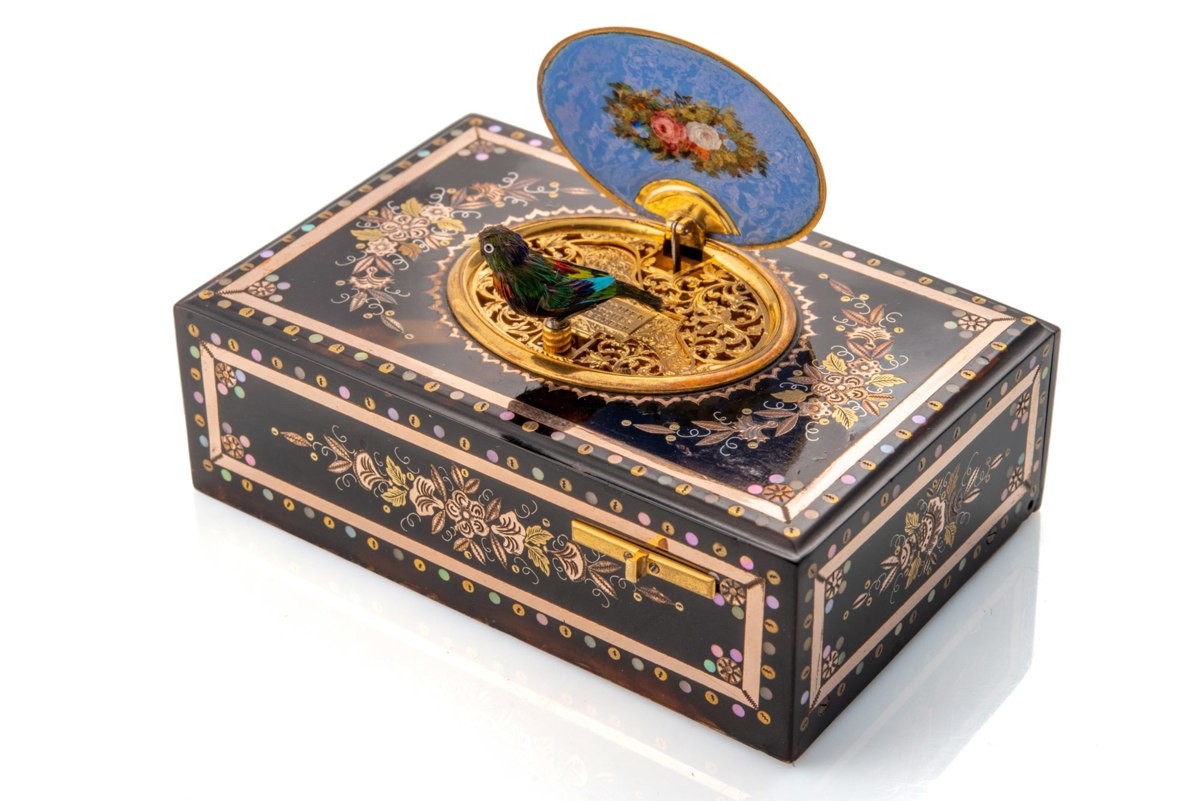
Perspective view of the singing-bird box with the oval lid open, displaying the miniature bird automaton and pierced grille.
Perspective view of the singing-bird box with the oval lid open, displaying the miniature bird automaton and pierced grille. — Antiquorum. Rights pending — permission not yet requested. Original source

Catalogue identity

Source
catalog.antiquorum.swiss
Category
Clock · Singing-bird box automaton
Maker / attribution
Jacques Bruguier
Reference
Not recorded
Catalogue / lot identifier
110
Source-reported date
circa 1870
Country
Switzerland

Source-reported attribution and specifications are not independent authentication. A listing does not establish present ownership, current display, availability or permission to reproduce.

Object description

Construction and Exterior Decoration

The object is a horizontal, rectangular singing-bird box with a cabinet constructed from tortoise-shell panels. The exterior is decorated on all sides with mother-of-pearl and three-coloured gold inlays featuring a partially engraved floral motif.

The lid of the bird compartment contains an oval painted enamel panel depicting a mountain landscape. The specific scene is not definitively confirmed; it is described as a mountain view reminiscent of either the Staubbach waterfall or the Pissevache waterfall.

Evidence for this section
  • “Rectangular cabinet made of tortoise-shell panels,with a three-coloured gold and mother-of-pearl decoration inlaid on all sides representing a partially engraved floral motif”
  • “oval cover of the bird enamelled with a scene depicting a mountain landscape”
  • “The scene painted on enamel represents a mountain view which reminds us of the Staubbach waterfall near the village of Lauterbrunnen in the Bernese Oberland; others may see the Pissevache waterfall in Valais.”

Automaton Mechanism

The mechanism is a rectangular brass singing-bird movement featuring a fusee and chain, bellows, and cams. It is wound by a key, with a compartment for the key located at the back of the cabinet.

A gold pull tab located on the right side of the cabinet operates the mechanism. When activated, an articulated bird emerges through a pierced grille, moving its wings, beak, and tail while pivoting from side to side. The device is powered by a barrel spring.

Evidence for this section
  • “Singing-bird mechanism, rectangular (~ 85 x 45 mm.), brass, fusee and chain, bellows and cams”
  • “on the right side of the cabinet, a pull tab to operate the bird mechanism”
  • “the revolving bird with moving wings, beak and tail, controlled by two cams mounted beneath the barrel wheel”
  • “The plate at the back of the cabinet consists of a hinged door that provides access to a compartment to house the winding key.”

Attribution and Documentation

The automaton is attributed to Jacques Bruguier of Geneva, with a date estimated at circa 1870. The object bears a signature on the movement plate and on the retractable plate/grille beneath the bird.

Condition grading provided in the source categorizes the case as 3 (Good) and the movement as 2. Not all internal components are described as verified by the current documentation.

Evidence for this section
  • “Brand Jacques Bruguier, Geneva”
  • “Year circa 1870”
  • “Signature movement (on the plate and on the retractable plate/grill under the singing-bird)”
  • “Grade: Case: 3 Good Movement: 2”

Open research questions

  • What criteria were used for the specific grading system (Case 3, Movement 2) provided by the source?
  • Does the signature on the retractable plate and movement plate follow known historical naming conventions for Jacques Bruguier?

Source evidence

Recorded claims and source quotations for Jacques Bruguier Singing-Bird Box
FieldSource-reported valueSource quotation
Maker attributionJacques Bruguier, Geneva“Brand Jacques Bruguier, Geneva”
Datecirca 1870“Year circa 1870”
Case MaterialsTortoise-shell, gold, mother-of-pearl and enamel“Tortoise-shell, gold, mother-of-pearl and enamel, key-winding, horizontal singing-bird box.”
Movement MechanismBrass, fusee and chain with bellows and cams“Singing-bird mechanism, rectangular (~ 85 x 45 mm.), brass, fusee and chain, bellows and cams”
Dimensions62.6 mm length x 94.2 mm width x 33.1 mm height“Length 62.6 mm. Height 33.1 mm. Width 94.2 mm.”
Mechanism dimensionsApproximately 85 x 45 mm“Singing-bird mechanism, rectangular (~ 85 x 45 mm.)”
Overall dimensions62.6 mm length x 94.2 mm width x 33.1 mm height“Length 62.6 mm. Height 33.1 mm. Width 94.2 mm.”

Visible details

  • An articulated miniature feathered bird rests on a pierced gilt grille within an oval opening.
  • The interior of the open oval lid reveals a painted floral spray against a pale blue ground.
  • A gold slide or pull tab is positioned on the upper front side to operate the mechanism.
  • The rectangular tortoiseshell case features inlaid floral motifs and border banding in multi-coloured gold and mother-of-pearl.

Research qualifications

  • Internal movement plates, fusee chain, and bellows are concealed inside the case and not visible in the provided image.
  • The source notes that the movement is signed on the plate and retractable grill, but this signature is not legibly visible in the primary photograph.

Photograph identity and source facts were screened before import; rights clearance remains pending.

Terms in this record

Glossary explanations for terms named in this object’s record.