
Skip to content
The Encyclopedia of Horology

Clock · Tide Gauge Clock

J. Newman Tide Gauge Clock

Partially verified

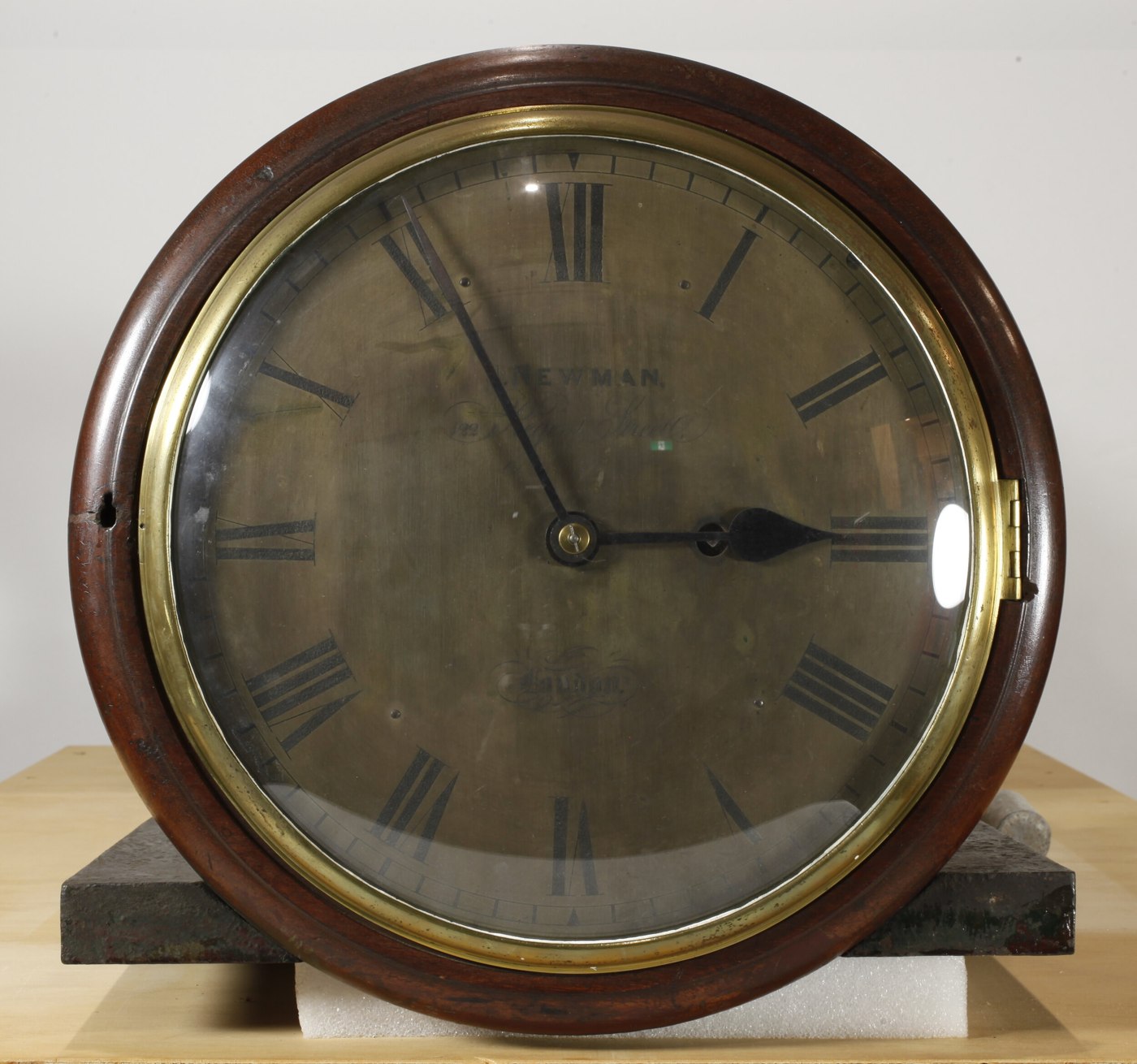
This weight-driven pendulum clock was constructed by J. Newman in London during the 1850s. It was specifically designed to drive the recording apparatus of a self-registering tide gauge. The clock features a brass dial inscribed with the maker's name and address, 'J. NEWMAN, 122 REGENT ST LONDON'. It was originally installed at the Breakwater Pier in Williamstown, Australia, in 1858, where it remained in operation until the 1950s. The clock served to drive a drum around which a calibrated strip of paper was wrapped, allowing for the consistent measurement and recording of tidal movements. Following its tenure at the pier, the instrument was supervised by the Melbourne Observatory from 1874 until 1943, before the equipment was transferred to the Melbourne Harbour Trust Commissioners, who later donated the clock to the museum in 1962.

Front view of the J. Newman tide gauge clock with the hinged bezel in the closed position, displaying the brass dial and hands.
Front view of the J. Newman tide gauge clock with the hinged bezel in the closed position, displaying the brass dial and hands. — Museums Victoria. Rights pending — permission not yet requested. Original source

Catalogue identity

Source
collections.museumsvictoria.com.au
Category
Clock · Tide Gauge Clock
Maker / attribution
J. Newman
Reference
Not recorded
Catalogue / lot identifier
ST 25237
Source-reported date
circa 1850s
Source-reported place
England

Source-reported attribution and specifications are not independent authentication. A listing does not establish present ownership, current display, availability or permission to reproduce.

Object description

Movement and Function

The clock is configured as a weight-driven instrument designed for the specialized function of driving a recording mechanism. The movement architecture incorporates a series of gears that transfer power to a rotating drum, which carried the calibrated paper strip necessary for logging tidal data. This system ensured the regular, timed advancement of the recording medium relative to the tide gauge's fluctuating input.

The mechanical assembly is mounted on a heavy frame, visible in profile, with the movement components positioned to interface directly with the external apparatus. The construction includes a heavy bob pendulum suspended by a flat wooden shaft, which is central to the timekeeping regulation of the gauge system. Its functional design enabled the long-term continuous operation required for scientific monitoring at the Breakwater Pier.

Evidence for this section
  • “Weight driven. Heavy bob pendulum with flat wooden shaft.”
  • “The movement of the tides was recorded on a calibrated strip of paper, which rotated on a drum driven by the clock.”

Case and Dial

The dial is composed of a circular brass plate finished with dark, contrasting numerals. It features a traditional layout with a central aperture for the time-telling hands and is signed prominently near the top. The inscription 'J. NEWMAN, 122 REGENT ST LONDON' is etched directly onto the dial surface, identifying the maker and their London location.

The housing for the dial consists of a circular wood surround protected by a hinged brass bezel containing a glass face. This enclosure design allows for access to the hands while maintaining a degree of protection for the dial plate. The overall diameter of the clock unit is 37 centimeters, maintaining a scale suitable for mounting within the tide gauge's dedicated housing structure.

Evidence for this section
  • “Dial is marked 'J. NEWMAN, 122 REGENT ST LONDON'.”
  • “configuration: Overall Dimensions, dimensions: 37 cm (Outside Diameter)”

Provenance and History

The clock was part of a tide-monitoring installation established at Breakwater Pier, Williamstown, in 1858. It operated within a small bluestone house at the pier's end, functioning as the primary driver for the tide-recording equipment until the middle of the 20th century. Ownership and supervisory responsibilities transitioned through several entities, including the Harbour Department and the Melbourne Observatory, which oversaw the apparatus from 1874 until 1943.

Following the cessation of the gauge's operation, the clock and associated apparatus were managed by the Melbourne Harbour Trust Commissioners. The clock was subsequently donated to the museum collection in July 1962, preserving the record of its extensive service history in Victoria, Australia.

Evidence for this section
  • “Used to drive the recording apparatus of a self-registering tide-gauge [registered as ST 29815], which was erected at Williamstown by the Harbour Department in 1858, and operated until the 1950s.”
  • “Donation from Melbourne Harbour Trust Commissioners (MHT), Jul 1962”

Open research questions

  • What specific type of escapement was employed to maintain accuracy under the load of the recording drum?
  • Are there internal movement stamps that confirm the 1850s manufacture date beyond the stylistic dial signature?

Source evidence

Recorded claims and source quotations for J. Newman Tide Gauge Clock
FieldSource-reported valueSource quotation
MakerJ. Newman“J. Newman, London”
Datecirca 1850s“circa 1850s”
InscriptionJ. NEWMAN, 122 REGENT ST LONDON“Dial is marked 'J. NEWMAN, 122 REGENT ST LONDON'.”
Registration NumberST 25237“Registration number: ST 25237”
Dimensions37 cm diameter“37 cm (Outside Diameter)”
AcquisitionDonated 1962 by MHT“Donation from Melbourne Harbour Trust Commissioners (MHT), Jul 1962”
Primary UseDriving a tide gauge“Used to drive the recording apparatus of a self-registering tide-gauge”

Visible details

  • Brass dial signed with address
  • Hinged glass and brass bezel
  • Weight-driven movement mechanism
  • Drum-drive gear train for paper registration

Research qualifications

  • Specific original escapement mechanism details not provided
  • Date 'circa 1850s' attributed by institution

Photograph identity and source facts were screened before import; rights clearance remains pending.

Consulted source

Tide Gauge Clock - Used at Williamstown, J. Newman, London, England, circa 1850s

Reviewed 2026-10-26 · Record 74848ec60a

Terms in this record

Glossary explanations for terms named in this object’s record.