
Skip to content
The Encyclopedia of Horology

Tool · Italian astrolabe

Italian Astrological Instrument

Partially verified

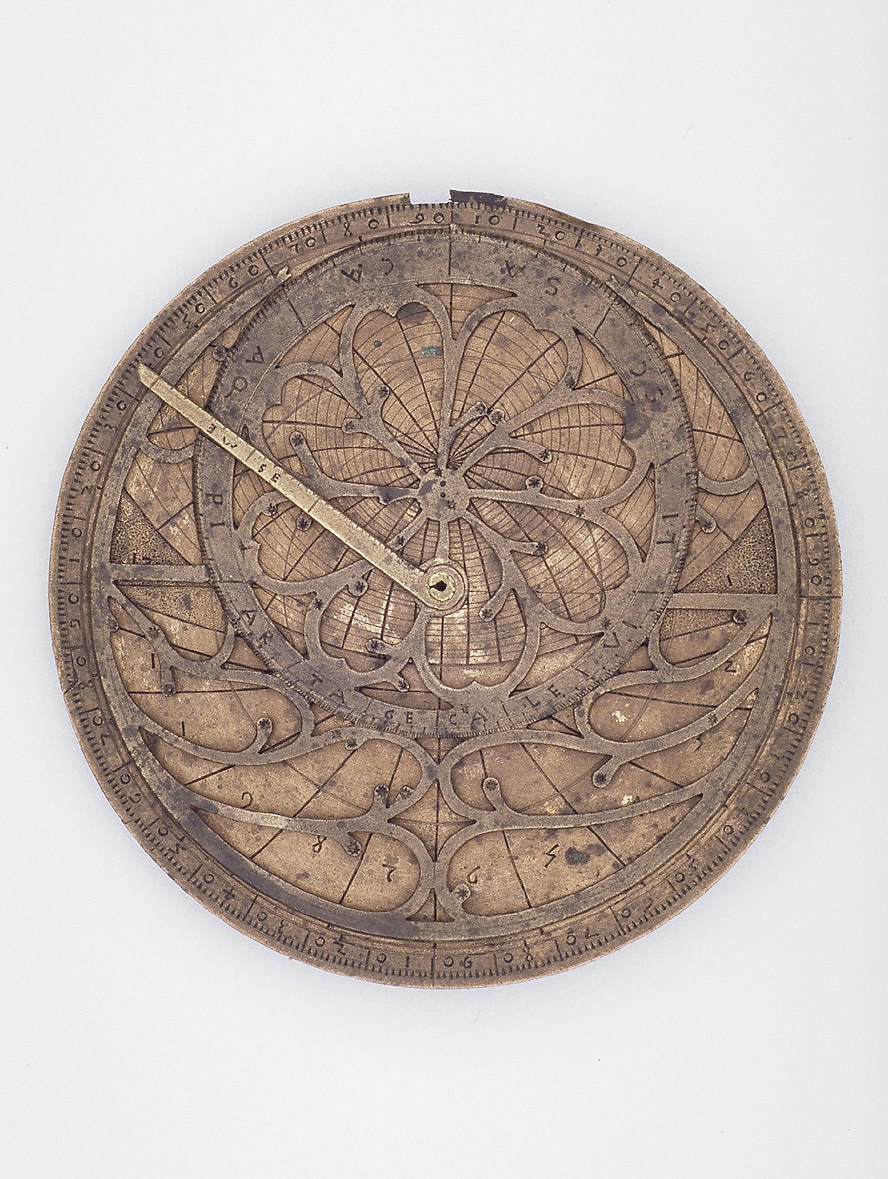
This unsigned Italian instrument, dating to circa 1500, is a brass astrological device measuring 95 mm in diameter. While classified as an astrolabe, it is intended for determining the positions of planets and celestial bodies relative to astrological houses. The front features a rete and rule riveted to a thin brass plate. The rete includes an ecliptic marked with abbreviated zodiac signs, 28 star pointers in the form of round-ended lobes, and an eight-leaf flower motif. The reverse is characterized by a series of eight concentric rotating brass volvelles with arms. The limb of the plate is graduated in degrees. The back displays the names and numbers of the twelve astrological houses.

Front view showing the rete, rule, and hour lines.
Front view showing the rete, rule, and hour lines. — Museum of the History of Science, Oxford. Rights pending — permission not yet requested. Original source

Catalogue identity

Source
www.mhs.ox.ac.uk
Category
Tool · Italian astrolabe
Maker / attribution
Not established
Reference
Not recorded
Catalogue / lot identifier
45127
Source-reported date
circa 1500
Source-reported place
Italy

Source-reported attribution and specifications are not independent authentication. A listing does not establish present ownership, current display, availability or permission to reproduce.

Object description

Construction and Design

The instrument is constructed from thin brass plates. On the obverse, a rete and a single-arm rule are riveted to the main plate. The plate displays tropics, equator lines, almucantars, azimuth lines, and unequal hour lines. The space between the horizon and the first and last hour lines is shaded. A faint inscription, possibly representing latitude, is visible at the center of the plate.

The rete pattern includes 28 star pointers shaped as round-ended lobes with small stars, supplemented by 13 additional stars etched into the rete design. The rule contains an unequal scale marked only with 'SE' and 'ME'. The suspension system for the instrument is currently missing.

Evidence for this section
  • “consists of a thin brass plate with rete and rule riveted on one side”
  • “The space between the horizon and the first and last hour line has been shaded”
  • “There was probably a system of suspension, now missing”

The Volvelle System

The reverse of the instrument features an elaborate assembly of eight concentric, rotating brass volvelles. The limb is engraved with the twelve astrological houses, each identified by name and number. The first volvelle includes a 365-day calendar scale with month names, and a zodiac scale with the first point of Aries corresponding to March 16th.

Inner circles indicate ruling planets, three for every sign, along with associations for water, earth, fire, or wind. Subsequent volvelles are engraved with names of planets, including 'IVPITER', 'MARSE', 'VENVS', 'MERQRIO', and 'SOL'. The final volvelle consists of a double arm depicting the head and tail of the Dragon, labeled 'CAPVT' and 'CAVDA', used to track lunar phases and astrological positions.

Evidence for this section
  • “series of 8 brass volvelles with arms riveted on the other side”
  • “engraved on the limb with the names and numbers of the astrological houses”
  • “The last volvelle is just a double arm, shaped as the head and tail of the Dragon, inscribed 'CAPVT' and 'CAVDA'”

Provenance and Documentation

This object is held by the Museum of the History of Science in Oxford under the inventory number 45127. It is catalogued as an astrological instrument rather than an observational one. The description provided by Ilaria Meliconi emphasizes that the instrument deviates from standard astrolabe usage due to its focus on planetary positions in relation to traditional astrological houses.

Research documentation includes a reference to R. T. Gunther's 'The Astrolabes of the World' (1932). The instrument remains unsigned, and its precise origin is attributed generally to Italian workshops of the period.

Evidence for this section
  • “This instrument has been classified as an astrolabe , but it is primarily an astrological instrument used for finding the position of planets”
  • “Inventory number 45127”
  • “See R. T. Gunther, The Astrolabes of the World”

Open research questions

  • What is the specific function of the shading between the horizon and hour lines?
  • Do the unusual spellings of the months provide clues to the specific region of Italy where this was made?

Source evidence

Recorded claims and source quotations for Italian Astrological Instrument
FieldSource-reported valueSource quotation
Diameter95 mm“95 mm in diameter”
OriginItalian“Italian”
Datecirca 1500“circa 1500”
Inventory number45127“Inventory number 45127”
SignatureUnsigned“Unsigned”

Visible details

  • The rete is centered around an eight-leaf flower motif.
  • The limb is graduated into four 90-degree quadrants.
  • The reverse features a complex system of eight stacked brass volvelles.

Research qualifications

  • The source notes that a suspension system was probably present but is now missing.
  • The inscription '33' at the plate center is only 'probably' indicative of the latitude.

Photograph identity and source facts were screened before import; rights clearance remains pending.

Consulted source

Astrolabe

Reviewed 2026-10-26 · Record 5c6737f90f

Terms in this record

Glossary explanations for terms named in this object’s record.