
Skip to content
The Encyclopedia of Horology

Tool · Italian astrolabe

Falcono Astrolabe

Partially verified

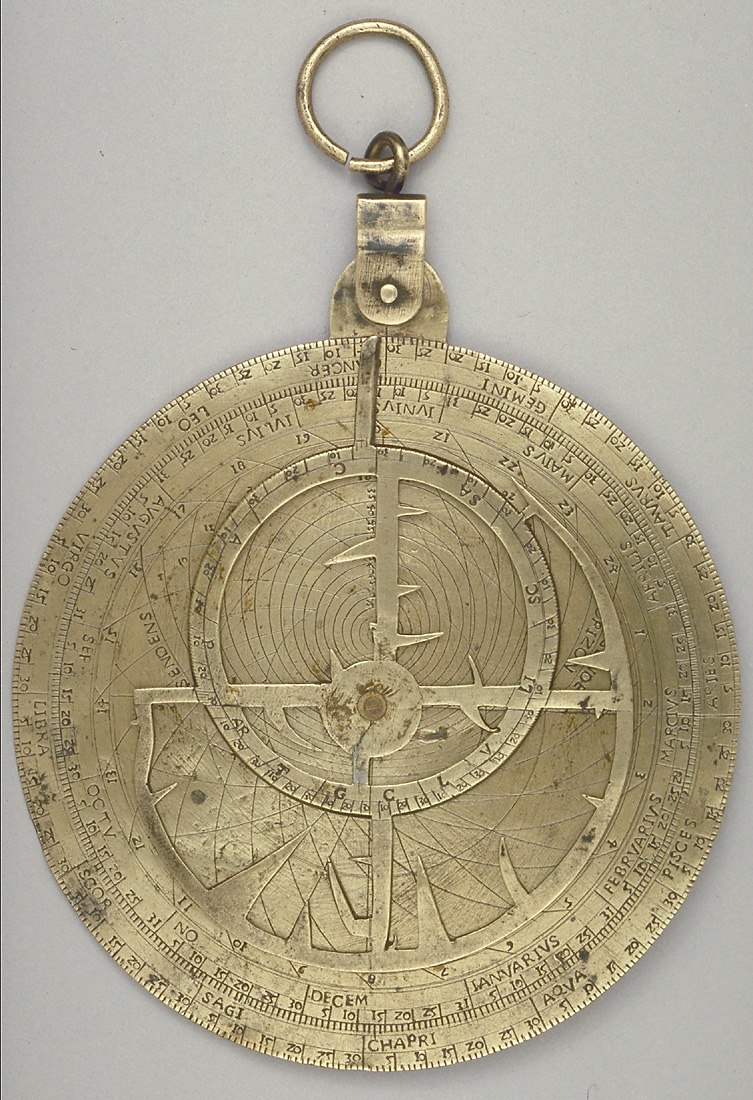
This brass astrolabe, measuring 115 mm in diameter, is dated 1507 and signed by Falcono. The instrument is distinct in its construction as it lacks a traditional mater. Instead, it consists of a single plate featuring a zodiacal calendar scale and markings for the sixth climate on one side, while the reverse displays a degree scale, a double horary quadrant, and a shadow square. An integral throne supports the instrument. The obverse includes circular scales for zodiacal signs and months, along with almucantars marked for every five degrees and hour lines for equal hours one to twenty-four. The reverse side features clockwise and anticlockwise degree scales and a double shadow scale to the base twelve. The rete is damaged with a portion of the tropic of Capricorn missing, an outcome attributed to damage sustained during the 1941 bombing of the British Museum gallery where the instrument was displayed.

The obverse of the 1507 brass astrolabe signed by Falcono, displaying the zodiacal and calendrical scales, almucantars, and the damaged rete.
The obverse of the 1507 brass astrolabe signed by Falcono, displaying the zodiacal and calendrical scales, almucantars, and the damaged rete. — British Museum, London. Rights pending — permission not yet requested. Original source

Catalogue identity

Source
www.mhs.ox.ac.uk
Category
Tool · Italian astrolabe
Maker / attribution
Falcono
Reference
MLA 1894,4-16.4
Catalogue / lot identifier
MLA 1894,4-16.4
Source-reported date
1507
Source-reported place
Italy

Source-reported attribution and specifications are not independent authentication. A listing does not establish present ownership, current display, availability or permission to reproduce.

Object description

Construction and Layout

The instrument is constructed from brass and measures 115 mm in diameter. It deviates from standard configurations by omitting a mater. The design comprises a single plate that incorporates an integral throne for suspension. One face of the plate contains a zodiacal calendar scale and specific markings for a plate corresponding to the sixth climate, denoted as 'C 6'.

The obverse displays two circular scales at the edge: a zodiacal scale with Latin signs and a calendrical scale showing months and corresponding day counts. The centre provides almucantars marked in five-degree increments, ranging from 5 to 75, accompanied by hour lines for equal hours numbered 1 to 24. Horizon markers and directional indicators for east and west are included on this face.

Evidence for this section
  • “This unusual instrument does not have a mater”
  • “A simple throne is an integral part of the ' plate '.”
  • “The centre of the disc has markings for a plate for the sixth climate, marked 'C 6'.”

Reverse Instrumentation and Signatures

The reverse of the plate houses a double degree scale, featuring both clockwise numbering from 0 to 360 and anticlockwise numbering from 90 to 0. The upper portion functions as a double horary quadrant, numbered 1 through 12. The lower half is engraved with a double shadow scale based on 12.

The signature and date are placed in the centre of the reverse scale. The lettering reads '1507 OPVS FALCONI'. The rete, while original to the piece, shows evidence of significant damage, with a portion of the tropic of Capricorn notably absent from its structure.

Evidence for this section
  • “The obverse has a double degree scale”
  • “The date and the signature '1507 OPVS FALCONI' are given in the centre of the scale.”
  • “The rete is damaged and part of the tropic of Capricorn is missing.”

History and Condition

The instrument has been held by the British Museum since its purchase in 1894. It was documented in F. A. B. Ward's 1981 work, A Catalogue of European Scientific Instruments in the Department of Medieval and Later Antiquities of the British Museum.

During the 1941 bombing raids on London, the instrument was located within a gallery of the British Museum that was destroyed by incendiary bombs. The damage to the rete is reported as a direct consequence of this event. The instrument serves as a subject of study for its specific Italian construction characteristics dated to the early 16th century.

Evidence for this section
  • “The instrument was purchased in 1894”
  • “The instrument was in the 'war time exhibition' at the British Museum in the gallery destroyed by incendiary bombs in 1941 and the rete is consequently badly damaged.”

Open research questions

  • What specific mathematical calculations were intended by the 'C 6' marking for the sixth climate?
  • To what extent does the current damage to the rete impede the functional operation of the instrument?

Source evidence

Recorded claims and source quotations for Falcono Astrolabe
FieldSource-reported valueSource quotation
MakerFalcono“Signed by Falcono”
Date1507“Dated 1507; Italian”
MaterialBrass“Brass; 115 mm in diameter”
Registration NumberMLA 1894,4-16.4“Registration no. MLA 1894,4-16.4”
Diameter115 mm“115 mm in diameter”
ProvenanceBritish Museum“The instrument was in the 'war time exhibition' at the British Museum”
Signature1507 OPVS FALCONI“The date and the signature '1507 OPVS FALCONI' are given in the centre of the scale.”

Visible details

  • The rete features wedge-shaped star pointers
  • Obverse includes 'ORIZON', 'ASCENDENS' and 'DESENDENS' markings
  • Signature 'OPVS FALCONI' is located at the center of the scale on the reverse
  • The equinoxes are positioned at 10 March and 13.5 September

Research qualifications

  • The exact extent of the 'badly damaged' rete beyond the loss of the tropic of Capricorn is not detailed
  • The specific technical purpose of the 'C 6' marking remains a matter of historical interpretation

Photograph identity and source facts were screened before import; rights clearance remains pending.

Consulted source

Astrolabe

Reviewed 2026-10-26 · Record d28dc85fa1

Terms in this record

Glossary explanations for terms named in this object’s record.