
Skip to content
The Encyclopedia of Horology

Tool · English nocturnal

Humfrey Cole Nocturnal

Partially verified

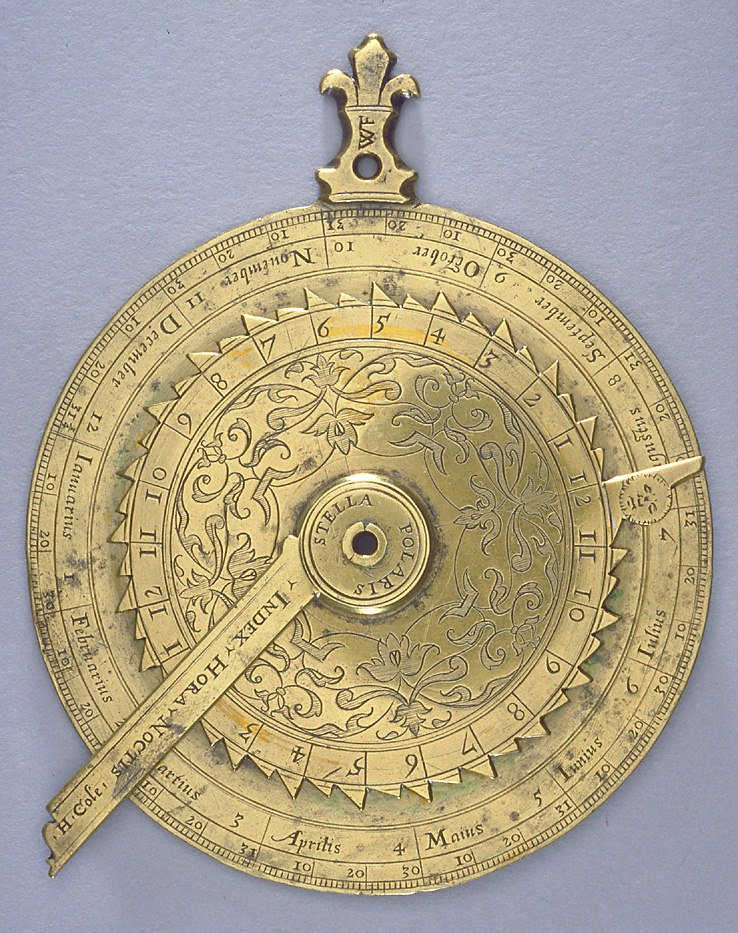
This gilt brass nocturnal, measuring 95 mm in diameter, is the work of Humfrey Cole and dates to circa 1575. The instrument serves as both a nocturnal and a tide-prediction tool, featuring a circular disc with complex volvelles and indices on both sides. The front incorporates a calendrical scale and an hour-scaled volvelle with a sun-effigy index, centered over scrollwork engraving. The reverse contains a 360-degree scale, a 24-hour scale, and a 32-point compass rose, integrated with a lunar-age disc and an aperture for displaying moon phases. A pierced fleur-de-lis handle, bearing the initials 'W F', is attached to the disc. The device incorporates functional mechanics for celestial navigation and tidal forecasting, as described by Digges in his 1555 publication, 'Prognostication'. It is currently held by the British Museum.

Front view of the gilt brass nocturnal by Humfrey Cole, featuring the calendrical scale, hour volvelle, and index arm.
Front view of the gilt brass nocturnal by Humfrey Cole, featuring the calendrical scale, hour volvelle, and index arm. — British Museum, London. Rights pending — permission not yet requested. Original source

Catalogue identity

Source
www.mhs.ox.ac.uk
Category
Tool · English nocturnal
Maker / attribution
Humfrey Cole
Reference
Not recorded
Catalogue / lot identifier
MLA 1857,11-16.2
Source-reported date
circa 1575
Source-reported place
London

Source-reported attribution and specifications are not independent authentication. A listing does not establish present ownership, current display, availability or permission to reproduce.

Object description

Construction and Design

The nocturnal is constructed of gilt brass and measures 95 mm in diameter. It is distinguished by a central disc with volvelles and indices on both the front and the reverse. A small handle, shaped as a pierced fleur-de-lis and marked with the initials 'W F', is attached to the edge of the disc. The front features a circular calendrical scale showing Latin month names and their respective day counts, with December notably featuring 31 1/4 days to account for the leap year.

A volvelle situated in the center of the front scale provides an hour scale, numbered 1 to 12 twice in an anticlockwise direction. Alternating teeth on the volvelle denote full and half-hour increments. A sun effigy at the 12 o'clock position serves as an index to set the date. The central area of this side is decorated with engraved scrollwork, and an index arm, inscribed 'STELLA POLARIS' and 'INDEX HORA NOCTIS', rotates over the volvelle.

Evidence for this section
  • “Gilt brass; 95 mm in diameter”
  • “December has 311/4 to indicate the leap year”
  • “Teeth of alternating size indicate the full and half hours”
  • “The centre of the disc is engraved with scrollwork.”

Functional Scales and Tidal Prediction

The reverse of the instrument provides secondary functionality for celestial and tidal calculation. It includes three distinct circular scales: an outermost degree scale marked from 0 to 360 degrees, a 24-hour scale, and a 32-point compass rose featuring a fleur-de-lis for North. The central component on this side is a fixed disc indicating the lunar age from 1 to 30, coupled with a rotating volvelle and an aperture displaying the phases of the moon.

The integration of these scales enables the prediction of high tide at a specific port, provided the port's direction is known. This function aligns with methods documented in Digges' 'Prognostication', which was printed in 1555 by Thomas Gemini. The plate on the reverse also includes markings for planetary aspects, although this feature is noted as being incomplete.

Evidence for this section
  • “The reverse is inscribed with several circular scales”
  • “The combination of scales 2 and 3 with the central disc and volvelle allow the prediction of high tide at a particular port”
  • “The plate is marked with planetary aspects but has not been completed.”

Provenance and Documentation

The nocturnal was acquired by the British Museum in 1857 and is catalogued under the inventory number MLA 1857,11-16.2. The instrument has been the subject of several scholarly records, including an entry in R. T. Gunther’s 'The Great Astrolabe and other Scientific Instruments of Humphrey Cole', published in Archaeologia in 1927.

Additional documentation is provided by F. A. B. Ward in 'A Catalogue of European Scientific Instruments in the Department of Medieval and Later Antiquities of the British Museum', published in 1981. These texts confirm the attribution to Humfrey Cole and detail the instrument's design features as they appear in the collection.

Evidence for this section
  • “The instrument was purchased in 1857”
  • “described and illustrated in R. T. Gunther, "The Great Astrolabe and other Scientific Instruments of Humphrey Cole", Archaeologia , 76 (1927)”
  • “F. A. B. Ward, A Catalogue of European Scientific Instruments in the Department of Medieval and Later Antiquities of the British Museum (London, 1981)”

Open research questions

  • What is the significance of the initials 'W F' located on the fleur-de-lis handle?
  • Was the incomplete state of the planetary aspects on the reverse plate intended, or does it represent an unfinished commission?

Source evidence

Recorded claims and source quotations for Humfrey Cole Nocturnal
FieldSource-reported valueSource quotation
MakerHumfrey Cole“Signed by Humfrey Cole”
Datecirca 1575“circa 1575”
MaterialGilt brass“Gilt brass”
Diameter95 mm“95 mm in diameter”
Inventory NumberMLA 1857,11-16.2“Registration no. MLA 1857,11-16.2”
SignatureH Cole“The signature of the maker 'H Cole' is inscribed on the same arm.”
HandlePierced fleur-de-lis with 'W F'“attached to the disc is a small handle in the shape of a pierced fleur-de-lis. On this handle are the initials 'W F'.”

Visible details

  • Pierced fleur-de-lis handle with initials 'W F'
  • Sun effigy at 12 o'clock on the front volvelle
  • Scrollwork engraving on the front disc center
  • Inscribed 'STELLA POLARIS' and 'INDEX HORA NOCTIS' on the index arm

Research qualifications

  • The planetary aspects on the reverse plate are described as incomplete.
  • The exact identity of the person with the initials 'W F' is not provided in the source.

Photograph identity and source facts were screened before import; rights clearance remains pending.

Consulted source

Nocturnal

Reviewed 2026-10-26 · Record fe84a38495

Terms in this record

Glossary explanations for terms named in this object’s record.

Other english nocturnal records