
Skip to content
The Encyclopedia of Horology

Tool · English nocturnal

English Brass Nocturnal

Partially verified

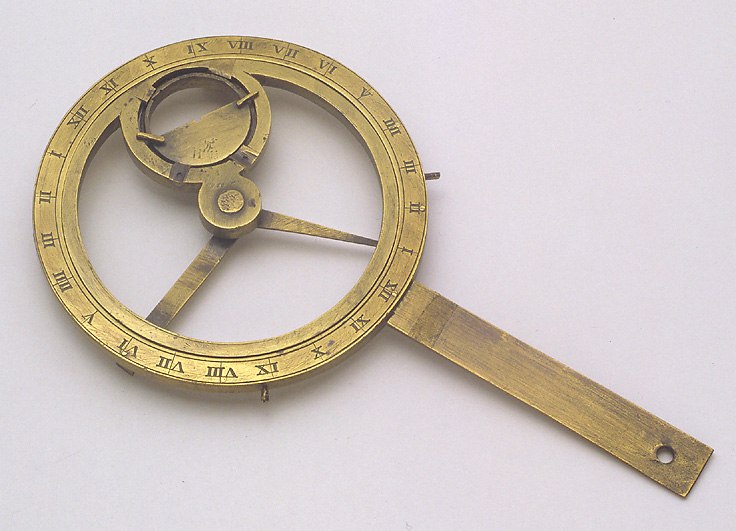
This nocturnal is a 16th-century brass instrument, measuring 77 mm in diameter, and originates from the bequest of Sir Robert Dudley to the Grand Duke of Tuscany in 1649. Unlike solid-disc nocturnals, this example is constructed from two concentric rings supported by a straight arm with a terminal attachment hole. The outer ring features an engraved anti-clockwise double 12-hour scale and 24 touch pins. Within this, a rotating second ring displays a calendar scale. A subsidiary ring arrangement occupies the space between March and the central boss, including a partial fourth ring with a central notch. Two central indexes with distinct, possibly replaced ends facilitate operation. The instrument is currently separated from its original parent piece. It is housed in the Istituto e Museo di Storia della Scienza in Florence.

Overview of the brass nocturnal, inventory number 2500, displaying the central indexes and concentric ring arrangement.
Overview of the brass nocturnal, inventory number 2500, displaying the central indexes and concentric ring arrangement. — Istituto e Museo di Storia della Scienza, Firenze. Rights pending — permission not yet requested. Original source

Catalogue identity

Source
www.mhs.ox.ac.uk
Category
Tool · English nocturnal
Maker / attribution
Not established
Reference
Not recorded
Catalogue / lot identifier
2500
Source-reported date
16th century
Source-reported place
England

Source-reported attribution and specifications are not independent authentication. A listing does not establish present ownership, current display, availability or permission to reproduce.

Object description

Structural Design and Scale Configuration

This nocturnal features a skeletal construction, distinct from the common solid-disc variety. It consists of two concentric rings mounted on a straight arm, which terminates in a hole used for suspension or attachment to a missing parent component. The outer ring is engraved on one side with an anti-clockwise double 12-hour scale (I to XII, I to XII). This unconventional layout is specifically designed to function in conjunction with the 24 touch pins positioned on the opposite side of the ring, which are arranged in a clockwise direction. Beneath these pins, on the inner edge, lies an unnumbered 360-degree scale.

The interior of the instrument contains a second, free-rotating ring bearing a calendar scale. This scale is graduated to indicate the day of the month, though it lacks specific provisions for leap years. In the space between the month of March and the central boss, there is a complex arrangement including a subsidiary ring and a fourth, partially open ring. This fourth component is capable of independent rotation within the subsidiary ring and features a small notch cut at the center of its diameter, facilitating time-telling operations.

Evidence for this section
  • “The nocturnal is unlike many other more typical instruments in being made up of a ring rather than a solid disc mounted on an arm.”
  • “The outer ring is engraved on one side with an undivided double 12 hour scale (I to XII, I to XII) engraved anti-clockwise”
  • “Beneath the touch pins, on the inner edge of the ring, is an unnumbered 360? scale.”
  • “Within this ring and free to rotate is a second ring engraved on its circumference with a calendar scale”

Central Indexes and Components

The center of the instrument is occupied by two indexes that pivot from the central boss. These indexes are constructed with distinct profiles: one terminates in a flat, pointed end, while the other features a square end that has been returned through 90 degrees. These specific shapes are necessary for the accurate alignment of the device during observational use, allowing the user to map the rotation of the constellations against the calendar scale provided on the inner ring.

There is uncertainty regarding the historical integrity of these central indexes. The provided documentation suggests that these specific parts may not be original to the instrument, but rather later replacements. Additionally, the instrument is noted for having become separated from its parent assembly.

Evidence for this section
  • “Mounted at the centre of the instrument are two indexes, one with a flat pointed end, the other with a square end returned through 90?. Both these however may be replacements.”
  • “There is an attachment hole at the end of the supporting arm, but this instrument has become separated from its parent piece.”

Provenance and Attribution

Although the instrument remains unsigned, it is attributed to English manufacture during the 16th century. Historical documentation links the object directly to the collection of Sir Robert Dudley, an English explorer and cartographer. Following his departure from England, his collection was moved to Italy, where it became part of a significant bequest to the Grand Duke of Tuscany in 1649.

The nocturnal is currently preserved under inventory number 2500 within the collections of the Istituto e Museo di Storia della Scienza in Florence.

Evidence for this section
  • “Although unsigned, this instrument appears to have been made in England”
  • “originates in the bequest left to the Grand Duke of Tuscany by Sir Robert Dudley (1649)”

Open research questions

  • What is the nature of the missing 'parent piece' to which this nocturnal was originally attached?
  • To what extent do the replaced central indexes deviate from the original 16th-century design?

Source evidence

Recorded claims and source quotations for English Brass Nocturnal
FieldSource-reported valueSource quotation
MakerUnsigned“Unsigned”
Date16th century“16th century”
Dimensions77 mm in diameter“77 mm in diameter”
OriginEngland“appears to have been made in England”
ProvenanceBequest of Sir Robert Dudley (1649) to the Grand Duke of Tuscany“originates in the bequest left to the Grand Duke of Tuscany by Sir Robert Dudley (1649)”
Inventory Number2500“Inventory no. 2500”

Visible details

  • Two concentric rings on a supporting arm
  • Twenty-four touch pins on the outer ring
  • Anti-clockwise 12-hour scale
  • Two central indexes of differing shapes

Research qualifications

  • Both central indexes may be replacements
  • Instrument has been separated from its parent piece

Photograph identity and source facts were screened before import; rights clearance remains pending.

Consulted source

Nocturnal

Reviewed 2026-10-26 · Record 4ac8fb5c6b

Terms in this record

Glossary explanations for terms named in this object’s record.

Other english nocturnal records