
Skip to content
The Encyclopedia of Horology

Tool · Horizontal dial / scientific instrument

Horizontal dial for latitude 32° North

Partially verified

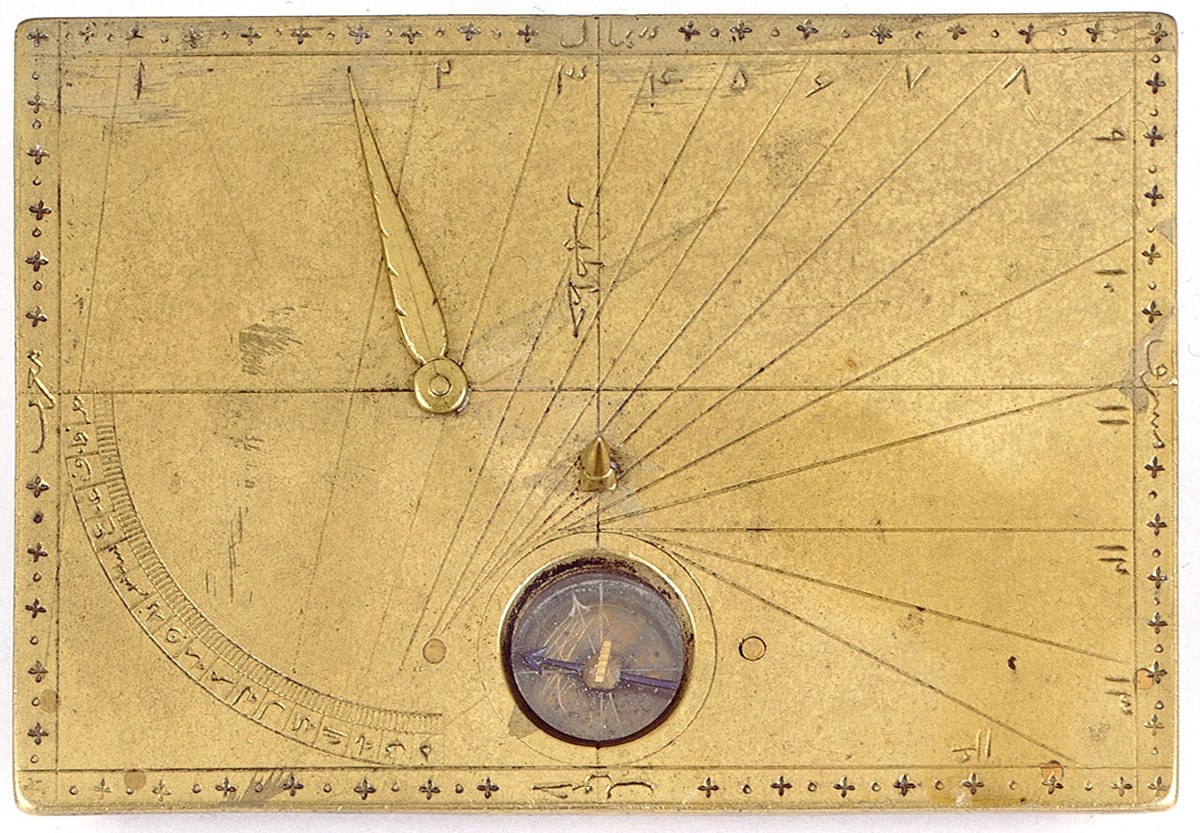
Catalogued under ID AST0499 in the National Maritime Museum, Greenwich, this 17th-century horizontal dial is constructed from a rectangular brass plate measuring 9 by 57 by 82 mm. Designed for latitude 32° North, the obverse surface is engraved with hour lines for Babylonian hours numbered in Indo-Arabic numerals, accompanied by a degree arc graduated in abjad numerals and a leaf-shaped index pointer. A round inset compass beneath glass features a blued arrow needle with an offset magnetic variation marking. The reverse side, as the museum reports, contains a three-column table detailing 41 Middle Eastern locations and their inhirafs.

Obverse view of the brass horizontal dial showing engraved hour lines, degree arc, leaf index, and inset compass
Obverse view of the brass horizontal dial showing engraved hour lines, degree arc, leaf index, and inset compass — National Maritime Museum, Greenwich, London, Caird Collection. Rights pending — permission not yet requested. Original source

Catalogue identity

Source
www.rmg.co.uk
Category
Tool · Horizontal dial / scientific instrument
Maker / attribution
Not established
Reference
AST0499
Catalogue / lot identifier
Source URL identifies the listing
Source-reported date
17th century
Country
Not established

Source-reported attribution and specifications are not independent authentication. A listing does not establish present ownership, current display, availability or permission to reproduce.

Object description

Construction and Physical Properties

The instrument is a horizontal dial consisting of a rectangular brass plate measuring 9 by 57 by 82 mm. It is supported by four shaped corner brackets; the museum notes that one bracket is copper while the remaining three are brass.

The device features an inset round compass protected by a glass plate. The compass assembly includes a blued, arrow-shaped needle resting on a brass pyramidal pivot and is secured to the plate with two screws visible on the reverse side.

Evidence for this section
  • “This dial comprises a rectangular brass plate supported by four shaped corner brackets (one copper, the rest brass).”
  • “Measurements: Overall: 9 x 57 x 82 mm”
  • “The compass is set into the plate, attached by two screws on the back”
  • “The needle is blued, in the form of an arrow and surmounted by a brass pyramidal pivot. There is a glass plate over all.”

Obverse Engravings and Functionality

The obverse includes a hinged pin gnomon and hour-lines for Babylonian hours, labeled in Indo-Arabic numerals. A degree arc, numbered in abjad numerals, is located in the top-right quadrant. A narrow, leaf-shaped index pointer is used to indicate the 'inhiraf'.

The design displays four cardinal points and a meridian line providing the midday prayer curve (khatt zuhr). The edge of the plate is finished with a simple decorative border. The dial is designed for latitude 32° North and functions as a qibla pointer.

Evidence for this section
  • “On the obverse side, the horizontal dial is marked with hour-lines for Babylonian hours, numbered in Indo-Arabic numerals.”
  • “It has a hinged pin gnomon and a degree arc in the top right quarter numbered in 'abjad' numerals.”
  • “An index in the shape of a narrow leaf is used to mark the 'inhiraf'.”
  • “Four cardinal points are marked, as is the meridian line, giving the midday prayer curve (khatt zuhr). Around the edge is a simple decorative border.”
  • “Together with the latitude arc, it therefore serves as a qibla pointer”

Documentation and Historical Context

The museum documents a three-column table on the reverse side containing 41 Middle Eastern locations and their corresponding 'inhirafs'.

The creator of the dial is unknown and it is dated to the 17th century. The museum references a similar example in the Whipple Museum (accession no. Wh: 1482).

Evidence for this section
  • “On the reverse side is a table of 41 places in the Middle East with their 'inhirafs', in three columns.”
  • “Creator: Unknown”
  • “Date made: 17th century”
  • “This horizontal dial, of which there is a very similar example in the Whipple Museum (accession no. Wh: 1482)”

Open research questions

  • What is the significance of the mixed material (copper and brass) used for the corner brackets?
  • Does the 17th-century dating rely on stylistic analysis or historical records of similar instruments?
  • What specific locations are included in the 41-entry table on the reverse?

Source evidence

Recorded claims and source quotations for Horizontal dial for latitude 32° North
FieldSource-reported valueSource quotation
Museum IDAST0499“ID: AST0499”
Date made17th century“Date made: 17th century”
Latitude specification32° North“Horizontal dial for latitude 32° North.”
DimensionsOverall: 9 x 57 x 82 mm“Measurements: Overall: 9 x 57 x 82 mm”
MaterialsBrass ; Glass“Materials: Brass ; Glass”
Reverse inscriptionTable of 41 Middle Eastern places“On the reverse side is a table of 41 places in the Middle East with their 'inhirafs', in three columns.”
Museum IDAST0499“ID: AST0499”
Magnetic Variation15° West of North“marked with a magnetic variation for 15° West of North.”

Visible details

  • Rectangular brass plate engraved with radiating Babylonian hour lines numbered in Indo-Arabic script.
  • Graduated degree arc inscribed with abjad numerals located in the lower-left sector.
  • Movable leaf-shaped pointer positioned on the upper-left field.
  • Centrally placed upright brass gnomon pivot just above an inset round compass with a blued steel arrow needle beneath glass.
  • Perimeter border decorated with engraved quatrefoil cross and circular punch motifs.

Research qualifications

  • The reverse side containing the table of 41 locations and their inhirafs is documented by the museum but not visible in the provided image.
  • Maker and exact place of production are unknown.

Photograph identity and source facts were screened before import; rights clearance remains pending.

Consulted source

Horizontal dial | Royal Museums Greenwich

Reviewed 2026-10-25 · Record fd1506eafb

Terms in this record

Glossary explanations for terms named in this object’s record.