
Skip to content
The Encyclopedia of Horology

Tool · Italian horizontal dial

Horizontal Dial

Partially verified

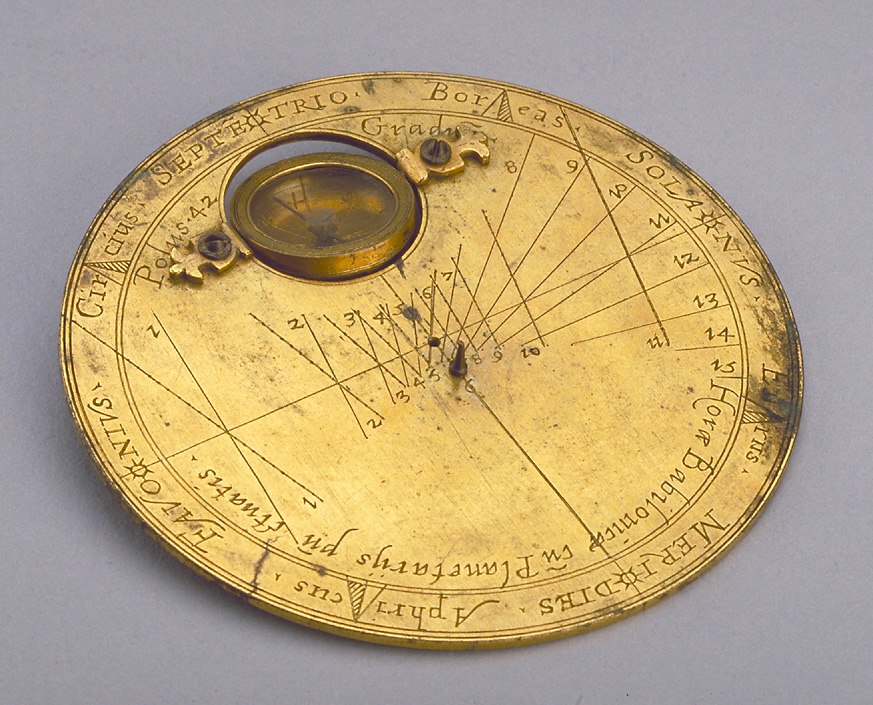
This horizontal dial, made of gilt brass and measuring 90 mm in diameter, is attributed to the Roman maker Carlo Plato and dated 1585. The instrument is constructed as a circular disc featuring a pivoted compass designed for use on both sides. One side of the disc is engraved with the names of cardinal points and winds in Latin, including 'SEPTE TRIO' and 'SOLANVS'. This side includes a pin gnomon dial marking Babylonian and planetary hours. The reverse side features the names of winds in Italian, such as 'TRAMO TANA' and 'Greco', and a pin gnomon dial for Italian and common hours. The internal compass is weighted to remain horizontal when the dial is rotated. The object was bequeathed to the British Museum by Octavius Morgan and is recorded in the 1981 catalogue of European scientific instruments in the museum's collection.

A gilt brass horizontal dial with a pivoted compass and pin gnomon, attributed to Carlo Plato, 1585.
A gilt brass horizontal dial with a pivoted compass and pin gnomon, attributed to Carlo Plato, 1585. — British Museum, London. Rights pending — permission not yet requested. Original source

Catalogue identity

Source
www.mhs.ox.ac.uk
Category
Tool · Italian horizontal dial
Maker / attribution
Carlo Plato
Reference
MLA 1888, 12-1.292
Catalogue / lot identifier
MLA 1888, 12-1.292
Source-reported date
1585
Source-reported place
Rome

Source-reported attribution and specifications are not independent authentication. A listing does not establish present ownership, current display, availability or permission to reproduce.

Object description

Construction and Dial Layout

The instrument comprises a 90 mm diameter gilt brass disc engraved on both sides to serve as a horizontal sundial. The dial employs a pin gnomon to indicate various timekeeping systems. On the Latin-inscribed side, it tracks Babylonian hours via continuous lines and planetary hours using punctuated lines. The disc is engraved with cardinal points and wind names in Latin around the limb, specifically 'SEPTE TRIO', 'Boreas', 'SOLANVS', 'Eurus', 'MERIDIES', 'Aphricus', 'FAVONIVS', and 'Circius'.

The reverse side utilizes Italian terminology for wind names, listing 'TRAMO TANA', 'Greco', 'LEVA TE', 'Scirocco', 'OSTRO', 'Garbino', 'PONE TE', and 'Maestro'. This side features a pin gnomon dial for Italian hours from 9 to 23 and common hours from 4 to 12 a.m. and 1 to 8 p.m. The gnomon on this side is observed to be bent, impacting its current state. The dial is also inscribed with the latitude information 'Polus 42 Graduu' on both faces.

Evidence for this section
  • “The dial consists of a gilt brass disc engraved with hour lines on both sides, with a revolving compass.”
  • “The pin gnomon dial (the pin is bent) indicates Italian hours from 9 to 23 with continuous lines and common hours from 4 to 12 (a.m.), and 1 to 8 (p.m.) with punctuated lines.”
  • “The dial is inscribed'Polus 42 Graduu ?' and'Horae Italicae cu Astronomicis ?'.”

The Pivoted Compass

A key component of this instrument is the revolving compass designed to function when the dial is flipped. This compass is inscribed with the initials of wind names in Italian: 'P' for Ponente, 'M' for Maestro, 'T' for Tramontana, 'G' for Greco, 'S' for Scirocco, 'O' for Ostro, and 'Ga' for Garbino. To ensure it remains horizontal regardless of the dial's orientation, a weight is incorporated into the bottom of the compass housing.

The compass currently exhibits a configuration error where it is rotated by 90 degrees from its intended position. The bottom of the compass casing carries the inscription 'Romae anno d ni 1585', documenting the place and year of production in Rome.

Evidence for this section
  • “A peculiar feature of his horizontal dials is a pivoted compass , which can be used for both sides of the dial .”
  • “The bottom of the compass has a weight so that it remains horizontal on turning the dial, and is inscribed'Romae anno d ni 1585'.”

Provenance and Documentation

The object is held in the collection of the British Museum under the registration number MLA 1888, 12-1.292. The dial entered the museum's holdings through the bequest of Octavius Morgan. It is catalogued in the specialized study by F. A. B. Ward, titled 'A Catalogue of European Scientific Instruments in the Department of Medieval and Later Antiquities of the British Museum', published in 1981.

The entry in the catalogue serves as the primary reference for the object's history and identification within the British Museum. The instrument is attributed to Carlo Plato based on the construction of the dial and the specific arrangement of the winds and cardinal points, which aligns with his recorded output of scientific instruments in 16th-century Rome.

Evidence for this section
  • “The dial was bequeathed by Octavius Morgan and is described in F. A. B. Ward, A Catalogue of European Scientific Instruments in the Department of Medieval and Later Antiquities of the British Museum (London, 1981), p. 22, no.13.”
  • “This dial is a very typical example of the work of Carlo Plato , an Italian maker working in Rome.”

Open research questions

  • What is the specific mechanical cause for the current 90-degree misalignment of the compass?
  • Are there variations in the engraving depth or technique between the Latin and Italian sides of the dial?

Source evidence

Recorded claims and source quotations for Horizontal Dial
FieldSource-reported valueSource quotation
MakerCarlo Plato“Attributed to Carlo Plato”
Date1585“Dated 1585”
MaterialGilt brass“Gilt brass; 90 mm in diameter”
ProvenanceOctavius Morgan“The dial was bequeathed by Octavius Morgan”
InscriptionRomae anno d ni 1585“is inscribed'Romae anno d ni 1585'”
Inventory NumberMLA 1888, 12-1.292“Registration no. MLA 1888, 12-1.292”
Design featurePivoted compass“A peculiar feature of his horizontal dials is a pivoted compass”

Visible details

  • The dial is made of gilt brass with a diameter of 90 mm.
  • A centrally located pin gnomon is visibly bent.
  • The compass is mounted within a pivoting frame for bidirectional use.
  • Engravings include Latin and Italian wind names on opposite sides of the disc.

Research qualifications

  • The compass is described as being currently mounted with a 90-degree orientation error.
  • The pin gnomon on the reverse side is explicitly noted as being bent.

Photograph identity and source facts were screened before import; rights clearance remains pending.

Consulted source

Horizontal Dial

Reviewed 2026-10-26 · Record a16b42631a

Terms in this record

Glossary explanations for terms named in this object’s record.