
Skip to content
The Encyclopedia of Horology

Tool · Italian horizontal dial

Horizontal Dial

Partially verified

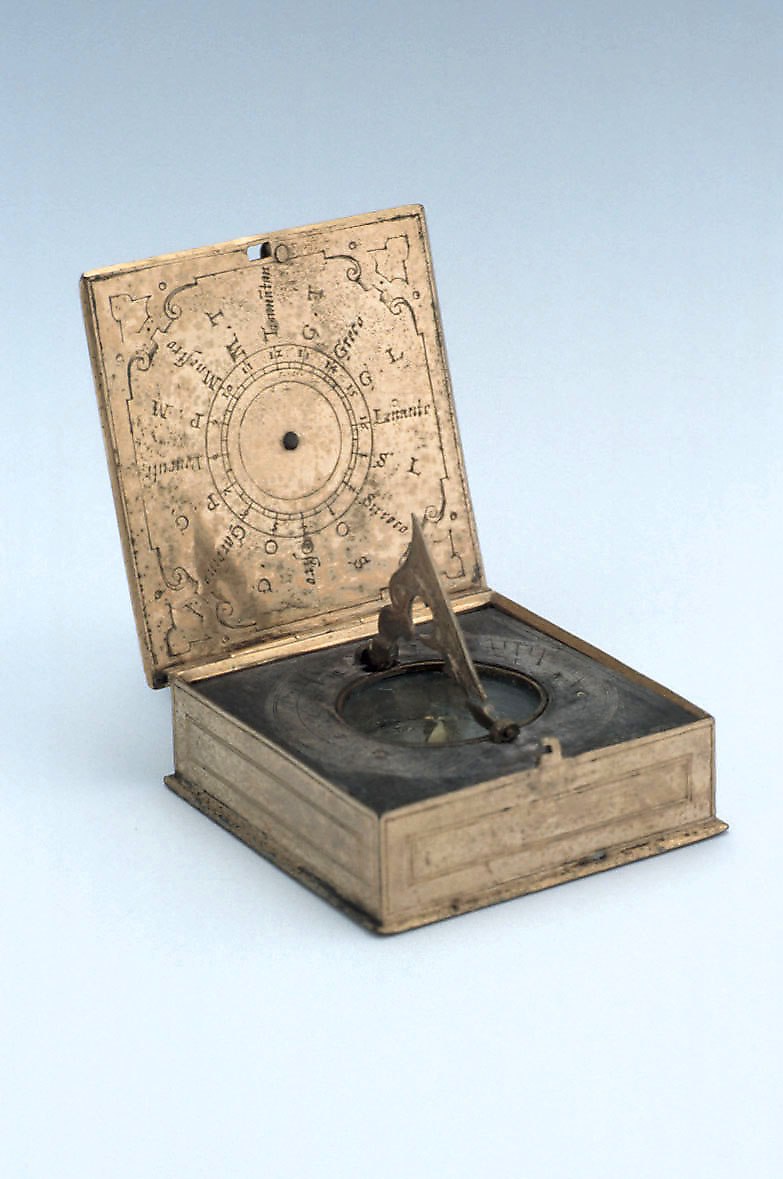
This horizontal dial is a compact instrument constructed of gilt and silvered brass, measuring 47 x 46 x 15 mm. The device features a square-section box with a hinged cover leaf secured by a clasp. The instrument is unsigned and undated. Its primary functions include timekeeping via a silvered horizontal dial plate with a folding, decorated gnomon, and astronomical calculation through multiple integrated volvelles. The outer lid face houses a lunar volvelle, an aspectarium for planetary relations, and hour scales. The inner lid face contains a wind rose with eight classical winds identified by Italian names, alongside sixteen directions and scrollwork engraving. The base of the instrument incorporates an additional inset volvelle designed for converting between equal and Italian hours, which is marked 'Horae Ab Occasu Solis'. A central magnetic compass with a 22 mm diameter bowl is inset beneath the gnomon, marked for westward variation.

View of the open horizontal dial showing the compass, gnomon, and inner lid wind rose.
View of the open horizontal dial showing the compass, gnomon, and inner lid wind rose. — Museum of the History of Science, Oxford. Rights pending — permission not yet requested. Original source

Catalogue identity

Source
www.mhs.ox.ac.uk
Category
Tool · Italian horizontal dial
Maker / attribution
Not established
Reference
Not recorded
Catalogue / lot identifier
51587
Source-reported date
Later 16th century
Source-reported place
Italy

Source-reported attribution and specifications are not independent authentication. A listing does not establish present ownership, current display, availability or permission to reproduce.

Object description

Construction and Exterior

The instrument is a square-section horizontal dial crafted from gilt and silvered brass. Its exterior is marked by simple rectangular line engraving along the sides of the box. A single cover leaf is hinged to the main body and held closed by a functional clasp.

The lid's outer face displays a lunar volvelle and an aspectarium, featuring a graphical representation of the moon's phases. The corners of the face are finished with line engraving, while the inner surface of the lid features a detailed wind rose, complete with the eight classical winds and sixteen directions, all rendered within engraved scrollwork.

Evidence for this section
  • “This square-section instrument has a single cover leaf hinged over the main box, whose sides are decorated with simple rectangular line engraving.”
  • “The inner face of the lid carries a wind rose with the eight classical winds named in Italian and a further eight directions represented by the initial letters of the two adjacent winds.”

Dial and Compass

The main box houses the horizontal dial plate, which is finished in silver and engraved with hatched corner patterns. The hour scale is divided into 1/2 and 1/4 hour increments. Centered on the dial plate is a 22 mm diameter compass bowl.

The compass is marked with cardinal directions labeled 'N', 'OR', 'S', and 'OC'. It is specifically configured to account for westward magnetic variation. The gnomon is decorated and hinged, allowing it to fold over the compass bowl when the instrument is closed.

Evidence for this section
  • “The silvered dial plate has hatched engraving in its corners and the hour scale runs 4 to 12 to 8”
  • “The compass bowl is 22 mm in diameter and the cardinal directions are labelled 'N', 'OR', 'S' and 'OC'; the compass plate is marked for a westward variation.”

Functional Volvelles

The instrument includes an additional volvelle on the underside of the base. This component allows for the conversion between equal hours and Italian hours, with the latter scale designated as 'Horae Ab Occasu Solis' and ranging from 10 to 24.

This base volvelle also includes a cut-away pointer that reveals a scale showing the length of the day. The entire underside is decorated with the same engraved scrollwork found on other parts of the instrument, maintaining stylistic consistency.

Evidence for this section
  • “The underside of the instrument has an inset volvelle for converting between equal and Italian hours”
  • “the scale of Italian hours on the disc is marked 'Horae Ab Occasu Solis' and runs 10 to 24.”

Open research questions

  • Can the wind naming convention be definitively linked to a specific region or school of instrument making?
  • Does the specific engraving style on the scrollwork allow for closer identification of the maker or workshop?

Source evidence

Recorded claims and source quotations for Horizontal Dial
FieldSource-reported valueSource quotation
Inventory number51587“Inventory number: 51587”
Dimensions47 x 46 x 15 mm“47 x 46 x 15 mm”
MaterialGilt and silvered brass“Gilt and silvered brass”
Compass diameter22 mm“The compass bowl is 22 mm in diameter”
Date estimateLater 16th century“Later 16th century”
ProvenanceBillmeir Collection“Provenance: Billmeir Collection (57-84/197).”

Visible details

  • Folding gnomon with decorative cutout profile
  • Compass bowl marked for westward variation
  • Gilt and silvered brass construction with scrollwork engraving

Research qualifications

  • Origin is attributed to Italy based on the Italian wind names, though German instruments of the period also used this convention
  • Maker and date are unknown, with attribution based on general stylistic analysis of the late 16th century

Photograph identity and source facts were screened before import; rights clearance remains pending.

Consulted source

Horizontal Dial

Reviewed 2026-10-26 · Record 3d110d0ec6

Terms in this record

Glossary explanations for terms named in this object’s record.