
Skip to content
The Encyclopedia of Horology

Tool · Horary Quadrant

Horary Quadrant

Partially verified

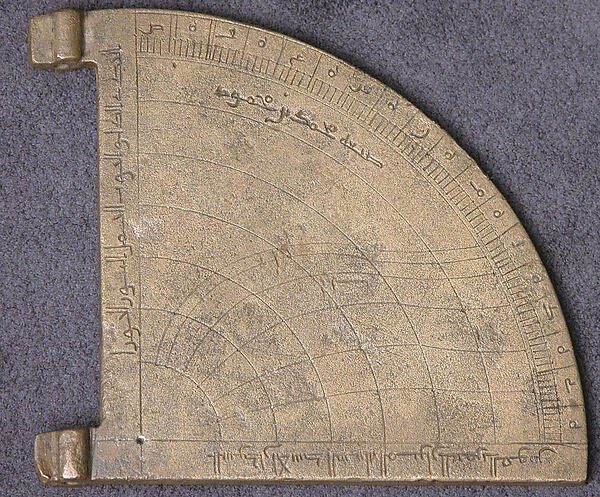
The horary quadrant is a brass instrument, crafted via casting and incising, attributed to the maker Muhammad ibn Mahmud. Dating to the 10th century, the object measures 7.3 cm in height and 7.0 cm in width. The quadrant is a timekeeping device used to determine the hour of the day based on the sun's position. The object was discovered during the Metropolitan Museum of Art’s excavations in Nishapur, Iran, between 1935 and 1948, as part of the museum's broader archaeological efforts in the region during the early to middle Islamic period. It is now part of the permanent collection under the department of Islamic Art, acquired through the Rogers Fund in 1936. The instrument demonstrates early techniques in metalwork and astronomical calculation found in the Nishapur archaeological site.

Front view of the brass horary quadrant showing incised inscriptions, scales, and two side lugs.
Front view of the brass horary quadrant showing incised inscriptions, scales, and two side lugs. — The Metropolitan Museum of Art, New York. Rights pending — permission not yet requested. Original source

Catalogue identity

Source
www.metmuseum.org
Category
Tool · Horary Quadrant
Maker / attribution
Muhammad ibn Mahmud
Reference
Not recorded
Catalogue / lot identifier
36.20.54
Source-reported date
10th century
Source-reported place
Iran

Source-reported attribution and specifications are not independent authentication. A listing does not establish present ownership, current display, availability or permission to reproduce.

Object description

Construction and Design

The horary quadrant is a compact astronomical tool constructed from brass. It is manufactured through a process involving casting followed by the incising of scales and geometric lines. The primary face of the instrument features an arc calibrated with numerical markers and a series of intersecting lines, which serve as the grid for solar hour determination.

The surface of the brass shows the effects of age and archaeological recovery, displaying signs of oxidation, fine surface scratching, and minor pitting. The incised markings remain legible across the body of the quadrant, providing the mathematical data required for its function as a time-measuring device. The proportions of the instrument are small and portable, reflecting its design for active field use.

Evidence for this section
  • “Brass; cast, incised”
  • “H. 2 7/8 in. (7.3 cm) W. 2 1/2 in. (7.0 cm)”

Archaeological Context

The quadrant was recovered during the 'Persian Expedition' conducted by the Metropolitan Museum of Art between 1935 and 1948. These excavations took place at various sites in Nishapur, a city historically significant for its location along trade routes connecting Islamic lands with Central Asia and China. The Metropolitan Museum's fieldwork in the area yielded thousands of artifacts spanning the ninth to twelfth centuries.

This specific quadrant, accessioned in 1936, emerged from the extensive archaeological activity directed by American teams in cooperation with Iranian authorities.

Evidence for this section
  • “This object was found and purchased in Nishapur.”
  • “Between 1935 and 1948, the "Persian Expedition" of the Metropolitan Museum of Art excavated at several sites at Nishapur”
  • “Rogers Fund, 1936”

Attribution and Signature

The object bears an inscription attributing it to the maker Muhammad ibn Mahmud. This attribution is recorded in the museum's catalogue entry, which identifies the individual responsible for the creation of the instrument. The signature is incised directly onto the face of the brass plate, integrated with the astronomical coordinate lines that cover the instrument's surface.

While the specific workshop or life details of Muhammad ibn Mahmud are not elaborated upon in the provided source, his identification as the maker remains the established record for this piece in the Metropolitan Museum's collection.

Evidence for this section
  • “Maker: Muhammad ibn Mahmud, Maker”

Open research questions

  • What is the specific intended use of the two hinge-like lugs on the vertical edge?
  • Are the numerical inscriptions on the arc indicative of specific geographic latitude adjustments?

Source evidence

Recorded claims and source quotations for Horary Quadrant
FieldSource-reported valueSource quotation
Object NameQuadrant“Object name: Quadrant”
MakerMuhammad ibn Mahmud“Maker: Muhammad ibn Mahmud, Maker”
Date10th century“Date: 10th century”
Place of ManufactureNishapur, Iran“Place / culture: Nishapur, Iran”
MediumBrass; cast, incised“Medium: Brass; cast, incised”
DimensionsH. 2 7/8 in. (7.3 cm) W. 2 1/2 in. (7.0 cm)“Dimensions: H. 2 7/8 in. (7.3 cm) W. 2 1/2 in. (7.0 cm)”
ProvenanceFound and purchased in Nishapur, Iran“This object was found and purchased in Nishapur.”
Accession Number36.20.54“Accession number: 36.20.54”

Visible details

  • Cast brass construction with incised markings
  • Graduated arc scale with Arabic numerals
  • Two hinge-like lugs on the straight vertical edge
  • Surface shows visible wear, scratching, and archaeological patina

Research qualifications

  • Original function of the hinge-like lugs is unconfirmed
  • Precise astronomical accuracy of the incised coordinate lines is not verified

Photograph identity and source facts were screened before import; rights clearance remains pending.

Consulted source

Horary Quadrant

Reviewed 2026-10-26 · Record 2fd608f6ec

Terms in this record

Glossary explanations for terms named in this object’s record.