
Skip to content
The Encyclopedia of Horology

Pocket watch · Coach watch

Henry Carus Coach Watch

Partially verified

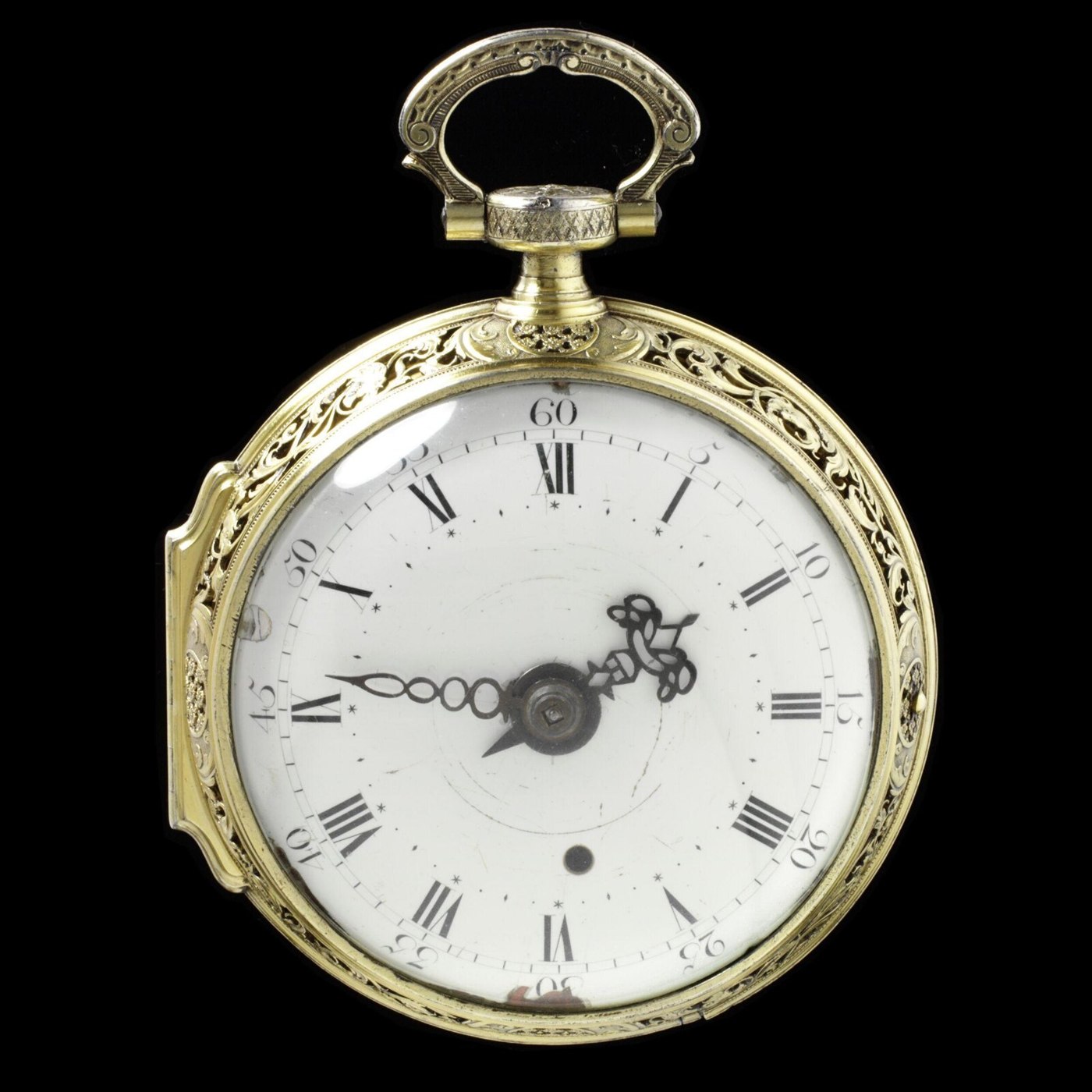
This coach watch, identified by the Victoria and Albert Museum as 123-1908, originated in Paris and is dated between 1733 and 1734. The object consists of a gilded silver case that has been embellished with chased and engraved decorative elements. The watch functions as a quarter-repeater and contains an integrated alarm mechanism, which was the work of maker Henry Carus. The movement is documented with the identification number 507. The aesthetic design features a circular metallic frame characterized by detailed openwork and engraved foliate patterns positioned around the dial perimeter. A large, patterned suspension bow with a decorative stem is mounted to the top of the case. The white dial is printed with black Roman numerals for hour indication and outer Arabic numerals denoting five-minute intervals, accompanied by central hands with ornamental piercing.

A frontal view of the Henry Carus coach watch (123-1908), showcasing the ornate gilded silver frame and the white dial with Roman and Arabic numerals.
A frontal view of the Henry Carus coach watch (123-1908), showcasing the ornate gilded silver frame and the white dial with Roman and Arabic numerals. — Victoria and Albert Museum. Rights pending — permission not yet requested. Original source

Catalogue identity

Source
orbiscollectibles.com
Category
Pocket watch · Coach watch
Maker / attribution
Henry Carus
Reference
Not recorded
Catalogue / lot identifier
123-1908
Source-reported date
1733-1734
Source-reported place
France
Source-reported serial
507

Source-reported attribution and specifications are not independent authentication. A listing does not establish present ownership, current display, availability or permission to reproduce.

Object description

Case and Dial Design

The coach watch is enclosed in a gilded silver case that utilizes traditional metalworking techniques. The exterior is finished with chasing and engraving, reflecting the decorative priorities of the manufacture. A round metallic frame defines the outer profile, featuring ornate openwork designs and engraved foliate borders that surround the white dial face.

Mounted to the top of the case is a substantial suspension bow. This element includes a patterned stem, which secures the watch for its specific intended use. The dial itself provides time-telling through black Roman numerals for the hours, paired with Arabic numerals positioned at the periphery to mark five-minute intervals, utilized alongside decorative central hands.

Evidence for this section
  • “The watch features a gilded silver case decorated with chasing and engraving.”
  • “The exterior presents a round metallic frame with ornate openwork and engraved foliate borders surrounding the dial.”
  • “Mounted at the top is a substantial decorative suspension bow with a patterned stem.”

Movement and Mechanism

The internal mechanism is a quarter-repeater, designed to audibly signal the time through a series of chimes. In addition to the repeating function, the movement is equipped with an integrated alarm mechanism. This assembly is attributed to the maker Henry Carus.

The movement is identified by the number 507, which is recorded within the V&A collection documentation for this specific object. The combination of these features indicates a specialized focus on audible timekeeping functions.

Evidence for this section
  • “It houses a quarter-repeating movement equipped with an alarm”
  • “created by the maker Henry Carus and recorded with the number 507.”

Documentation and Origin

The object is held within the Victoria and Albert Museum collections under the number 123-1908. It is attributed to a manufacturing origin in Paris, with a dated production window spanning 1733 to 1734. The information provided reflects the museum's own internal records.

It acknowledges that the broader representativeness of this specific watch as a collectible type has not been independently verified outside of the provided museum reference.

Evidence for this section
  • “Museum object number 123-1908”
  • “This coach watch dates to 1733–1734 and was manufactured in Paris.”
  • “Transcribed from the Victoria and Albert Museum collection record for this single object”

Open research questions

  • What specific type of repeating mechanism is utilized in movement 507?
  • Are there archival records identifying the original patron or owner of this coach watch?

Source evidence

Recorded claims and source quotations for Henry Carus Coach Watch
FieldSource-reported valueSource quotation
MakerHenry Carus“maker Henry Carus”
Date1733-1734“This coach watch dates to 1733–1734”
LocationParis“manufactured in Paris”
Movement Serial507“recorded with the number 507”
Case MaterialGilded silver“gilded silver case decorated with chasing and engraving”
Accession Number123-1908“Museum object number 123-1908”

Visible details

  • White dial with Roman numerals for hours
  • Outer Arabic numerals for five-minute marks
  • Ornate openwork frame around the dial
  • Substantial patterned suspension bow

Research qualifications

  • The broader historical context for this specimen type is not independently verified
  • Source notes suggest the record relies on museum transcription

Photograph identity and source facts were screened before import; rights clearance remains pending.

Consulted source

Coach watch

Reviewed 2026-11-02 · Record 12b5f79689

Terms in this record

Glossary explanations for terms named in this object’s record.

Other coach watch records