
Skip to content
The Encyclopedia of Horology

Clock · Table clock

Haagse klok

Partially verified

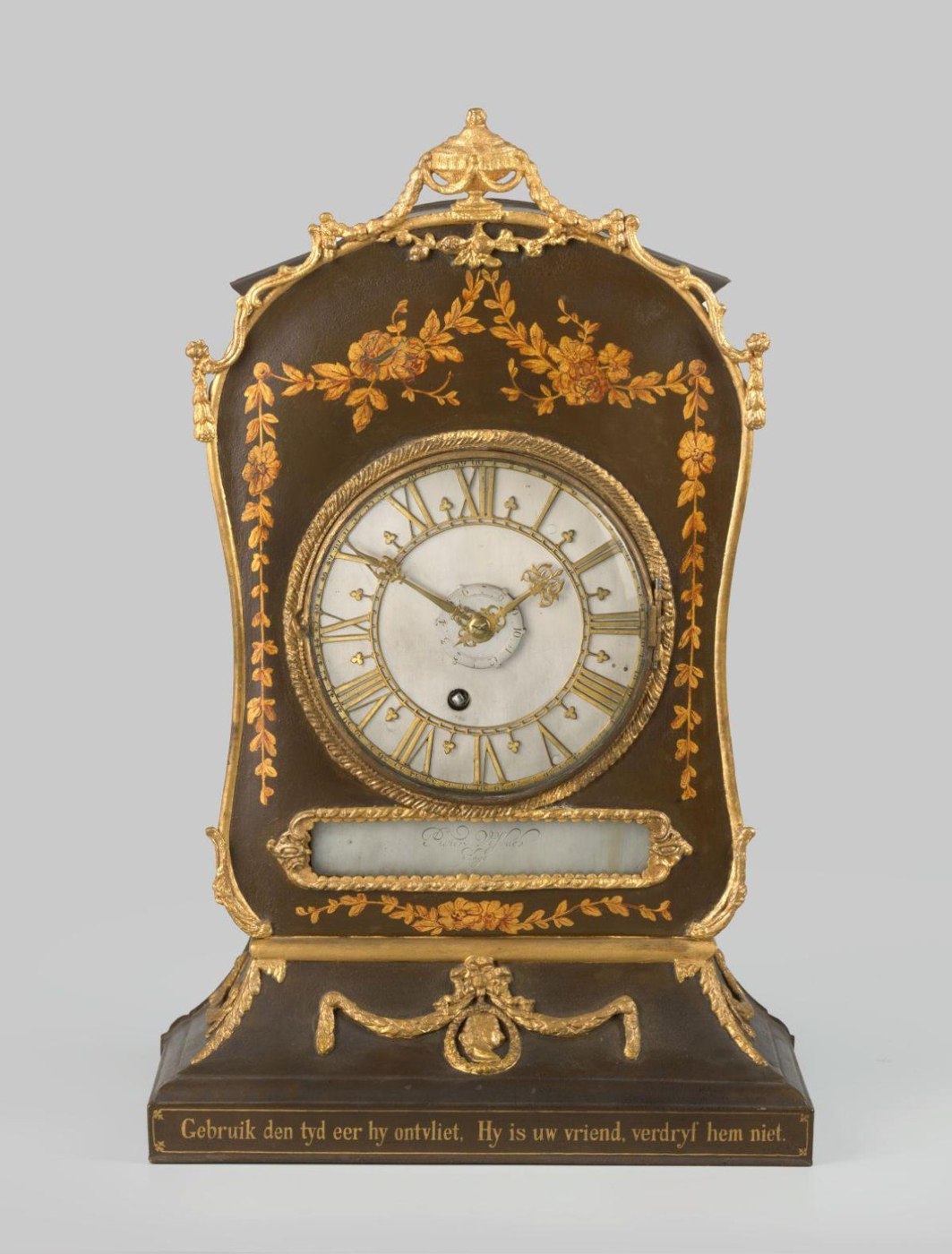
This table clock, categorized as a 'Haagse klok', is attributed to the Dutch clockmaker Pieter Visbach (II), active in The Hague, and dated to approximately 1800. The timepiece is housed in an iron case that has been finished with brown and gold paint. It features an iron dial adorned with brass numerals. The clock is signed 'PIETER VISBACH HAGE' on the dial, and this signature is repeated on the reverse of the movement. The clock was acquired by the Rijksmuseum through the legacy of J.G. de Groot Jamin in 1921. It functions with a striking mechanism, and its dimensions are recorded as 36.3 cm in height by 23.8 cm in width for the original case construction.

Front view of the Haagse klok showing the painted iron case, gilt metal mounts, and the inscribed base.
Front view of the Haagse klok showing the painted iron case, gilt metal mounts, and the inscribed base. — Rijksmuseum. Rights pending — permission not yet requested. Original source

Catalogue identity

Source
www.rijksmuseum.nl
Category
Clock · Table clock
Maker / attribution
Pieter Visbach (II)
Reference
Not recorded
Catalogue / lot identifier
BK-NM-12905-E
Source-reported date
ca. 1800
Source-reported place
Netherlands

Source-reported attribution and specifications are not independent authentication. A listing does not establish present ownership, current display, availability or permission to reproduce.

Object description

Case and Dial

The clock is constructed with an iron case finished in a combination of brown and gold paint. The design incorporates elaborate gilt-metal applications which provide a contrast to the painted surfaces. Floral motifs are depicted across the upper portions of the clock case, surrounding the central dial. The base of the clock features a horizontal inscription that serves as a moral instruction to the user regarding the passage of time.

The dial is manufactured from iron and incorporates brass numerals for the time display. A central aperture or plate area provides a location for the signature of the maker. The overall dimensions of the dial are recorded as 25.3 cm in height and 20.3 cm in width, occupying a central position within the main body of the housing.

Evidence for this section
  • “Kast van ijzer, bruin en goud geschilderd”
  • “Wijzerplaat van ijzer met cijfers van messing.”
  • “wijzerplaat: hoogte 25,3 cm x breedte 20,3 cm”

Signatures and Marks

The clock is identified by its maker's signature, which appears in two locations on the object. The dial surface is marked 'Pieter Visbach Hage', which attributes the work to the clockmaker operating in The Hague.

Beyond the dial, the clock carries a secondary mark on the reverse of the assembly. This ensures consistent identification of the maker's work across both the visible face and the internal mechanical housing.

These inscriptions confirm the professional identification of the maker as Pieter Visbach (II) and designate the geographical center of production as The Hague, consistent with the designation of the piece as a 'Haagse klok'.

Evidence for this section
  • “signatuur, wijzerplaat: ‘Pieter Visbach Hage’”
  • “De klok is op de achterzijde eveneens op dze manier gemerkt.”

Acquisition and Documentation

The object entered the institutional collection in 1921. It was acquired as part of the legacy of J.G. de Groot Jamin, a resident of Amsterdam. The institution catalogs the clock under the object number BK-NM-12905-E.

The record indicates that the object is part of the public domain. Documentation for the clock is maintained in a designated file within the museum's archives to support the provenance and technical details of the item. This entry is confirmed by the museum as a mechanical table clock equipped with a striking mechanism.

Evidence for this section
  • “Legaat van de heer J.G. de Groot Jamin, Amsterdam”
  • “Objectnummer BK-NM-12905-E”
  • “Tafelklok met slagwerk.”

Open research questions

  • What is the specific nature of the distinction between the 'original case' and the 'metal case' measurements provided in the documentation?
  • Does the striking mechanism require manual adjustment or is it fully automated within the frame?

Source evidence

Recorded claims and source quotations for Haagse klok
FieldSource-reported valueSource quotation
MakerPieter Visbach (II)“Pieter Visbach (II)”
Dateca. 1800“ca. 1800”
LocationThe Hague“Den Haag”
SignaturePIETER VISBACH HAGE“PIETER VISBACH HAGE”
InscriptionGEBRUIK DEN TIJD, EER HIJ ONTVLIET. HIJ IS UW VRIEND VERDRIJF HEM NIET.“GEBRUIK DEN TIJD, EER HIJ ONTVLIET. HIJ IS UW VRIEND VERDRIJF HEM NIET.”
Accession NumberBK-NM-12905-E“BK-NM-12905-E”
ProvenanceLegaat van de heer J.G. de Groot Jamin, Amsterdam“Legaat van de heer J.G. de Groot Jamin, Amsterdam”

Visible details

  • Iron dial with brass numerals
  • Case painted brown and gold with floral decorative motifs
  • Instructional inscription on the base
  • Gilt metal ornamentation applied to the case front

Research qualifications

  • The source distinguishes between an 'original case' and a 'metal case' with differing dimensions, which could imply later housing modifications.
  • The exact date of 1800 is given as an approximation.

Photograph identity and source facts were screened before import; rights clearance remains pending.

Consulted source

Haagse klok

Reviewed 2026-11-02 · Record 6a2410fb4e

Terms in this record

Glossary explanations for terms named in this object’s record.