
Skip to content
The Encyclopedia of Horology

Pocket watch · Oval pocket watch

H. Ester oval pocket watch

Partially verified

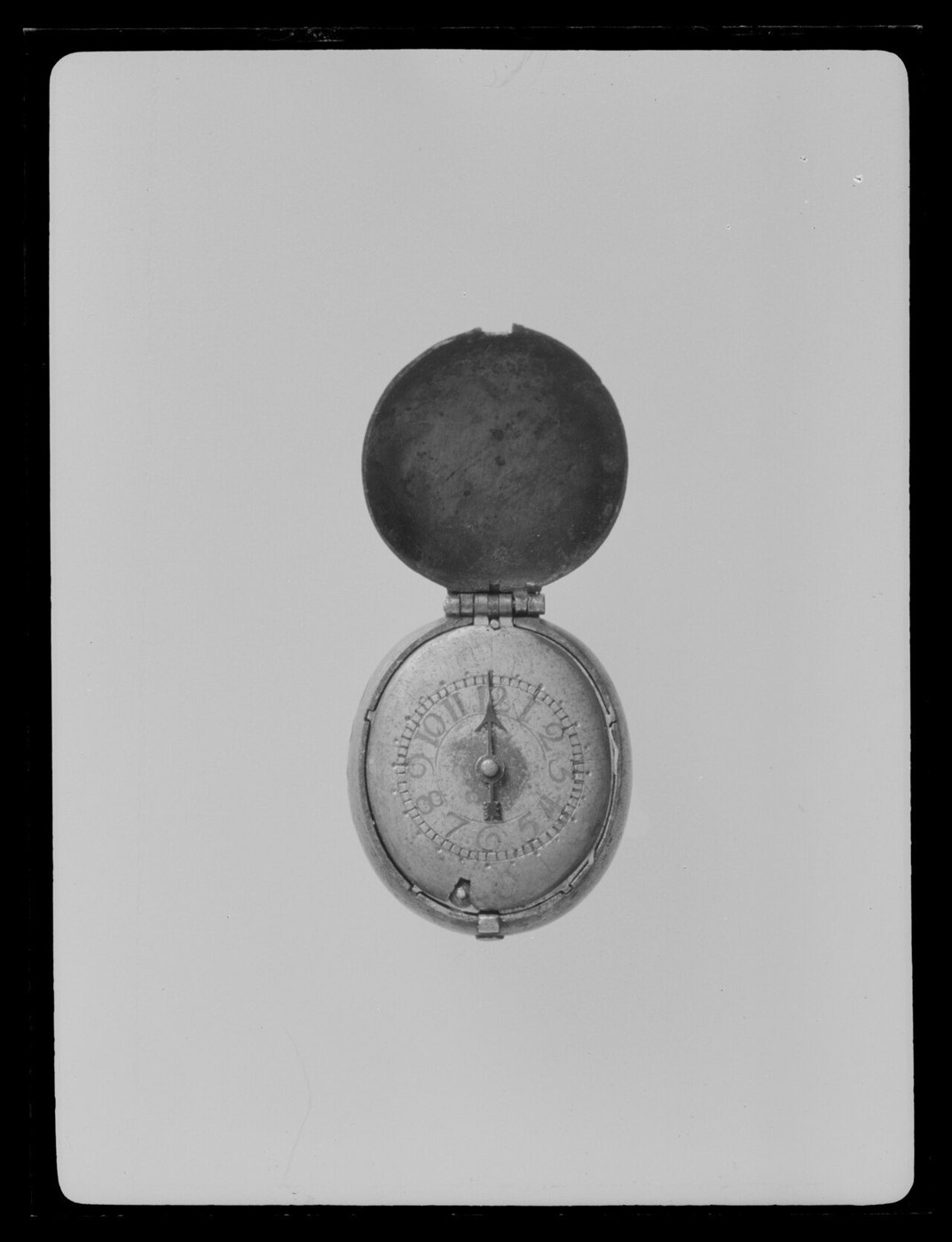
This 17th-century pocket watch, created by the French maker H. Ester (active circa 1630–1660), features an oval, bulbous steel case. The construction incorporates a hinged lid that opens to reveal a steel dial. The dial displays a circular scale graduated from 1 to 12 with red Arabic numerals, further divided into half-hour and five-minute intervals. The watch includes a spherical steel ring at the top, which secures a secondary brass ring for suspension. On the case back, there is an opening for the winding axle, shielded by a rotating, arched steel cover. The movement is fabricated from brass and steel and bears the signature of H. Ester. The object is held in the collection of the Royal Armoury (Livrustkammaren) in Stockholm, Sweden, under accession number LRK 1112.

Oval steel pocket watch by H. Ester, circa 1630, as viewed from the front with the lid open.
Oval steel pocket watch by H. Ester, circa 1630, as viewed from the front with the lid open. — Livrustkammaren. Rights pending — permission not yet requested. Original source

Catalogue identity

Source
commons.wikimedia.org
Category
Pocket watch · Oval pocket watch
Maker / attribution
H. Ester
Reference
Not recorded
Catalogue / lot identifier
LRK 1112
Source-reported date
circa 1630
Source-reported place
France

Source-reported attribution and specifications are not independent authentication. A listing does not establish present ownership, current display, availability or permission to reproduce.

Object description

Case and Dial

The pocket watch is housed in an oval, bulbous case crafted from steel. It features an upper hinged lid that, when opened, exposes the interior dial face. The underside of this cover is finished in a blued state, providing contrast to the steel construction. At the bottom of the case, a spring mechanism secures the lid in the closed position. A spherical ring is attached to the top of the case, which retains a brass ring for suspension or attachment purposes.

The dial is constructed from steel and features an engraved circular track. It is marked with Arabic numerals ranging from 1 to 12, rendered in red. The chapter ring is further segmented to indicate half-hour and five-minute intervals. Access to the movement's winding mechanism is provided on the reverse of the case through an aperture covered by a rotatable, arched steel cap.

Evidence for this section
  • “Ovalt, kulformigt ur med boett av stål.”
  • “Uppfällbart, invändigt blånerat lock, fäst upptill med gångjärn, nertill med fjäderlås.”
  • “Där innanför urtavla av stål med graverad cirkel, graderad 1-12, röda, arabiska siffror, varje timme delad i halvtimme och femdelar.”
  • “På baksidan hål med uppdragningsaxel, täckt med vridbart, välvt lock av stål.”

Movement and Signature

The internal mechanics of the watch are constructed using a combination of brass and steel. The movement is signed by the French maker H. Ester. Historical documentation characterizes H. Ester as a French watchmaker active during the mid-17th century, specifically between 1630 and 1660.

The presence of the winding axle at the rear of the case indicates an early method of adjusting the timekeeping mechanism, requiring the removal of the protective rotating cover to access the movement components directly.

Evidence for this section
  • “Urverk av mässing och stål, signerat: "H. Ester" (fransk urmakare, känd 1630-1660).”

Provenance and History

This watch is part of the collection at the Royal Armoury (Livrustkammaren) in Stockholm, Sweden, designated by the accession number LRK 1112. The object's history is linked to several notable historical figures, including Gustav II Adolf of Sweden, Karl XII of Sweden, Josefina of Leuchtenberg, and Eugenia of Sweden and Norway.

The item has appeared in numerous public exhibitions focusing on royal history and the measurement of time, including displays at the Nationalmuseum and the Royal Armoury between 1989 and 2008.

Evidence for this section
  • “Accession number LRK 1112”
  • “Karl XII av Sverige”
  • “Josefina av Leuchtenberg”
  • “Eugenia av Sverige och Norge”
  • “Gustav II Adolf av Sverige”

Open research questions

  • What specific escapement type is utilized within this movement?
  • Can the specific provenance path through the named Swedish royal figures be further clarified in the museum records?

Source evidence

Recorded claims and source quotations for H. Ester oval pocket watch
FieldSource-reported valueSource quotation
MakerH. Ester“(fransk urmakare, känd 1630-1660)”
Accession NumberLRK 1112“LRK 1112”
Datecirca 1630“circa 1630”
Case MaterialSteel“boett av stål”
DialSteel with engraved circle“urtavla av stål med graverad cirkel”
MovementBrass and steel“Urverk av mässing och stål”
Dimensions28 mm height, 20 mm width, 13 mm thickness“height: 28 mm (1.10 in); width: 20 mm (0.78 in); thickness: 13 mm (0.51 in)”
Place of CreationFrance“Place of creation France”

Visible details

  • Single hand dial with 1-12 hour graduation
  • Red numerals on the steel dial
  • Rotating cover on the case back for the winding axle
  • Bulbous oval case form

Research qualifications

  • The maker H. Ester is described as a French watchmaker known 1630-1660, which implies his work is associated with that period rather than specifically dated to 1630.
  • Exact materials and composition details are based on museum descriptions rather than physical inspection.

Photograph identity and source facts were screened before import; rights clearance remains pending.

Consulted source

H. Ester oval steel pocket watch, circa 1630

Reviewed 2026-11-02 · Record 5a2a5b70ba

Terms in this record

Glossary explanations for terms named in this object’s record.