
Skip to content
The Encyclopedia of Horology

Clock · Gravity clock

Gravity mantel clock

Partially verified

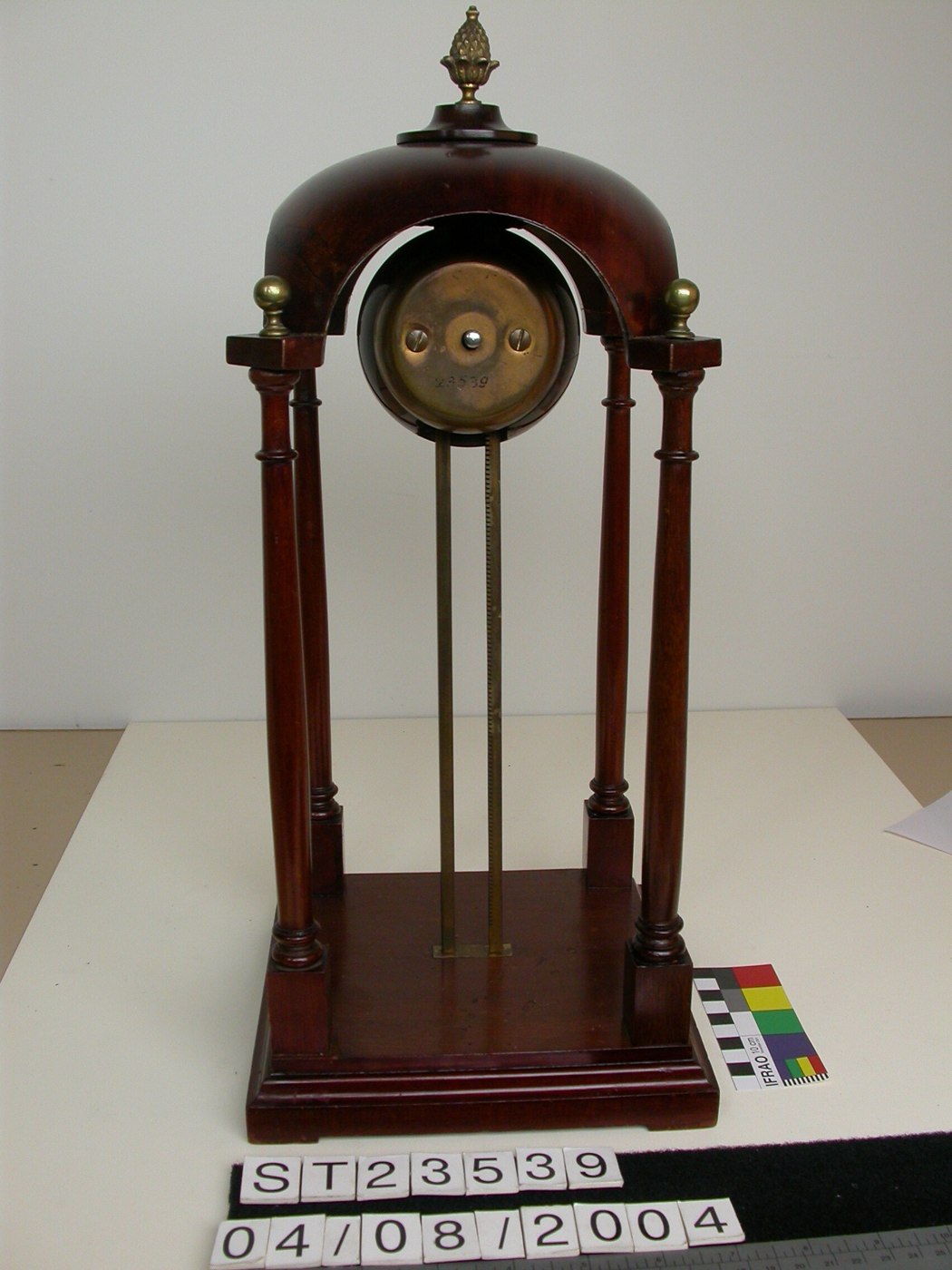
This gravity mantel clock was manufactured in France and retailed by Barraud & Lund, London, circa 1880. The timekeeping mechanism is housed in a round casing suspended within a wooden structure comprised of a curved canopy supported by four tapering pillars rising from a square base. The movement operates by gravity; the clock casing is fitted with a gear mechanism that meshes with a vertical brass toothed runner positioned between two plain brass vertical guides. As the clock descends the runners under its own weight, the gear train is driven to operate the mechanism. The constant weight of the casing ensures that the motive force remains consistent at any given location. The timepiece measures 18.5 cm in length, 18.5 cm in width, and 41 cm in height. It was acquired by the museum in 1952 via a donation from Joseph Lowy.

Gravity clock with a rounded body, wooden canopy and pillars, and a toothed vertical runner for gravity-driven descent.
Gravity clock with a rounded body, wooden canopy and pillars, and a toothed vertical runner for gravity-driven descent. — Museums Victoria. Rights pending — permission not yet requested. Original source

Catalogue identity

Source
collections.museumsvictoria.com.au
Category
Clock · Gravity clock
Maker / attribution
Barraud & Lund (retailer)
Reference
Not recorded
Catalogue / lot identifier
ST 23539
Source-reported date
circa 1880
Source-reported place
France

Source-reported attribution and specifications are not independent authentication. A listing does not establish present ownership, current display, availability or permission to reproduce.

Object description

Structural Configuration

The clock is designed as a mantel timepiece characterized by a gravity-driven descent mechanism. The visual profile is dominated by a rounded, dark wood-cased clock body suspended beneath an arched wooden canopy. This superstructure is held aloft by four slender, tapering pillars that anchor into a substantial square wooden base.

The mechanics of the ascent and descent are facilitated by two vertical brass runners anchored to the base and the canopy. One of these runners is engineered with a rack of teeth, which engages directly with the internal gear train of the clock head. The weight of the movement itself provides the necessary force to power the escapement as it travels downward.

Evidence for this section
  • “Round clock under curved wooden canopy supported by four tapering pillars.”
  • “Two vertical brass runners, one with regular teeth. The toothed runner meshes with the gear mechanism of the clock and the weight of gravity causes the clock to descend the brass runners, thereby operating the mechanism.”

Signatures and Origins

While the clock's internal components and housing construction are attributed to a French source, its distribution and final retail were managed by the London-based firm of Barraud & Lund.

The identification of the retailer and origin is confirmed by two distinct marks located on the timepiece. The dial serves as the primary location for the retailer's identity, while the movement backplate provides the geographical attribution of the clock's manufacture.

Evidence for this section
  • “Dial is marked 'Barraud & Lund, Vendors, London'.”
  • “Backplate is marked 'Made in France'.”

Provenance and Technical Principle

The clock was accessioned into the museum's collection on November 19, 1952, following a donation by Joseph Lowy.

The device operates on the principle that the gravitational force acting upon a constant mass results in a consistent motive power. By allowing the clock head to slowly descend along the toothed runner, the energy required to drive the wheels is maintained at a steady rate throughout the clock's travel duration.

Evidence for this section
  • “The weight of the clock is constant so at any one place the motive force is constant.”
  • “Acquisition: Donation from Joseph Lowy, 19 Nov 1952”

Open research questions

  • What specific French firm manufactured the clock mechanism for Barraud & Lund?
  • Did Barraud & Lund market these gravity clocks under a specific model name or patent during the 1880s?

Source evidence

Recorded claims and source quotations for Gravity mantel clock
FieldSource-reported valueSource quotation
MakerFrance“made in France”
RetailerBarraud & Lund, London“retailed by Barraud & Lund, London”
Datecirca 1880“circa 1880”
Registration NumberST 23539“ST 23539”
Height41 cm“41 cm (Height)”
Dial InscriptionBarraud & Lund, Vendors, London“Dial is marked 'Barraud & Lund, Vendors, London'”
Backplate InscriptionMade in France“Backplate is marked 'Made in France'”

Visible details

  • The clock dial bears the mark 'Barraud & Lund, Vendors, London'.
  • The backplate features the inscription 'Made in France'.
  • The mechanism relies on a toothed vertical brass track for descent.
  • The wooden canopy is topped by a decorative finial.

Research qualifications

  • The exact identity of the French manufacturer remains unstated.
  • The functionality of the gravity mechanism as an accurate timekeeper is not independently verified.

Photograph identity and source facts were screened before import; rights clearance remains pending.

Consulted source

Gravity Clock - France, circa 1880

Reviewed 2026-10-26 · Record d28ed402a8

Terms in this record

Glossary explanations for terms named in this object’s record.

Other gravity clock records