
Skip to content
The Encyclopedia of Horology

Clock · Gravity clock

Gravity mantel clock

Partially verified

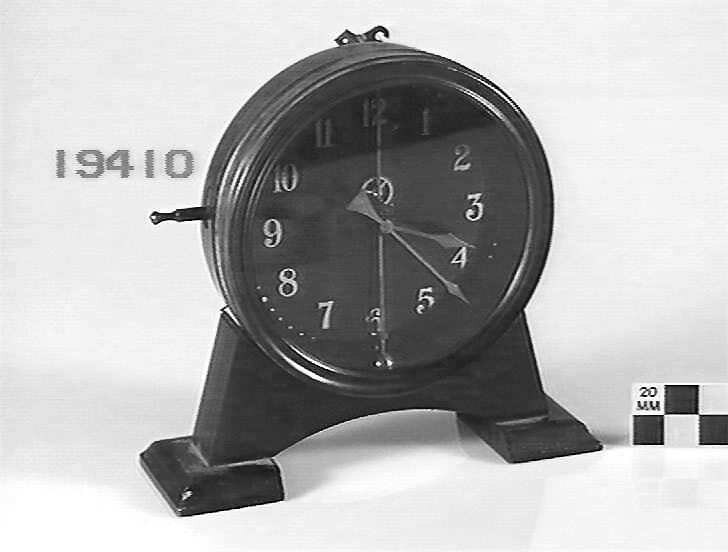
This gravity mantel clock was manufactured in England circa 1925. The object features a circular metal case mounted on a wooden base, measuring 26.5 cm in length, 8 cm in width, and 26 cm in height. The power mechanism relies on gravity, utilizing an elliptical cast iron weight which is raised by a lever located on the left side of the clock. This weight is connected to a curved rack that gears with a pinion. The timekeeping mechanism incorporates a foliot-type pendulum suspended in front of a black dial. Patents for the design were registered in 1920 by Thomas Watson and Christopher F. Webb. The clock was acquired by the museum via a bequest from Mr. John Askew in 1928. A plate on the back of the case is marked 'British Make' and includes references to patent numbers, such as 140668.

Gravity mantel clock showing the circular case on a wooden base with the manual lever on the left.
Gravity mantel clock showing the circular case on a wooden base with the manual lever on the left. — Museums Victoria. Rights pending — permission not yet requested. Original source

Catalogue identity

Source
collections.museumsvictoria.com.au
Category
Clock · Gravity clock
Maker / attribution
Not established
Reference
Not recorded
Catalogue / lot identifier
ST 19410
Source-reported date
circa 1925
Source-reported place
England

Source-reported attribution and specifications are not independent authentication. A listing does not establish present ownership, current display, availability or permission to reproduce.

Object description

Construction and Mechanism

The clock is configured as a gravity mantel timepiece. The primary power source is an elliptical cast iron weight, which functions by being manually raised via a lever positioned on the left side of the clock housing. This weight is linked to a curved rack that gears directly with a pinion to drive the internal movement.

The visual presentation includes a circular metal case supported by a wooden base. Situated in front of a black dial is a foliot-type pendulum, which regulates the escapement. The overall dimensions of the assembly are 26.5 cm long, 8 cm wide, and 26 cm high.

Evidence for this section
  • “An elliptical cast iron weight is raised by a lever on left of the clock. The weight is attached to a curved rack gearing with pinion.”
  • “Circular metal case on wooden base. Pendulum of the foliot type suspended in front of black dial.”

Signatures and Marks

The object features identifying marks on a plate attached to the reverse. This plate bears the inscription 'British Make', indicating the national origin of the manufacture.

Furthermore, the plate lists relevant patent documentation, specifically citing patent number 140668 associated with the 1920 patent registration filed by Thomas Watson and Christopher F. Webb.

Evidence for this section
  • “Plate on back is marked 'British Make' and lists patent numbers [including 140668].”
  • “Patent by Thomas Watson & Christopher Webb, England, 1920.”

Provenance and History

This clock was officially registered under the number ST 19410. The provenance is documented through the museum's acquisition records, which detail that the item was originally received as a loan and subsequently became a bequest from Mr. John Askew on February 1, 1928.

The object is classified within the Science & Measurement collecting area of the museum, with its origin and manufacture dated to circa 1925 in England.

Evidence for this section
  • “Registration number: ST 19410”
  • “Loan & Subsequent Bequest from Mr John Askew, 01 Feb 1928”
  • “Gravity Clock - England, circa 1925”

Open research questions

  • What is the specific horological significance of the patent 140668 in relation to gravity-driven clocks?
  • Are there extant surviving examples of this specific model from other collections that might clarify the manufacturer?

Source evidence

Recorded claims and source quotations for Gravity mantel clock
FieldSource-reported valueSource quotation
Registration numberST 19410“Registration number: ST 19410”
PatenteeThomas Watson and Christopher F. Webb“Patent by Thomas Watson & Christopher Webb, England, 1920.”
Dimensions26.5 cm (L) x 8 cm (W) x 26 cm (H)“26.5 cm (Length), 8 cm (Width), 26 cm (Height)”
Mechanism typeGravity power with foliot pendulum“Gravity power; foliot pendulum escapement.”
Inscription'British Make' and patent numbers“Plate on back is marked 'British Make' and lists patent numbers [including 140668].”
Acquisition sourceBequest from Mr John Askew“Loan & Subsequent Bequest from Mr John Askew, 01 Feb 1928”

Visible details

  • Circular metal clock case
  • Black dial with Arabic numerals
  • Lever visible on the left side of the clock body
  • Wooden base supports the clock housing

Research qualifications

  • The specific manufacturing workshop is not identified in the records.
  • The exact functional status or current timekeeping performance remains unverified.

Photograph identity and source facts were screened before import; rights clearance remains pending.

Consulted source

Gravity Clock - England, circa 1925

Reviewed 2026-10-26 · Record cf99221c56

Terms in this record

Glossary explanations for terms named in this object’s record.

Other gravity clock records