
Skip to content
The Encyclopedia of Horology

Clock · Longcase clock

Grandfather clock by John Wilson of Peterborough

Partially verified

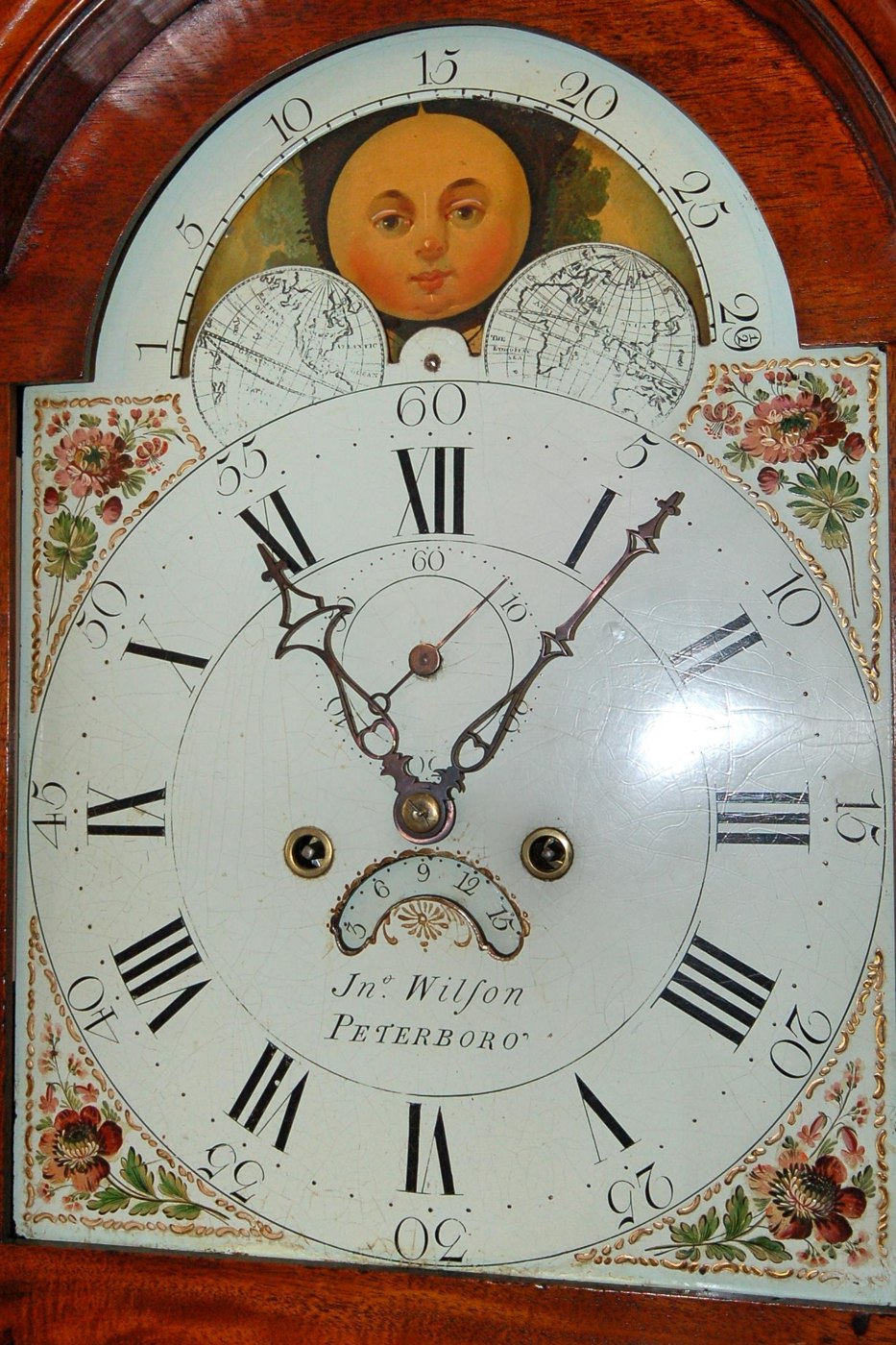
This longcase clock is attributed to the late 18th century and is signed by John Wilson of Peterborough on its arched white dial. The clock features an eight-day duration movement that strikes on a bell and is equipped with a brass compensated pendulum described as being in the Ellicott style. The painted dial exhibits a specific design with floral motifs and gold leaf ornamentation at the corners, alongside Roman numerals and a subsidiary seconds dial. Moon-phase indication is present in the dial arch, complemented by a lunette-shaped calendar aperture in the centre. The cabinet is constructed from flame mahogany veneers, incorporating a glass lenticle in the trunk door to view the pendulum. The overall presentation incorporates design elements the source associates with London, and the piece shows patination on the mahogany exterior. The clock remains as described in the source reference.

The painted arched dial of the longcase clock by John Wilson of Peterborough, with moon-phase arch and subsidiary dials
The painted arched dial of the longcase clock by John Wilson of Peterborough, with moon-phase arch and subsidiary dials — Pendulum of Mayfair. Rights pending — permission not yet requested. Original source

Catalogue identity

Source
www.pendulumofmayfair.co.uk
Category
Clock · Longcase clock
Maker / attribution
John Wilson
Reference
1210
Catalogue / lot identifier
Source URL identifies the listing
Source-reported date
circa 1790
Source-reported place
United Kingdom

Source-reported attribution and specifications are not independent authentication. A listing does not establish present ownership, current display, availability or permission to reproduce.

Object description

Dial and Indication

The timepiece features an arched white painted dial, which serves as the primary interface for timekeeping and astronomical complications. The dial is decorated with floral patterns and gold leaf at the four corners. The chapter ring utilizes Roman numerals for the hour indications and includes a subsidiary seconds register positioned below the central hand arbour.

A moon-phase display is located within the upper arch, featuring a painted moon face flanked by terrestrial hemispheres. Additionally, a lunette aperture is positioned in the centre of the dial to display calendar information. The maker's signature, "Jn. Wilson PETERBORO'", is inscribed centrally on the dial plate.

Evidence for this section
  • “The painted dial of ‘Wilson’ design with flowers and gold leaf decoration to the corners.”
  • “The arched white dial with moon-phase to the arch and lunette calendar aperture to the dial centre.”
  • “The dial centre signed by maker John Wilson of Peterborough.”

Movement and Pendulum

The movement is designed for an eight-day duration and incorporates a striking mechanism that sounds on a bell. It is noted for its quality and the specific implementation of the oscillation regulation.

A primary mechanical feature is the brass compensated pendulum. The pendulum is described as being executed in an 'Ellicott' style, referring to a method of temperature compensation.

Evidence for this section
  • “8 day duration bell strike movement”
  • “The movement of high quality and with very special brass compensated ‘Ellicott’ style pendulum.”

Cabinet Construction

The clock is housed in a longcase cabinet constructed from mahogany, utilizing flame veneers to create decorative patterns on the front panels. The trunk of the case includes a glass lenticle, allowing for the observation of the pendulum's motion while the door is closed.

The external finish displays patination. The construction is characterized by the source as incorporating high-quality design elements reminiscent of London-made cases of the late 18th century.

Evidence for this section
  • “The cabinet showing high quality London design and of lovely flame mahogany veneers.”
  • “Glass lentical to the trunk.”
  • “Superb colour and case patination.”

Open research questions

  • What is the full recorded history of the John Wilson who worked in Peterborough during this period?
  • Does the 'Ellicott style' pendulum contain the specific bimetallic rods typically associated with John Ellicott’s compensation design?

Source evidence

Recorded claims and source quotations for Grandfather clock by John Wilson of Peterborough
FieldSource-reported valueSource quotation
MakerJohn Wilson“The dial signed John Wilson of Peterborough.”
Movement duration8 day“8 day duration bell strike movement”
Pendulum typeBrass compensated“very special brass compensated ‘Ellicott’ style pendulum.”
Case materialFlame mahogany“lovely flame mahogany veneers.”
Dial featuresPainted with moon-phase“The arched white dial with moon-phase to the arch and lunette calendar aperture to the dial centre.”
SKU1210“SKU: 1210”

Visible details

  • Moon-phase dial with celestial imagery in the arch
  • Mahogany case with visible flame veneer patterns
  • Signature reads 'Jn. Wilson PETERBORO'
  • Glass lenticle on the trunk door

Research qualifications

  • The attribution of the cabinet to a 'London design' is a qualitative claim without verifying workshop origin.
  • The 'Ellicott style' description of the pendulum describes an aesthetic or mechanical influence rather than an explicit documented connection to the Ellicott firm.

Photograph identity and source facts were screened before import; rights clearance remains pending.

Consulted source

Antique Grandfather Clock by John Wilson Peterborough C1790

Reviewed 2026-11-02 · Record a2f41f3422

Terms in this record

Glossary explanations for terms named in this object’s record.