
Skip to content
The Encyclopedia of Horology

Pocket watch · Chatelaine watch

Gouden horloge aan chatelaine

Partially verified

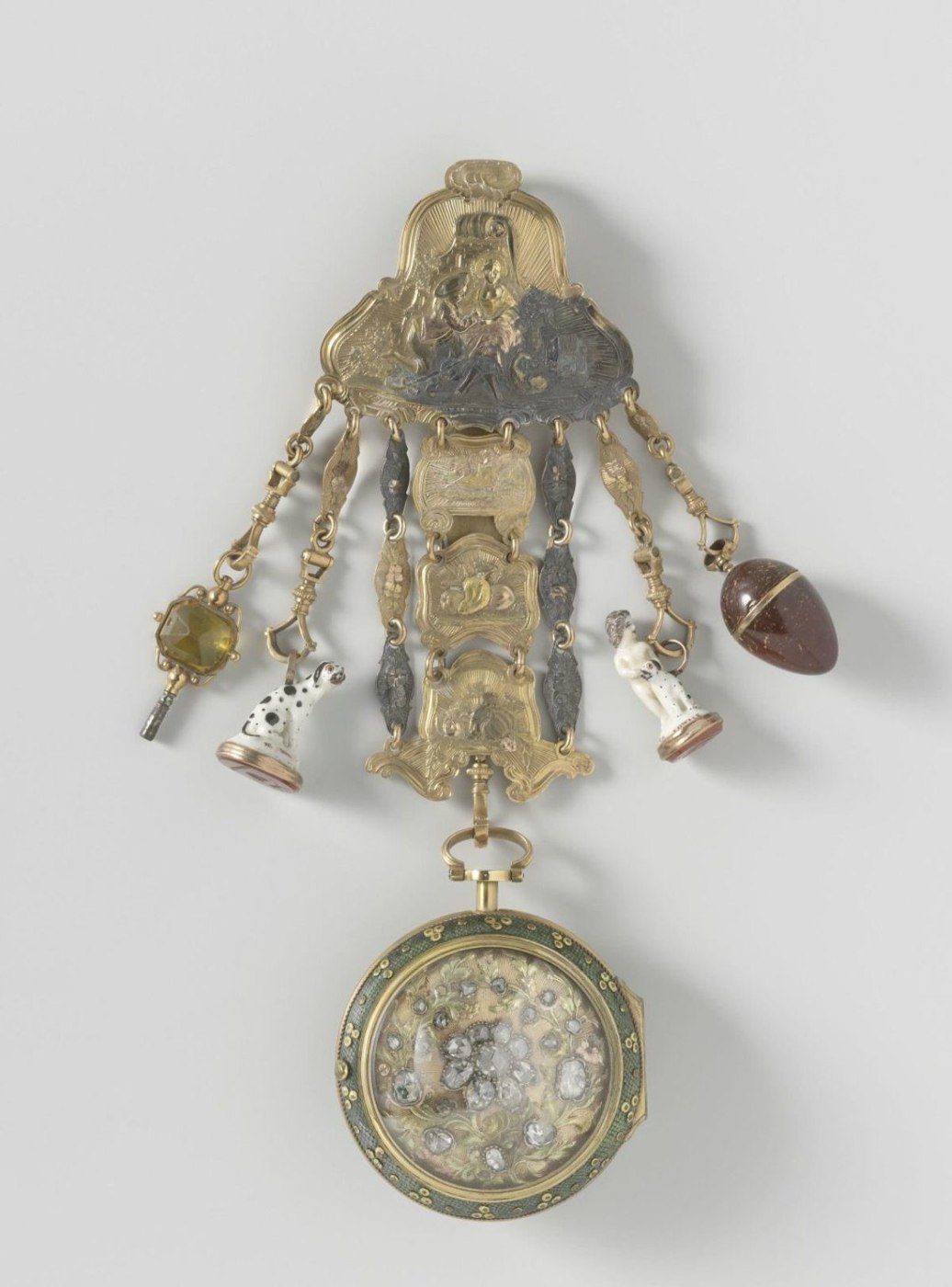
This gold pocket watch, dating to circa 1755, is accompanied by a matching gold chatelaine. The watch case is decorated with an asymmetrical arrangement of flowers rendered in three-color gold, with petals and centers accented by inset diamonds. The watch is signed by the Paris-based clockmaker Jean Baptiste Baillon, a supplier to the French queen, who frequently commissioned the gold work from specialized goldsmiths such as Claude Michel Dequay. The accompanying chatelaine features a relief depicting a shepherd and a shepherdess, and the assembly is preserved within its original green seal-skin case. It entered the collection of the Rijksmuseum in 1898 as a legacy from F.Z. Reneman of Haarlem.

Gold pocket watch with chatelaine, featuring a floral design in three-color gold and diamonds, with an integrated shepherd and shepherdess relief on the chatelaine.
Gold pocket watch with chatelaine, featuring a floral design in three-color gold and diamonds, with an integrated shepherd and shepherdess relief on the chatelaine. — Rijksmuseum. Rights pending — permission not yet requested. Original source

Catalogue identity

Source
www.rijksmuseum.nl
Category
Pocket watch · Chatelaine watch
Maker / attribution
Jean Baptiste Baillon
Reference
Not recorded
Catalogue / lot identifier
BK-NM-11238
Source-reported date
ca. 1755
Source-reported place
France

Source-reported attribution and specifications are not independent authentication. A listing does not establish present ownership, current display, availability or permission to reproduce.

Object description

Case and Decorative Work

The gold casing is embellished with intricate floral bouquets fashioned from three distinct colors of gold, creating a nuanced, layered effect across the cover. Many of the flower hearts and individual petals are set with small, sparkling diamonds to enhance the visual depth of the design.

These metallic floral compositions are integrated into a broader aesthetic scheme, supported by a gold chatelaine that serves as both a functional and ornamental anchor. The chatelaine itself is decorated with a detailed relief scene depicting a shepherd and his counterpart, maintaining the stylistic consistency of the ensemble. The entire assembly is housed in a contemporary green seal-skin case, which served to protect the precious materials from daily environmental exposure.

Evidence for this section
  • “De kast is versierd met een bloemkrans van goud in 3 kleuren en bezet met diamantjes.”
  • “Op de gouden chatelaine staan een voorstelling van een herder en een herderin.”
  • “Het zit in een foedraal van groen robbenvel.”

Maker and Collaborations

Jean Baptiste Baillon is identified as the primary maker of this timepiece. As a supplier to the French queen, Baillon maintained a reputation for producing high-quality watch cases, often incorporating diamonds and intricate metalwork. The documentation indicates that while Baillon managed the overall production and signed the watch, he frequently subcontracted the goldsmithing to specialized masters.

Specifically, Claude Michel Dequay is credited as the goldsmith responsible for the metalwork on this piece. This division of labor reflects the professional dynamics of 18th-century Parisian horology, where master watchmakers coordinated with specialist artisans to achieve complex designs that required expertise in both mechanical movement assembly and fine metal manipulation.

Evidence for this section
  • “Jean Baptiste Baillon, hofleverancier van de Franse koningin, was beroemd om zijn horlogekasten met bloemen van diamant.”
  • “Baillon besteedde het goudsmeedwerk uit aan specialisten als Dequay.”
  • “uurwerkmaker: Jean Baptiste Baillon, Parijs”

Acquisition and History

The timepiece, recorded under the inventory number BK-NM-11238, entered the permanent collection of the Rijksmuseum in 1898. It was acquired as part of a legacy from Mr. F.Z. Reneman, who resided in Haarlem at the time of the bequest. The object is catalogued as both an horological instrument and a piece of wearable jewelry, categorizing it within the broader scope of 18th-century decorative arts.

The object remains in the public domain and serves as an important point of reference for the study of French horological decorative arts from the mid-18th century.

Evidence for this section
  • “Legaat van de heer F.Z. Reneman, Haarlem”
  • “legaat 1898”
  • “Soort kunstwerk chatelaine, sieraad, horloge”

Open research questions

  • What is the specific movement caliber type contained within this mid-18th-century watch?
  • Are there surviving records from the workshop of Claude Michel Dequay that specifically reference the commission of this gold chatelaine?

Source evidence

Recorded claims and source quotations for Gouden horloge aan chatelaine
FieldSource-reported valueSource quotation
MakerJean Baptiste Baillon“uurwerkmaker: Jean Baptiste Baillon, Parijs”
GoldsmithClaude Michel Dequay“edelsmid: Claude Michel Dequay, Parijs”
Dateca. 1755“ca. 1755”
MaterialsGold, diamond, glass, seal skin“goud, diamant, glas; uurwerk: diverse materialen”
ProvenanceLegacy of F.Z. Reneman“Legaat van de heer F.Z. Reneman, Haarlem”
Original storageGreen seal-skin case“Het zit in een foedraal van groen robbenvel.”

Visible details

  • The watch case features floral motifs set with small diamonds.
  • The chatelaine includes figurative components, specifically a shepherd and shepherdess.
  • The set is accompanied by a key and seal attachments suspended from the chatelaine chains.

Research qualifications

  • The specific attribution of the chatelaine to Jean Baptiste Baillon is noted as possible rather than confirmed.
  • The division of labor between the watchmaker and goldsmith is documented, but individual components may have involved other unspecified craftspeople.

Photograph identity and source facts were screened before import; rights clearance remains pending.

Consulted source

Pocket watch, c. 1755

Reviewed 2026-11-02 · Record 7d6df963f6

Terms in this record

Glossary explanations for terms named in this object’s record.