
Skip to content
The Encyclopedia of Horology

Clock · Bracket clock

Gothic Revival style mantel clock with Regent Street signature

Partially verified

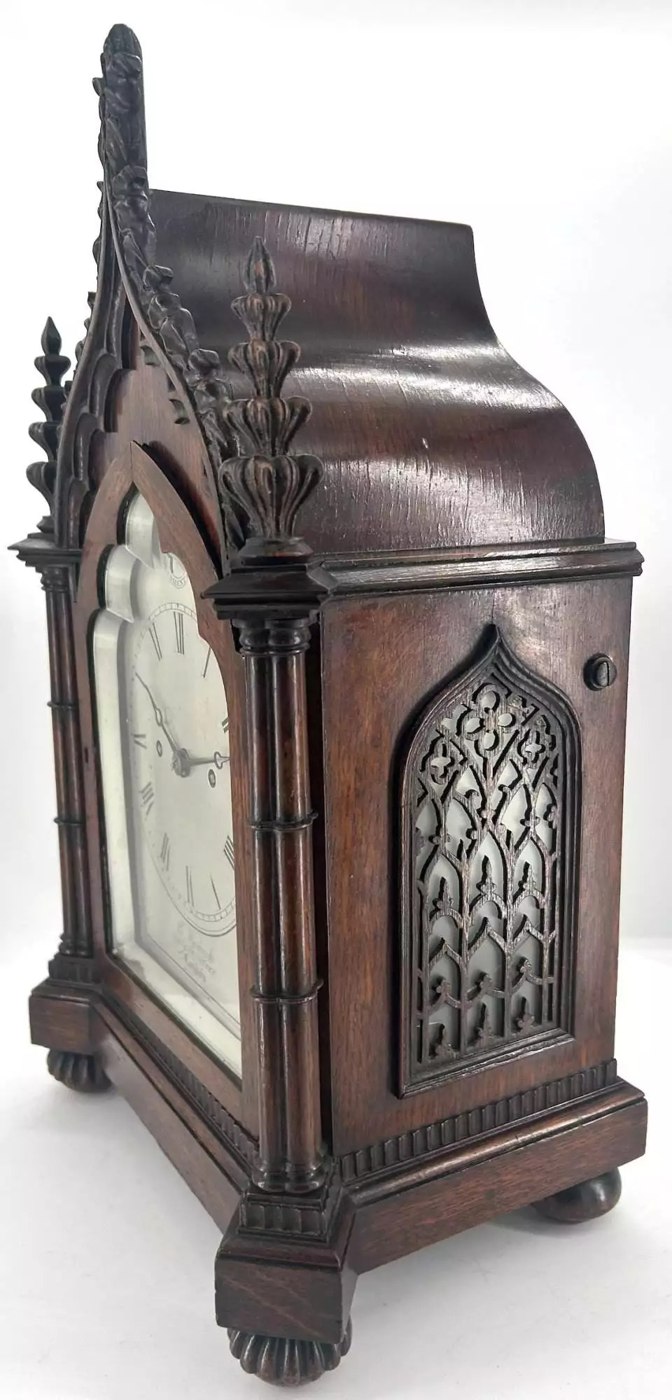
This object is a wooden mantel or bracket clock featuring architectural elements inspired by the Gothic Revival style. The case is constructed with a peaked roof, carved finials, pilasters, and lateral doors with arched, fretwork panels. The white dial features Roman numerals and dark metal hands, with "Regent Street, London" inscribed at the bottom. Internally, the clock houses a brass mechanical movement, visible through a glass rear panel, accompanied by a steel coil gong for the Westminster quarter-hour chime and a large pendulum. There is a discrepancy between the provided source description, which identifies it as a German wall clock, and the physical evidence in the photographs, which depict an English-market style bracket clock with London-specific inscriptions on both the dial and the movement plates.

Rear view of the bracket clock showing the mechanical brass movement, coiled gong, and large pendulum inside the Gothic-style wooden case.
Rear view of the bracket clock showing the mechanical brass movement, coiled gong, and large pendulum inside the Gothic-style wooden case. — Vintage Clocks UK (via Zamanito). Rights pending — permission not yet requested. Original source

Catalogue identity

Source
zamanito.com
Category
Clock · Bracket clock
Maker / attribution
Not established
Reference
Not recorded
Catalogue / lot identifier
Source URL identifies the listing
Source-reported date
circa 1970
Source-reported place
United Kingdom

Source-reported attribution and specifications are not independent authentication. A listing does not establish present ownership, current display, availability or permission to reproduce.

Object description

Case and Aesthetic Design

The clock is housed in a wooden case executed in a Gothic Revival architectural mode. The design incorporates a peaked gable roof, ornamental finials, and carved pilasters that frame the dial area. The base is supported by decorative feet.

Lateral doors are fitted with intricate wooden fretwork featuring arched, ecclesiastical window patterns. A glazed rear door is also present, providing an unobstructed view of the internal mechanical movement, which is secured within the main frame.

Signs of aging and minor surface abrasion are present on the wood, consistent with the age of the piece as estimated in the source.

Evidence for this section
  • “بدنه این قطعه از چوب با طاق نوک‌تیز گوتیک، فینیال‌ها و سرستون‌های تراش‌خورده و پایه‌های تزیینی ساخته شده است”
  • “در دو طرف بدنه، درهای مشبک با طرح پنجره‌های نوک‌تیز کلیسایی قرار دارند که باز می‌شوند”
  • “وضعیت ظاهری، فروشنده کیفیت آن را نسبت به سن دستگاه خوب ارزیابی کرده و به وجود نشانه‌های جزئی گذر زمان و سائیدگی‌های سطحی روی بدنه اشاره نموده است”

Movement and Functionality

The internal mechanism is a spring-driven mechanical type utilizing thick brass plates. It is designed to perform a Westminster chime on a quarter-hourly basis, utilizing a steel coiled gong for sound production.

Visible components include a large pendulum, which the source suggests contributes to the timing accuracy of the clock. The rear brass plate of the movement is inscribed with the location data 'Regent Street, London', matching the signature found on the dial.

The configuration of the mechanical assembly is visible from the rear, revealing the arrangement of the chime train and the timekeeping train within the brass frame structure.

Evidence for this section
  • “مکانیزم ساعت مجهز به زنگ ربع‌ساعته موزیکال Westminster و آونگی بزرگ است”
  • “بر روی صفحه برنجی پشت موتور، حکاکی نشانی Regent Street و London به وضوح دیده می‌شود”
  • “درب پشتی دارای شیشه قوسی‌شکل است که نمای کاملی از مکانیزم داخلی را به نمایش می‌گذارد”

Documentation and Attribution

The object is listed with a estimated date of circa 1970. Significant inconsistencies are noted regarding the source's descriptive text; the source labels the object as a 'German wall clock,' while the actual photographs confirm the object is an English-style bracket clock.

The inscriptions on both the dial and the rear movement plate explicitly reference 'Regent Street, London'.

Evidence for this section
  • “ساعت دیواری وست‌مینستر آلمانی متعلق به حدود ۱۹۷۰ (ca 1970) معرفی شده است؛ با این حال، کلیه تصاویر ارائه‌شده یک ساعت طاقچه‌ای یا رومیزی (Bracket Clock)”

Open research questions

  • What is the specific manufacturer or retailer associated with the Regent Street location marks?
  • Does the construction of the movement correlate with mass-produced clocks from the 1970s or earlier production methods?

Source evidence

Recorded claims and source quotations for Gothic Revival style mantel clock with Regent Street signature
FieldSource-reported valueSource quotation
Object TypeBracket clock“ساعت طاقچه‌ای یا رومیزی (Bracket Clock)”
SignatureRegent Street, London“بر روی صفحه و صفحه پشت موتور آن نام شهر لندن و خیابان Regent Street به چشم می‌خورد”
Mechanism TypeMechanical with pendulum and coiled gong“موتور مکانیکی کوکی با صفحات برنجی ضخیم، فنر زنگ حلزونی (Gong) فولادی و نگه‌دارنده آونگ”
Design StyleGothic Revival“معماری سبک نئوگوتیک”
ChimeWestminster quarter-hour“زنگ ربع‌ساعته موزیکال Westminster”
ConditionSurface wear noted“سائیدگی‌های سطحی روی بدنه”

Visible details

  • Case features carved columns, finials, and pierced wooden fretwork panels
  • Dial displays Roman numerals and the signature 'Regent Street, London'
  • Movement components include a brass plate, coiled gong, and pendulum
  • Overall finish shows superficial signs of wear and surface aging

Research qualifications

  • Discrepancy between source classification as a 'German wall clock' and visual evidence of an English bracket clock
  • Exact manufacturing date and technical service history remain undocumented

Photograph identity and source facts were screened before import; rights clearance remains pending.

Consulted source

Exquisite German Westminster Chime Wall Clock – ca1970

Reviewed 2026-11-02 · Record df01733c19

Terms in this record

Glossary explanations for terms named in this object’s record.