
Skip to content
The Encyclopedia of Horology

Pocket watch · Pocket watch

Gold Repeating Watch

Partially verified

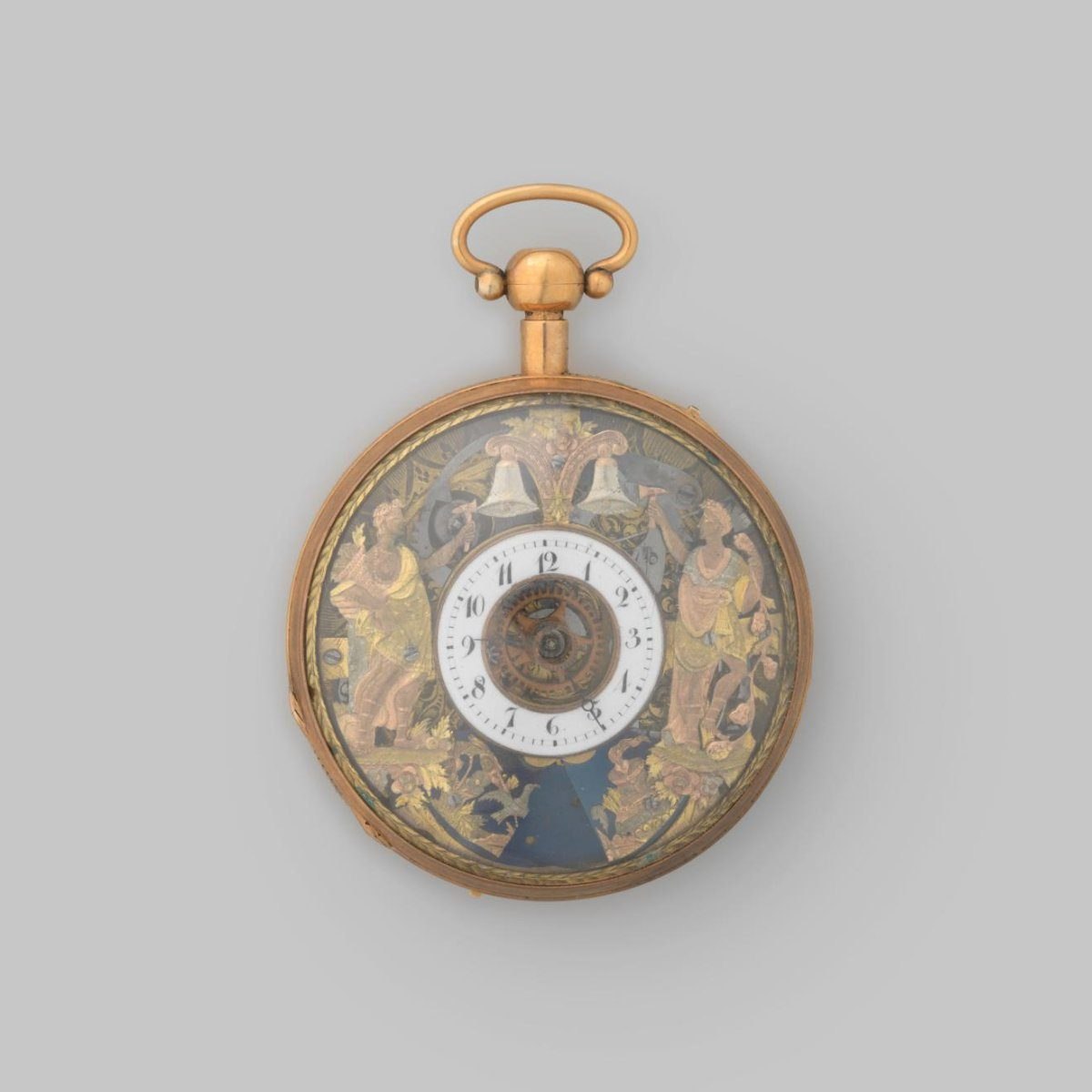
This gold repeating watch, held in the collection of the Rijksmuseum, Amsterdam (BK-NM-12836), is dated to between circa 1800 and 1900. Constructed in gold, the watch features an elaborate dial assembly. Centered on a white-enamelled chapter ring is an openwork decorative scene depicting a male and female figure, each positioned to strike a pair of bells situated above the dial. The reverse of the watch case features engine-turning for decoration. The object measures 5.5 cm in diameter, 7.4 cm in height, 5.5 cm in width, and 2.2 cm in depth.

The dial side of the gold repeating watch (BK-NM-12836), showing the central white-enamelled chapter ring surrounded by automaton figures and bells.
The dial side of the gold repeating watch (BK-NM-12836), showing the central white-enamelled chapter ring surrounded by automaton figures and bells. — Rijksmuseum, Amsterdam. Rights pending — permission not yet requested. Original source

Catalogue identity

Source
orbiscollectibles.com
Category
Pocket watch · Pocket watch
Maker / attribution
Not established
Reference
Not recorded
Catalogue / lot identifier
BK-NM-12836
Source-reported date
c. 1800 - c. 1900
Source-reported place
Not established

Source-reported attribution and specifications are not independent authentication. A listing does not establish present ownership, current display, availability or permission to reproduce.

Object description

Dial and Automaton Features

The dial of this timepiece is characterized by its complex visual arrangement. It centers on a white-enamelled chapter ring that provides time indication through standard Arabic numerals. Surrounding this central ring is an intricate openwork scene that incorporates two figures, a man and a woman, who appear to be engaged in the act of operating the watch's repeating function.

Positioned above the central dial are two bells, which the figures are depicted as striking. This integration of the repeating mechanism's sound-producing components into a figurative, animated scene is the primary aesthetic element of the watch face. The contrast between the plain white enamel of the chapter ring and the textured, openwork metal figures provides a focus for the visual display.

Evidence for this section
  • “The dial consists of a small, white-enamelled chapter ring amidst an openwork scene of a man and a woman striking two bells.”

Case and Dimensions

The watch is housed in a gold case designed with specific attention to its decorative surface. The reverse side of the watch features engine-turning, a decorative technique that adds geometric texture to the gold surface of the case back. This finishing choice complements the gold composition of the watch body.

In terms of physical scale, the watch is a substantial instrument. It measures 5.5 cm in diameter, which is consistent with the size of many repeating watches of this era, and has a height of 7.4 cm. The total depth of the case is recorded at 2.2 cm, providing sufficient room for the internal repeating complications and the figures on the dial assembly.

Evidence for this section
  • “The back cover is engine-turned.”
  • “diameter 5.5 cm x height 7.4 cm x width 5.5 cm x depth 2.2 cm”

Institutional Record and Classification

The object is held under the accession number BK-NM-12836 within the Rijksmuseum in Amsterdam. It is officially documented as part of their collection and is classified under the museum's internal categories as both a wrist watch and jewellery.

The current documentation provides broad dating, suggesting a manufacturing period between 1800 and 1900. Because the specific maker is not identified in the museum records, the object remains a subject for potential further research to determine its precise horological origins and the specific workshop responsible for the automaton construction.

Evidence for this section
  • “The Rijksmuseum, Amsterdam, holds this object as BK-NM-12836”
  • “Museum classification wrist watch · jewellery”
  • “Period c. 1800 - c. 1900”

Open research questions

  • Identify the specific workshop or maker responsible for the automaton repeating movement.
  • Determine if the 'wrist watch' classification in the museum record implies historical modification or an alternate designation for this size of pocket watch.

Source evidence

Recorded claims and source quotations for Gold Repeating Watch
FieldSource-reported valueSource quotation
Object numberBK-NM-12836“BK-NM-12836”
Materialgold“material recorded as gold (metal)”
Dimensions5.5 cm x 7.4 cm x 5.5 cm x 2.2 cm“diameter 5.5 cm x height 7.4 cm x width 5.5 cm x depth 2.2 cm”
Dial descriptionSmall, white-enamelled chapter ring with automaton figures“The dial consists of a small, white-enamelled chapter ring amidst an openwork scene of a man and a woman striking two bells.”
Case finishEngine-turned back cover“The back cover is engine-turned.”
Datingc. 1800 - c. 1900“c. 1800 - c. 1900”

Visible details

  • Openwork dial featuring two human figures with hammers
  • Two bells positioned at the top of the dial assembly
  • White-enamelled chapter ring with Arabic numerals
  • Engine-turned back case cover

Research qualifications

  • The exact maker of the timepiece is currently unidentified in the source material
  • The dating range covers an entire century, indicating the specific manufacture date is unverified within the source

Photograph identity and source facts were screened before import; rights clearance remains pending.

Consulted source

Watch of gold, c. 1800 - c. 1900 (Rijksmuseum, Amsterdam, BK-NM-12836)

Reviewed 2026-11-02 · Record 7c16432e18

Terms in this record

Glossary explanations for terms named in this object’s record.