
Skip to content
The Encyclopedia of Horology

Pocket watch · Pocket watch

Gold Pocket Watch by William Gib

Partially verified

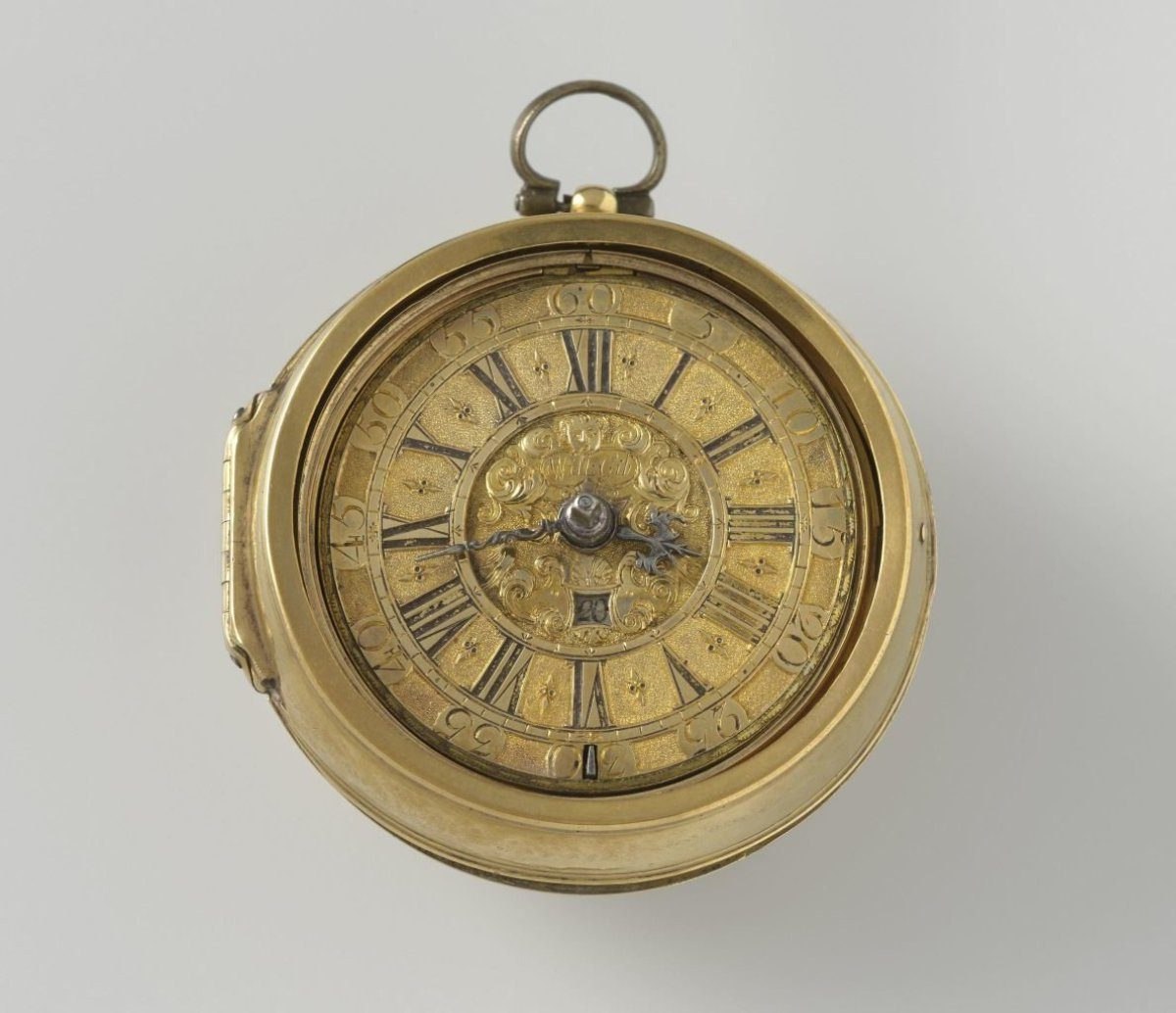
This gold pocket watch, identified by the museum number BK-15079, is attributed to the Rotterdam-based watchmaker William Gib. Produced circa 1709–1710, the watch is housed in a simple, unadorned gold case with a matching plain, bowl-shaped back. The center of the dial displays a relief of ornate vines, two birds, and a central mask, incorporating a cartouche engraved with the signature 'Will. Gib.' and a dedicated aperture for a date indicator. The internal plate, which features a finely decorated bridge, is inscribed with the maker’s name and the serial number 515. The gold case itself is attributed to the silversmith Pierre Hebert from The Hague. This item was bequeathed to the Rijksmuseum as part of the Maurits Elzas Collection in 1937.

The gold pocket watch, showing the dial with its relief-work center, Arabic and Roman numerals, and date aperture.
The gold pocket watch, showing the dial with its relief-work center, Arabic and Roman numerals, and date aperture. — Rijksmuseum. Rights pending — permission not yet requested. Original source

Catalogue identity

Source
www.rijksmuseum.nl
Category
Pocket watch · Pocket watch
Maker / attribution
William Gib
Reference
Not recorded
Catalogue / lot identifier
BK-15079
Source-reported date
ca. 1709 - ca. 1710
Source-reported place
Netherlands
Source-reported serial
515

Source-reported attribution and specifications are not independent authentication. A listing does not establish present ownership, current display, availability or permission to reproduce.

Object description

Case and Dial Composition

The watch is encased in a simple, unadorned gold housing characterized by a plain, bowl-shaped back. This minimalist approach to the exterior emphasizes the gold material itself, which remains free of external engravings or relief work.

The gold dial is complex in its execution, utilizing black-engraved Roman numerals for the hours and Arabic numerals for the minutes. These are set into individual gold plates placed upon a granulated base texture. The central area features a detailed relief depicting decorative vines accompanied by two birds and a human mask, providing a significant visual focal point within the watch face.

Evidence for this section
  • “Gouden horloge in losse onversierde gouden kast.”
  • “De komvormige achterbodem van het horloge is eveneens onversierd.”
  • “De gouden wijzerplaat heeft zwarte ingegrifte Romeinse uur- en Arabische minuutcijfers”

Signatures and Mechanical Marks

The watch identifies its origins through specific inscriptions located on both the exterior dial and the internal movement plate. The dial features the shortened signature 'Will. Gib.' integrated into an ornate cartouche nestled among the central relief motifs. This serves as the primary identification for the watchmaker.

On the internal plate, which houses a bridge with decorative work, the signature is expanded to 'Wiliam Gib. Rotterdam'. This inscription is accompanied by the number 515, which serves as the specific serial identifier for this unit.

Evidence for this section
  • “signatuur, platine: ‘Wiliam Gib. Rotterdam 515’”
  • “signatuur, wijzerplaat: ‘Will. Gib.’”

Provenance and Historical Context

The object carries a well-documented provenance originating from the Maurits Elzas Collection in Arnhem. Before its acquisition by the museum in 1937, the watch passed through the possession of Maurits Elzas in 1930, having been purchased from Rijks in Oosterbeek. The piece was bequeathed to the Rijksmuseum alongside 106 other timepieces as a unified collection.

Historical manufacturing records attribute the movement to William Gib of Rotterdam and the case to the silversmith Pierre Hebert, based in The Hague.

Evidence for this section
  • “Collectie Maurits Elzas, Arnhem”
  • “legaat 1937”
  • “goudsmid: Pierre Hebert (zilversmid), Den Haag”

Open research questions

  • Does the serial number 515 correlate with other surviving watches by William Gib in Dutch public collections?
  • Is there archival evidence to substantiate the specific collaboration between William Gib and the silversmith Pierre Hebert?

Source evidence

Recorded claims and source quotations for Gold Pocket Watch by William Gib
FieldSource-reported valueSource quotation
MakerWilliam Gib“uurwerkmaker: William Gib, Rotterdam”
GoldsmithPierre Hebert“goudsmid: Pierre Hebert (zilversmid), Den Haag”
Serial Number515“platine: ‘Wiliam Gib. Rotterdam 515’”
Dial SignatureWill. Gib.“wijzerplaat: ‘Will. Gib.’”
AcquisitionLegaat 1937“legaat 1937”
Case DescriptionPlain gold case“Gouden horloge in losse onversierde gouden kast.”

Visible details

  • The dial features a central relief of vine motifs, birds, and a mask.
  • The case is plain and lacks external decoration.
  • A small aperture for a date display is located at the bottom of the dial center.

Research qualifications

  • The exact date of manufacture is noted as both 1711 and circa 1709-1710 in the provided data.
  • Attribution of the case to Pierre Hebert is stated as a categorical fact without specific documentary proof in the source.

Photograph identity and source facts were screened before import; rights clearance remains pending.

Consulted source

Watch, 1711

Reviewed 2026-11-02 · Record c589f07d24

Terms in this record

Glossary explanations for terms named in this object’s record.