
Skip to content
The Encyclopedia of Horology

Pocket watch · Men's watch

Gold men's watch, c. 1800

Partially verified

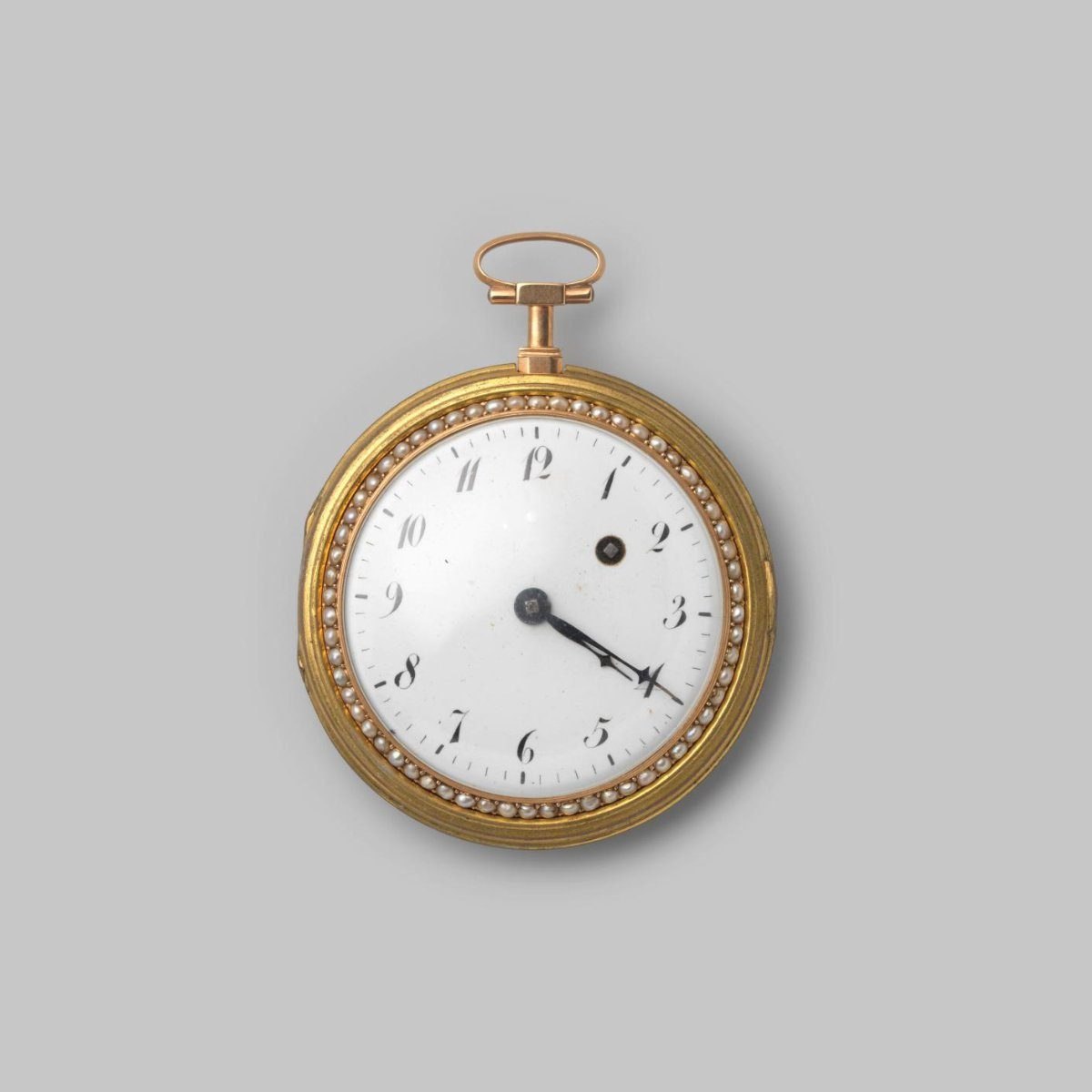
This gold men's watch, catalogued as BK-15032-1, is part of the collection held by the Rijksmuseum in Amsterdam. Dating to approximately 1800, the watch is constructed from gold and agate (chalcedony). The piece is characterized by an enamel painting on the case back, which depicts a boy painting alongside a girl, set against a background of translucent enamel. The white enamel dial features a winding aperture and dark, stylized hands. The watch measures 5.5 cm in diameter, 7 cm in height, 5.5 cm in width, and has a depth of 1.8 cm. The object is officially classified within the museum's records under the category of jewellery and watchmaking, though the museum classification specifically labels it as a 'wrist watch', which diverges from its physical form as a pocket watch.

Front view of the gold watch showing the white enamel dial, hands, and peripheral border.
Front view of the gold watch showing the white enamel dial, hands, and peripheral border. — Rijksmuseum, Amsterdam. Rights pending — permission not yet requested. Original source

Catalogue identity

Source
orbiscollectibles.com
Category
Pocket watch · Men's watch
Maker / attribution
Not established
Reference
BK-15032-1
Catalogue / lot identifier
BK-15032-1
Source-reported date
c. 1800
Source-reported place
Not established

Source-reported attribution and specifications are not independent authentication. A listing does not establish present ownership, current display, availability or permission to reproduce.

Object description

Case and Exterior Decoration

The watch is encased in gold and incorporates agate (chalcedony) in its construction. The exterior is notable for the decorative enamel work applied to the case back. This specific ornamentation consists of a scene showing a boy engaged in painting accompanied by a girl, placed against a background formed of translucent enamel.

A small bow is situated at the top, facilitating attachment, and the diameter is measured at 5.5 cm with a depth of 1.8 cm.

Evidence for this section
  • “material recorded as agate (chalcedony), gold (metal)”
  • “On the case back an enamel painting of a boy painting and a girl against a background of translucent enamel.”

Dial and Configuration

The dial is finished in white enamel, providing a high-contrast backdrop for the dark indices and hands. The presence of a winding aperture on the face indicates the watch is key-wound, requiring manual intervention to operate the movement. The aesthetic is understated, focusing on the clarity of the enamel surface.

The dimensions provided for the object—5.5 cm in diameter and 7 cm in height—align with those of a traditional pocket-worn instrument. While the museum record categorizes the object as a 'wrist watch', the physical attributes shown in the photograph conform to the standard form factor of an 18th- or early 19th-century pocket watch, suggesting a potential misalignment in the provided classification metadata.

Evidence for this section
  • “diameter 5.5 cm x height 7 cm x width 5.5 cm x depth 1.8 cm”
  • “Museum classification jewellery · wrist watch”

Institutional Provenance

The watch is registered within the holdings of the Rijksmuseum in Amsterdam under the accession number BK-15032-1. This registration ensures the object's preservation within a public context and confirms its status as an identified item within the museum's inventory.

Documentation for this object is derived directly from the museum's catalogue. The Orbis Collectibles record notes that these details are translations of the Dutch catalogue entries, providing a verified reference point for the object's existence and material composition, though broader horological research into the maker or specific production origin remains an open requirement.

Evidence for this section
  • “The Rijksmuseum, Amsterdam, holds this object as BK-15032-1”
  • “Description translated from the museum's Dutch catalogue text”

Open research questions

  • Does the Rijksmuseum classification as a 'wrist watch' imply a unique modification or is it a classification error?
  • Can the maker of the movement be identified via internal inspection of the caliber?

Source evidence

Recorded claims and source quotations for Gold men's watch, c. 1800
FieldSource-reported valueSource quotation
Materialagate (chalcedony), gold (metal)“material recorded as agate (chalcedony), gold (metal)”
Datec. 1800“c. 1800”
Dimensionsdiameter 5.5 cm x height 7 cm x width 5.5 cm x depth 1.8 cm“diameter 5.5 cm x height 7 cm x width 5.5 cm x depth 1.8 cm”
Holding InstitutionRijksmuseum, Amsterdam“The Rijksmuseum, Amsterdam, holds this object as BK-15032-1”
DecorationEnamel painting on case back“On the case back an enamel painting of a boy painting and a girl against a background of translucent enamel.”

Visible details

  • White enamel dial with dark hands
  • Peripheral ring of small white stones or beads around the dial
  • Circular gold case
  • Pendant-style winding bow at the top

Research qualifications

  • Museum classification as a 'wrist watch' appears inconsistent with the physical appearance of the object
  • Maker attribution and specific geographical origin are not confirmed by the source

Photograph identity and source facts were screened before import; rights clearance remains pending.

Consulted source

Men's watch of gold, c. 1800 (Rijksmuseum, Amsterdam, BK-15032-1)

Reviewed 2026-11-02 · Record 2a1a6ff68d

Terms in this record

Glossary explanations for terms named in this object’s record.

Other men's watch records