Composition and Sculptural Case
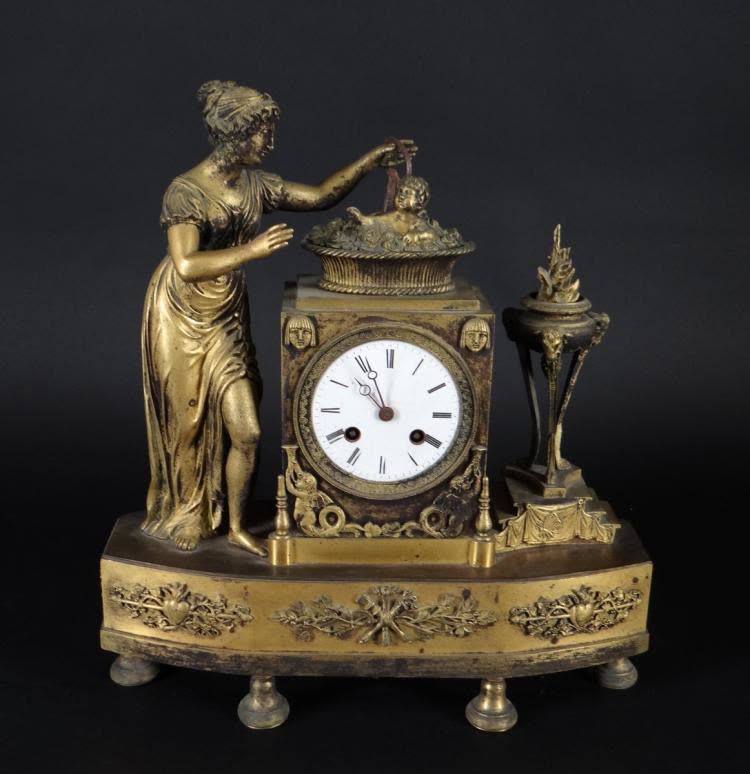
The mantel clock features a gilt bronze case catalogued under the thematic title "-Mère et enfant-". The sculptural arrangement depicts a classical female figure standing and gesturing toward an infant resting in a basket positioned atop the central clock case. Adjacent to the main case on the right sits a tripod brazier or incense burner detailed with a flame finial.
The case rests on an architectural plinth raised on turned feet. The front and sides of the base are ornamented with applied relief friezes displaying crossed torches, foliate garlands, and flaming hearts.
Evidence for this section
- “-Mère et enfant-”
- “Gilt bronze sculptural group depicting a standing classical female figure gesturing toward an infant resting in a basket atop the clock case.”
- “A tripod brazier or incense burner with flame motif is mounted to the right of the central clock case.”
- “Clock base supported on multiple turned feet and decorated with applied relief friezes of crossed torches, foliate garlands, and flaming hearts.”
Dial and Reported Movement
The dial is rendered in white enamel with Roman numerals, Breguet-style hands, and two winding arbors positioned in the lower dial face. The cataloguing records the total height of the assembly as 38 cm ("H: 38cm").
The listing reports an internal round Paris striking movement attributed to Japy ("mouvement rond de Paris JAPY à sonnerie"), accompanied by a pendulum and key ("avec balancier et clé"). As the movement is not visible in the catalogue photograph, its internal condition, maker markings, and the presence of the accessories remain source-reported claims.
Evidence for this section
- “White enamel dial displaying Roman numerals, Breguet-style hands, and two winding arbors.”
- “H: 38cm”
- “mouvement rond de Paris JAPY à sonnerie”
- “avec balancier et clé”
Dating and Source Terms
The auction catalogue lists the piece as "Horloge à poser NAPIII en bronze doré 1856". While this description assigns the clock to the Napoleon III era with a reported date of 1856, the entry does not specify whether the year is stamped on the movement or case, or if it represents a stylistic attribution.
The auction house conditions state that descriptions do not guarantee date, age, attribution, or condition ("ne garantit ni l'exactitude d'une déclaration relative à l'auteur, ni l'origine, la date, l'âge, l'attribution, la provenance, le poids, l'état ou la matière du lot"). Consequently, physical verification of movement signatures and mechanical completeness cannot be confirmed from the source documentation.
Evidence for this section
- “Horloge à poser NAPIII en bronze doré 1856”
- “ne garantit ni l'exactitude d'une déclaration relative à l'auteur, ni l'origine, la date, l'âge, l'attribution, la provenance, le poids, l'état ou la matière du lot”