
Skip to content
The Encyclopedia of Horology

Clock · Table clock

German Gilt Brass Table Clock

Partially verified

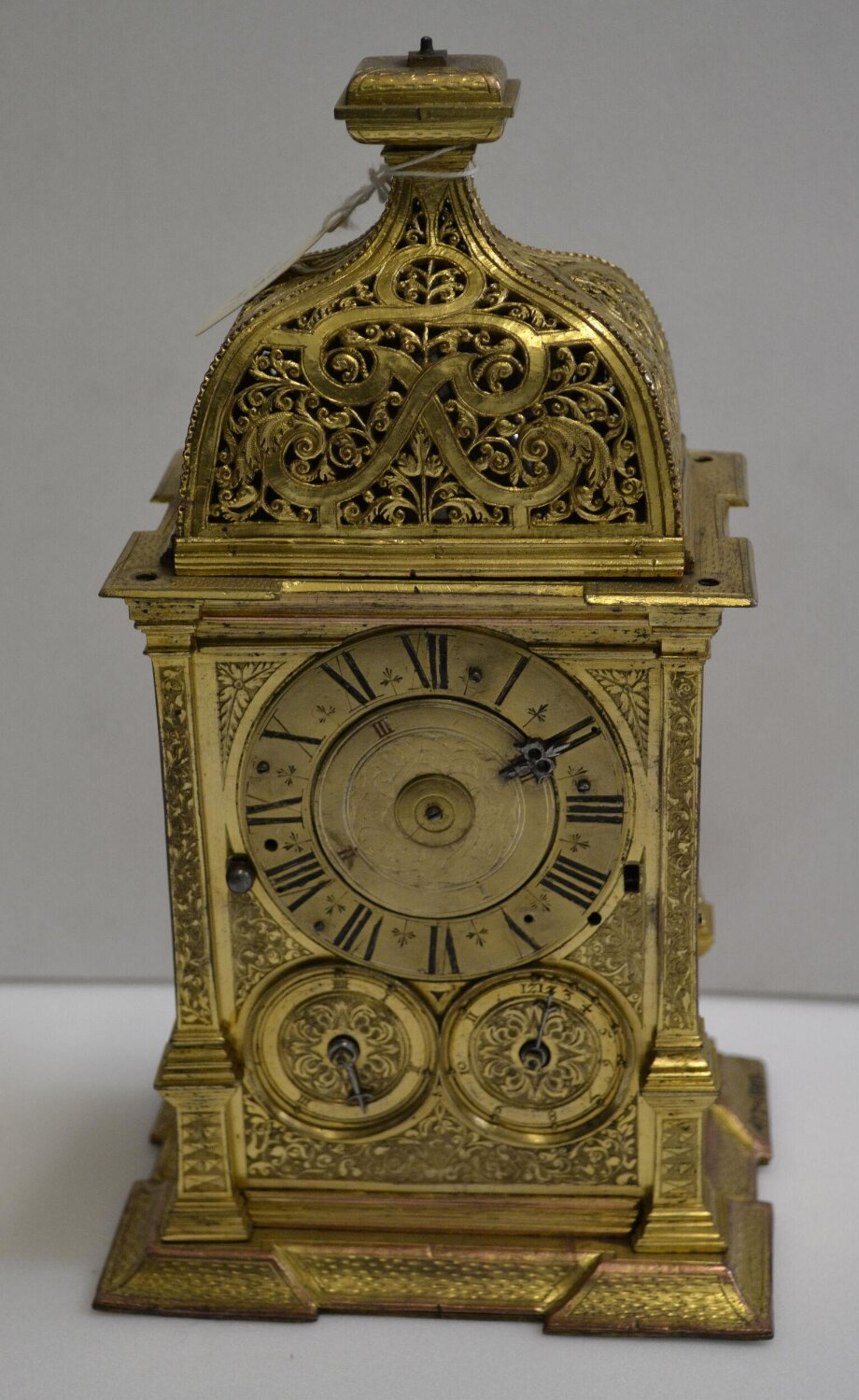
This rectangular table clock, dating to approximately 1584, is constructed from gilt brass and steel. Attributed to an unknown German maker, the object features a highly decorative case with engraved foliate corner motifs and a domed top characterized by intricate pierced strapwork and foliage designs. The side doors are adorned with emblematic figures, each clearly identified by the inscriptions 'FIDES' and 'CHARITAS'. The front face displays three distinct dials; the principal dial includes a rotating disc marked with quarters and a steel point indicator for timekeeping. The internal movement is fashioned from steel, though it has undergone later modifications to incorporate a pendulum mechanism. The base is pierced to accommodate chains and weights, while the reverse side has been restored with a brass sheet featuring diagonal line engravings. The clock stands at a height of 10 inches, with a width of 5 inches and a length of 5.5 inches.

The gilt brass clock showing the dial configuration, pierced domed top, and main time-telling disc.
The gilt brass clock showing the dial configuration, pierced domed top, and main time-telling disc. — V&A Museum. Rights pending — permission not yet requested. Original source

Catalogue identity

Source
collections.vam.ac.uk
Category
Clock · Table clock
Maker / attribution
Not established
Reference
Not recorded
Catalogue / lot identifier
477-1907
Source-reported date
c. 1584
Source-reported place
Germany

Source-reported attribution and specifications are not independent authentication. A listing does not establish present ownership, current display, availability or permission to reproduce.

Object description

Case and External Design

The object is a rectangular clock primarily constructed from gilt brass. Its aesthetic is defined by extensive engraving and piercing techniques applied to the exterior surfaces. The case corners are detailed with foliate motifs, while the top of the clock features a domed structure decorated with pierced strapwork and foliage patterns.

The side doors of the clock are specifically embellished with emblematic figures. These figures are explicitly identified by the inscribed labels 'FIDES' and 'CHARITAS'. The base of the clock is pierced with holes, designed to facilitate the function of internal chains and weights. The overall construction displays a high degree of metallic ornamentation consistent with the described technique of engraving.

Evidence for this section
  • “Rectangular clock case with engraved foliate corners, and a domed top pierced with strapwork and foliage.”
  • “The doors of the case are decorated with emblematic figures inscribed 'FIDES' and 'CHARITAS'.”
  • “The bottom is pierced with holes for chains and weights.”

Movement and Dial Configuration

The clock face is arranged with three dials, the primary of which is situated at the top. This principal dial encloses a rotating disc marked with quarters, equipped with a steel point to indicate the time. The internal works of the clock are crafted from steel.

The mechanical system has undergone physical modifications since the object's original production. Records indicate that the movement has been adapted specifically to operate with a pendulum, a feature that was not part of the original sixteenth-century configuration. The reverse of the clock movement has been replaced by a sheet of brass featuring diagonal lines.

Evidence for this section
  • “The front three dials, the princpial of which enclosing a disc marked with quarters and carrying a stell point to mark the time.”
  • “The works are steel, and have been adapted for a pendulum.”
  • “The reverse has been replaced by a sheet of brass engraved with diagonal lines.”

Identification and Provenance

The clock is catalogued under the accession number 477-1907. It is attributed to an unknown maker, with its origin identified as Germany.

The object has been subjected to historical repairs and alterations, such as the replacement of the reverse plate and the adjustment of the steel movement for pendulum timekeeping. These modifications are explicitly documented, highlighting that the internal mechanism represents a later adaptation rather than its state at the time of manufacture.

Evidence for this section
  • “Unknown”
  • “Germany”
  • “c. 1584”
  • “The works are steel, and have been adapted for a pendulum.”

Open research questions

  • What was the original escapement type prior to the pendulum adaptation?
  • Can the 'FIDES' and 'CHARITAS' emblematic figures be linked to a specific workshop or German region during the 1580s?

Source evidence

Recorded claims and source quotations for German Gilt Brass Table Clock
FieldSource-reported valueSource quotation
Accession Number477-1907“477-1907”
Datec. 1584“c. 1584”
OriginGermany“Germany”
Dial ConfigurationThree front dials“The front three dials, the princpial of which enclosing a disc marked with quarters and carrying a stell point to mark the time.”
Provenance/ModificationsReplaced reverse plate and pendulum adaptation“The reverse has been replaced by a sheet of brass engraved with diagonal lines.”
Side Door DecorationInscribed emblematic figures“The doors of the case are decorated with emblematic figures inscribed 'FIDES' and 'CHARITAS'.”

Visible details

  • Front face features three distinct circular dials
  • Domed top features pierced decorative strapwork and foliage
  • Steel movement shows evidence of adaptation to a pendulum

Research qualifications

  • The internal mechanism is an adaptation and not original to the 1584 construction
  • The rear brass plate is a replacement for the original component

Photograph identity and source facts were screened before import; rights clearance remains pending.

Consulted source

Clock, c. 1584

Reviewed 2026-11-02 · Record 2b41fff61c

Terms in this record

Glossary explanations for terms named in this object’s record.