
Skip to content
The Encyclopedia of Horology

Tool · Geared astrolabe

Geared Astrolabe by Muḥammad ibn Abī Bakr

Partially verified

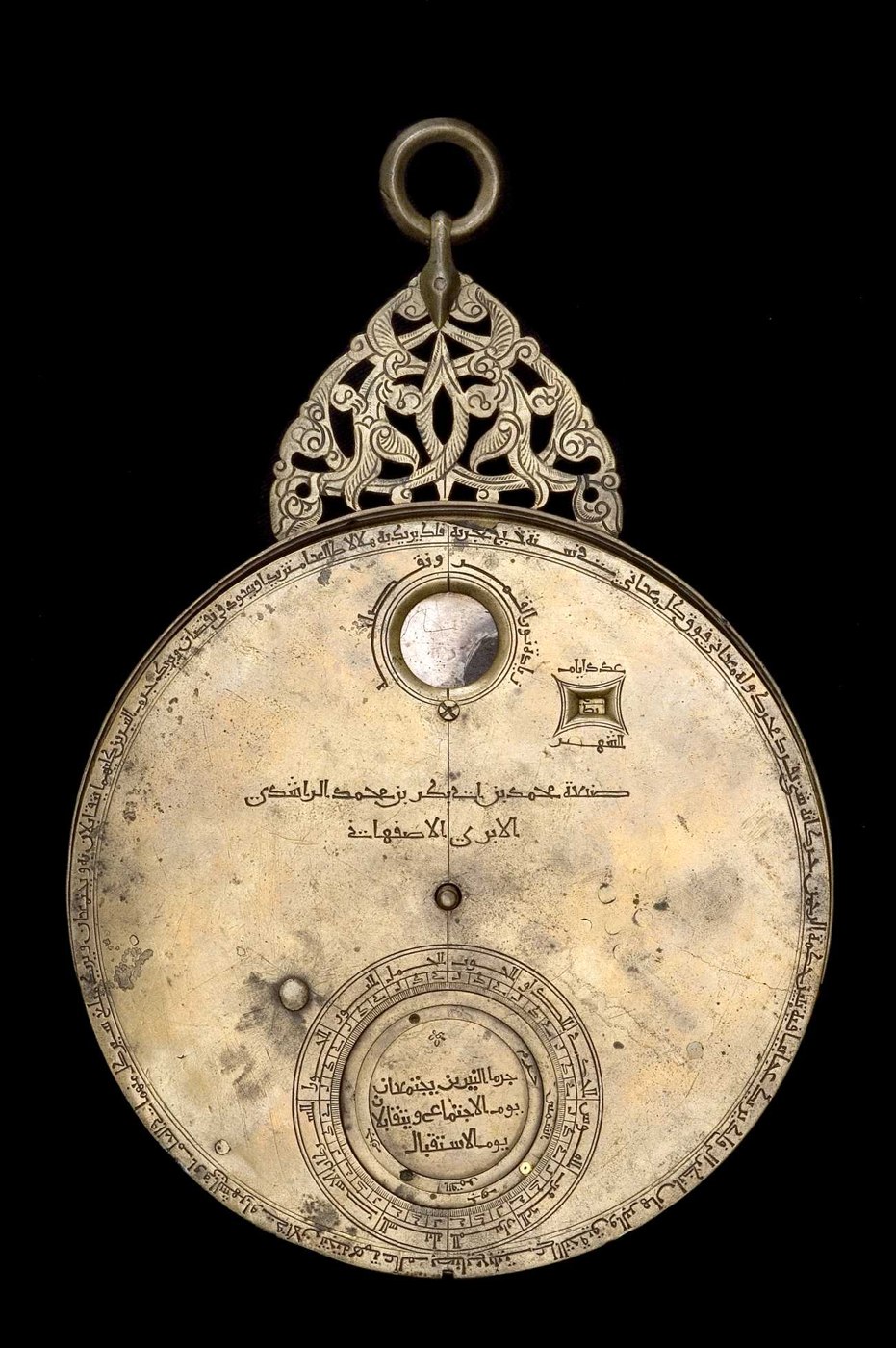
This brass geared astrolabe, produced in Iṣfahān in 1221/2 (A.H. 618), is attributed to the maker Muḥammad ibn Abī Bakr. It features an integrated gear train of five cogs housed between the back plate and the mater, intended to automate the display of celestial and calendrical data. As the rete on the front rotates, the axle drives these internal gears, which in turn move three distinct diagrams on the back: a circular window for lunar phases, a rectangular window indicating the age of the moon, and a lower moving diagram representing the solar and lunar positions within the zodiac. The instrument features a pierced Indo-Persian style throne and rete with three zoomorphic pointers, including a falcon and a horse. The device includes two plates with latitudes between 30° and 40°. Its provenance includes acquisition by the History of Science Museum in 1924, following purchase by Lewis Evans from Paris dealer Raoul Heilbronner in 1913.

The back of the geared astrolabe showing the calendrical windows, the central maker's inscription, and the circular moon phase diagram.
The back of the geared astrolabe showing the calendrical windows, the central maker's inscription, and the circular moon phase diagram. — History of Science Museum, University of Oxford. Rights pending — permission not yet requested. Original source

Catalogue identity

Source
www.mhs.ox.ac.uk
Category
Tool · Geared astrolabe
Maker / attribution
Muḥammad ibn Abī Bakr
Reference
Not recorded
Catalogue / lot identifier
48213
Source-reported date
1221/2 (A.H. 618)
Source-reported place
Iṣfahān

Source-reported attribution and specifications are not independent authentication. A listing does not establish present ownership, current display, availability or permission to reproduce.

Object description

Construction and Mechanism

The instrument is fabricated from brass and features a one-piece mater and limb construction. The core functionality relies on a mechanical gear train consisting of five cogs located between the back plate and the interior of the mater. This train is driven by an axle connected to the rotating rete on the front.

This mechanical arrangement synchronizes the front rete rotation with three specialized calendrical diagrams on the back. The back plate displays lunar phases in an upper circular window, the moon's age in a rectangular window, and the relative positions of the sun and moon within the zodiac in a lower moving volvelle window. The designer employed a simplified gear configuration that required only one cog to feature an odd number of teeth.

Evidence for this section
  • “Inside the instrument, between the back plate and the plate that forms the womb of the mater, is a gear train consisting of five cogs.”
  • “The entire mechanism was turned by an axle attached to the rete on the front.”

Rete and Throne

It is populated by three distinct zoomorphic star pointers: a bird identified as a falcon representing Vega, a diving bird pointing to al-Tayir, and a horse pointing to Mankib. The ecliptic is decorated with a quatrefoil at its center.

The throne is of a pierced Indo-Persian style, featuring an integrated base and a simple, square-section ring. It is attached to an omega-shaped shackle, a configuration that serves as the instrument's primary suspension point. The rete is secured by a pin and wedge, which also functions as the drive axle for the internal gear mechanism, though this component is considered a later replacement.

Evidence for this section
  • “The rete is of the indicator-line (quatrefoil) type.”
  • “The throne is of the indo-persian, pierced type made of brass attached with integrated base”

Signatures and Inscriptions

The instrument is marked with extensive Arabic script, which provides both technical instructions and the maker's identification. The signature of Muḥammad ibn Abī Bakr ibn Muḥammad al-Rāshidī al-Ibarī al-Iṣfahānī is inscribed across the center of the back.

The back also contains a philosophical passage inscribed around the entire rim, explaining the movement of celestial bodies and attributing the instrument's design to verification and demonstrative proof. Additional scale labels around the lunar and age-of-moon windows provide user guidance for interpreting the calendrical functions. An early owner, Ḥasan Shāh, added a rough inscription to one of the calendar wheels, providing evidence of the object's history before its entry into the Evans collection.

Evidence for this section
  • “On the volvelle within the lower window. with a maker's signature marked as صنعة محمد بن أبي بكر بن محمد الراشدي اﻹبري اﻹصفهاني”
  • “The back is inscribed: with a general explanation marked as فلك يريد به هلالاً طلعاً متزيداً ويعود في نقصان”
  • “An early owner's name, Ḥasan Shāh, is roughly engraved on one of the calendar wheels.”

Open research questions

  • What is the specific nature of the 618 A.H. date inscription, given the reported question mark regarding the year notation?
  • Are there any physical traces or comparative archaeological evidence that suggest the original design or material of the replacement rete pin and wedge?

Source evidence

Recorded claims and source quotations for Geared Astrolabe by Muḥammad ibn Abī Bakr
FieldSource-reported valueSource quotation
Inventory number48213“Inventory no. 48213”
MakerMuḥammad ibn Abī Bakr“Made by Muḥammad ibn Abī Bakr ibn Muḥammad al-Rāshidī al-Ibarī al-Iṣfahānī.”
Date1221/2 (A.H. 618)“Date 1221/2 (A.H. 618)”
Place of manufactureIṣfahān“Place Iṣfahān”
MaterialBrass“Material Brass”
ProvenanceLewis Evans (1924), previously Raoul Heilbronner (1913)“Evans bought it from Raoul Heilbronner, a dealer and collector of Paris, in 1913.”
Mechanism typeGeared gear train“Inside the instrument, between the back plate and the plate that forms the womb of the mater, is a gear train consisting of five cogs.”

Visible details

  • Pierced Indo-Persian style throne
  • Three zoomorphic pointers on the rete including a falcon and a horse
  • Detailed Arabic inscriptions surrounding the back perimeter and central windows
  • Internal gear train visible when back plate is opened

Research qualifications

  • The rete pin and wedge are believed to be replacements.
  • The exact 618 A.H. date is occasionally qualified with a question mark in catalogue transcriptions.

Photograph identity and source facts were screened before import; rights clearance remains pending.

Consulted source

Astrolabe, inventory 48213 (Iṣfahān, 1221/2 (A.H. 618))

Reviewed 2026-10-26 · Record e5e28ced15

Terms in this record

Glossary explanations for terms named in this object’s record.