
Skip to content
The Encyclopedia of Horology

Clock · Carriage clock

French Miniature Oval Carriage Clock

Partially verified

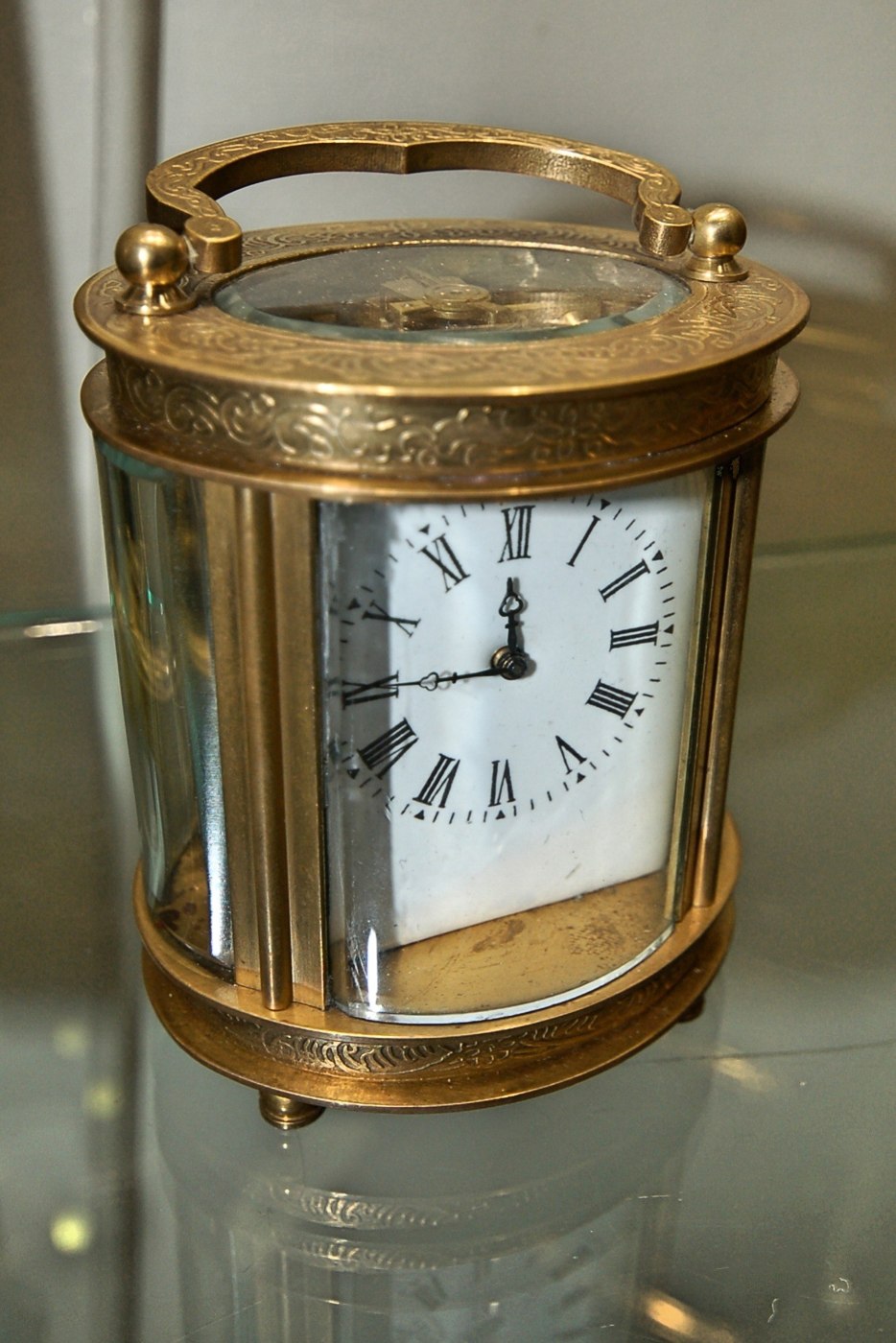
This French miniature carriage clock is dated to circa 1900. It features a brass oval case with engraved ornamental floral and scroll motifs on the base, top, and handle. The clock incorporates beveled glass panels, allowing visibility of the internal mechanism. The white porcelain dial displays black Roman numerals and minute markers, indicated by slender black hands. Mechanically, the timepiece is spring-driven and features a platform escapement with a fast/slow speed regulation lever, visible through the top glass. The rear of the case includes a framed glass panel for access to the winding and setting arbors. The object is presented as a timepiece only, with no integrated alarm or strike functions mentioned. The auction description notes the clock's miniature proportions and construction characteristics, while emphasizing that maintenance history and the presence of a winding key are not specified.

The miniature French oval carriage clock, showing its brass case, porcelain dial, and visible platform escapement.
The miniature French oval carriage clock, showing its brass case, porcelain dial, and visible platform escapement. — Pendulum of Mayfair. Rights pending — permission not yet requested. Original source

Catalogue identity

Source
zamanito.com
Category
Clock · Carriage clock
Maker / attribution
Not established
Reference
Not recorded
Catalogue / lot identifier
Source URL identifies the listing
Source-reported date
circa 1900
Source-reported place
France

Source-reported attribution and specifications are not independent authentication. A listing does not establish present ownership, current display, availability or permission to reproduce.

Object description

Case and Dial

The clock is housed in an oval brass case, a construction that defines its miniature profile. The base and top surfaces, as well as the integrated carrying handle, are detailed with engraved floral and scroll ornamentation. The design incorporates multiple beveled glass panels, which provide viewing angles into the movement and the interior.

The dial is composed of white porcelain, featuring black-painted Roman numerals and detailed minute indexing around the perimeter. Time is indicated by a pair of slender black hands. The overall composition aims for a compact, traditional aesthetic, with the porcelain dial set behind the primary viewing glass.

Evidence for this section
  • “بدنه این ساعت از جنس برنج بوده و ساختاری بیضی‌شکل (Oval case) دارد که بر روی سطوح فوقانی، پایه و دسته بالایی آن نقوش قلم‌زنی و حکاکی‌های ظریف اسلیمی و گیاهی اجرا شده است”
  • “صفحه ساعت از جنس پرسلین سفید با کیفیت بالا طراحی شده و ارقام ساعت به سبک رومی (Roman Numerals) با رنگ مشکی و نشانگرهای دقیق دقایق به دور آن نقش بسته‌اند”

Movement and Mechanics

Technically, the clock operates as a simple timepiece driven by a spring-wound movement. It lacks secondary functions such as striking or alarm mechanisms. The regulation of the timekeeping is facilitated by a platform escapement located in the upper section of the movement, which is visible through the oval glass panel set into the top of the case.

The mechanism includes an integrated fast/slow speed lever for rate adjustment. Access to the winding and time-setting arbors is provided through a hinged or removable framed glass panel located on the rear of the clock case.

Evidence for this section
  • “این ساعت با نیروی کوک فنری (Spring driven) کار می‌کند و تنها کارکرد نمایش زمان (Timepiece) را ارائه می‌دهد”
  • “در بخش بالایی موتور، یک مهار سکویی (Platform escapement) مجهز به اهرم تنظیم سرعت کند/تند (Fast/slow speed lever) تعبیه شده که از طریق شیشه بیضی‌شکل سقف ساعت به وضوح قابل مشاهده است”

Condition and Attribution

The object is attributed to French origin and is dated to approximately 1900. No specific manufacturer or workshop attribution is provided in the documentation. The auction description notes the lack of information regarding the clock's recent maintenance, current operational status, or the inclusion of an original winding key.

The auction description reports that these elements should be evaluated to confirm physical and functional health.

Evidence for this section
  • “در متن منبع اشاره‌ای به سرویس اخیر، وضعیت دقیق کارکرد فعلی، وجود کلید کوک اصلی یا نام دقیق کارگاه سازنده نشده است”
  • “به مجموعه‌داران گرامی توصیه می‌شود پیش از خرید، سلامت کامل پلتفرم مهار، فنر اصلی کوک، عدم وجود ترک‌خوردگی‌های مویی در صفحه پرسلین و سلامت فیزیکی شیشه‌های خمیده بیضی را به دقت مورد ارزیابی قرار دهند”

Open research questions

  • Is there any maker's mark or serial number hidden on the movement plate?
  • Does the movement contain any specific caliber identifiers for 1900s French carriage clocks?

Source evidence

Recorded claims and source quotations for French Miniature Oval Carriage Clock
FieldSource-reported valueSource quotation
Datecirca 1900“قدمت آن به حدود سال ۱۹۰۰ میلادی بازمی‌گردد”
Case shapeOval“ساختاری بیضی‌شکل (Oval case) دارد”
MaterialBrass“بدنه این ساعت از جنس برنج بوده”
Dial materialPorcelain“صفحه ساعت از جنس پرسلین سفید با کیفیت بالا طراحی شده”
Movement typeSpring driven“این ساعت با نیروی کوک فنری (Spring driven) کار می‌کند”
EscapementPlatform“یک مهار سکویی (Platform escapement) مجهز به اهرم تنظیم سرعت کند/تند (Fast/slow speed lever) تعبیه شده”
CountryFrance“ساخت فرانسه”

Visible details

  • Engraved scrollwork on the brass case and handle
  • Platform escapement visible through top glass panel
  • White porcelain dial with Roman numerals
  • Beveled glass side panels

Research qualifications

  • Absence of identified maker's marks
  • Status of original winding key and service history not verified

Photograph identity and source facts were screened before import; rights clearance remains pending.

Consulted source

Antique French Oval Carriage Clock C1900

Reviewed 2026-11-02 · Record 8efcba78ee

Terms in this record

Glossary explanations for terms named in this object’s record.