
Skip to content
The Encyclopedia of Horology

Clock · Mantel clock

French Empire mantel clock with figure of Mars

Partially verified

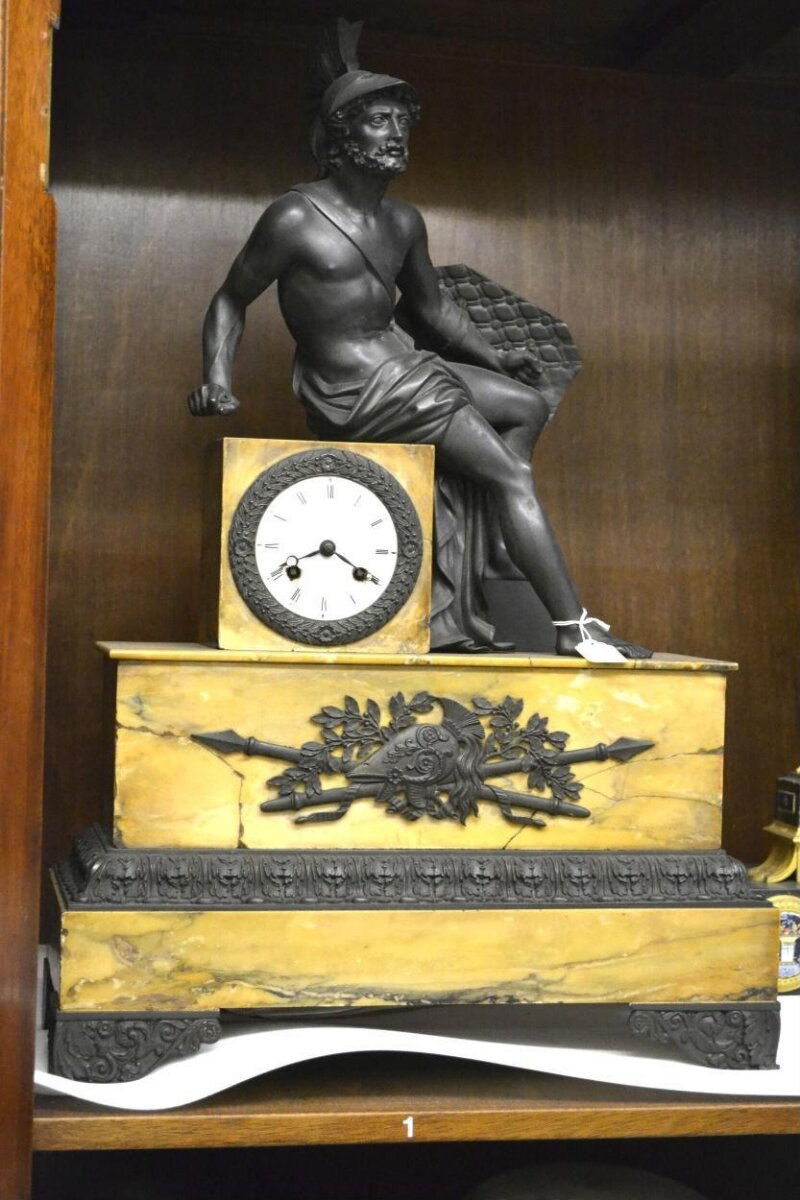
This mantel clock, dating to 1800-1825, was produced in France. The timekeeping mechanism is housed within a block of yellow Siena marble, which serves as a seat for a cast and chased patinated bronze figure of Mars, the God of War. The figure wears an antique helmet and holds an octagonal shield displaying a lion-mask inside a laurel wreath; the sword originally held in the right hand is currently missing. The white enamel dial features Roman numerals and is surrounded by a patinated bronze laurel wreath. The main body rests on an oblong yellow Siena marble pedestal decorated with a patinated bronze trophy of arms, including crossed spears, a helmet, and laurel sprays. The entire structure is supported on a plinth raised by four feet, with the front pair finished in acanthus foliage. It was donated to the Victoria and Albert Museum by Sir Edwin Durning-Lawrence in 1901.

French Empire mantel clock featuring a bronze figure of Mars on a yellow marble base.
French Empire mantel clock featuring a bronze figure of Mars on a yellow marble base. — Victoria and Albert Museum, London. Rights pending — permission not yet requested. Original source

Catalogue identity

Source
collections.vam.ac.uk
Category
Clock · Mantel clock
Maker / attribution
Not established
Reference
Not recorded
Catalogue / lot identifier
661-1901
Source-reported date
1800-1825
Source-reported place
France

Source-reported attribution and specifications are not independent authentication. A listing does not establish present ownership, current display, availability or permission to reproduce.

Object description

Clock Construction and Materials

The clock is constructed primarily from yellow Siena marble, which forms both the housing for the dial and the oblong pedestal base. The sculptural elements, including the figure of Mars and the applied decorative trophies, are made of patinated bronze. These bronze components have been finished through casting and chasing techniques to render fine details such as the lion-mask on the shield, the laurel wreaths, and the acanthus foliage on the front feet.

The dial of the clock is made of white enamel and displays Roman numerals. It is mounted directly into the marble clock block and is framed by a laurel wreath cast in patinated bronze. The figure of Mars sits on top of this block, and a trophy of arms, consisting of crossed spears, a helmet, and laurel, is applied to the front of the pedestal base.

Evidence for this section
  • “The clock forms a seat for the bronze figure”
  • “The white enamel dial has Roman numerals encircled by a laurel wreath in patinated bronze.”
  • “The lower plinth rests on four feet, the front pair enriched with acanthus foliage is similarly patinated bronze.”

Subject and Iconography

The timepiece is surmounted by a bronze figure identified as Mars, the God of War. The figure is depicted in a seated posture, wearing an antique-style helmet. In his left arm, he holds an octagonal shield decorated with a lion-mask within a laurel wreath. While the figure was originally designed to hold a sword in his right hand, this element is currently absent.

The military theme continues on the pedestal base, which is mounted with a relief depicting a trophy of arms. This trophy includes crossed spears, a helmet, and sprays of laurel, visually connecting the base to the martial subject represented by the figure of Mars above.

Evidence for this section
  • “the bronze figure representing Mars wearing an antique helmet and holding in his left arm an octagonal shield”
  • “the sword formerly in his right hand is missing.”
  • “bearing a trophy of arms in front consisting of crossed spears and a helmet with sprays of laurel.”

Provenance and History

The clock was donated to the Victoria and Albert Museum in 1901 by Sir Edwin Durning-Lawrence (1837–1914), a British lawyer and Member of Parliament for Truro.

According to historical records, the clock was intended for display on a mantelpiece.

Evidence for this section
  • “Given by Sir E. Durning Lawrence 1st Baronet”
  • “had donated thirteen paintings to the Victoria and Albert Museum in 1901”
  • “The clock was intended for display on a mantelpiece”

Open research questions

  • Who was the clockmaker or the foundry responsible for the bronze casting?
  • Are there known matching examples of this specific Mars mantel clock model in other collections?

Source evidence

Recorded claims and source quotations for French Empire mantel clock with figure of Mars
FieldSource-reported valueSource quotation
Accession number661-1901“661-1901”
Date1800-1825“1800-1825”
OriginFrance“France”
DonorSir Edwin Durning-Lawrence“Given by Sir Edwin Durning Lawrence Bart”

Visible details

  • The bronze sword originally held by the figure of Mars is missing.
  • The clock dial is signed with Roman numerals.
  • The base is supported by four feet, with the front two decorated in acanthus foliage.

Research qualifications

  • The source does not identify a specific maker or manufacturer for the clock.
  • The exact date of production is a range, and the source does not confirm a precise year of manufacture.

Photograph identity and source facts were screened before import; rights clearance remains pending.

Consulted source

Clock, France, 1800-1825

Reviewed 2026-11-02 · Record 9cc105fa4c

Terms in this record

Glossary explanations for terms named in this object’s record.