
Skip to content
The Encyclopedia of Horology

Clock · Mantel clock

French Directoire period pendulum clock 'au char'

Partially verified

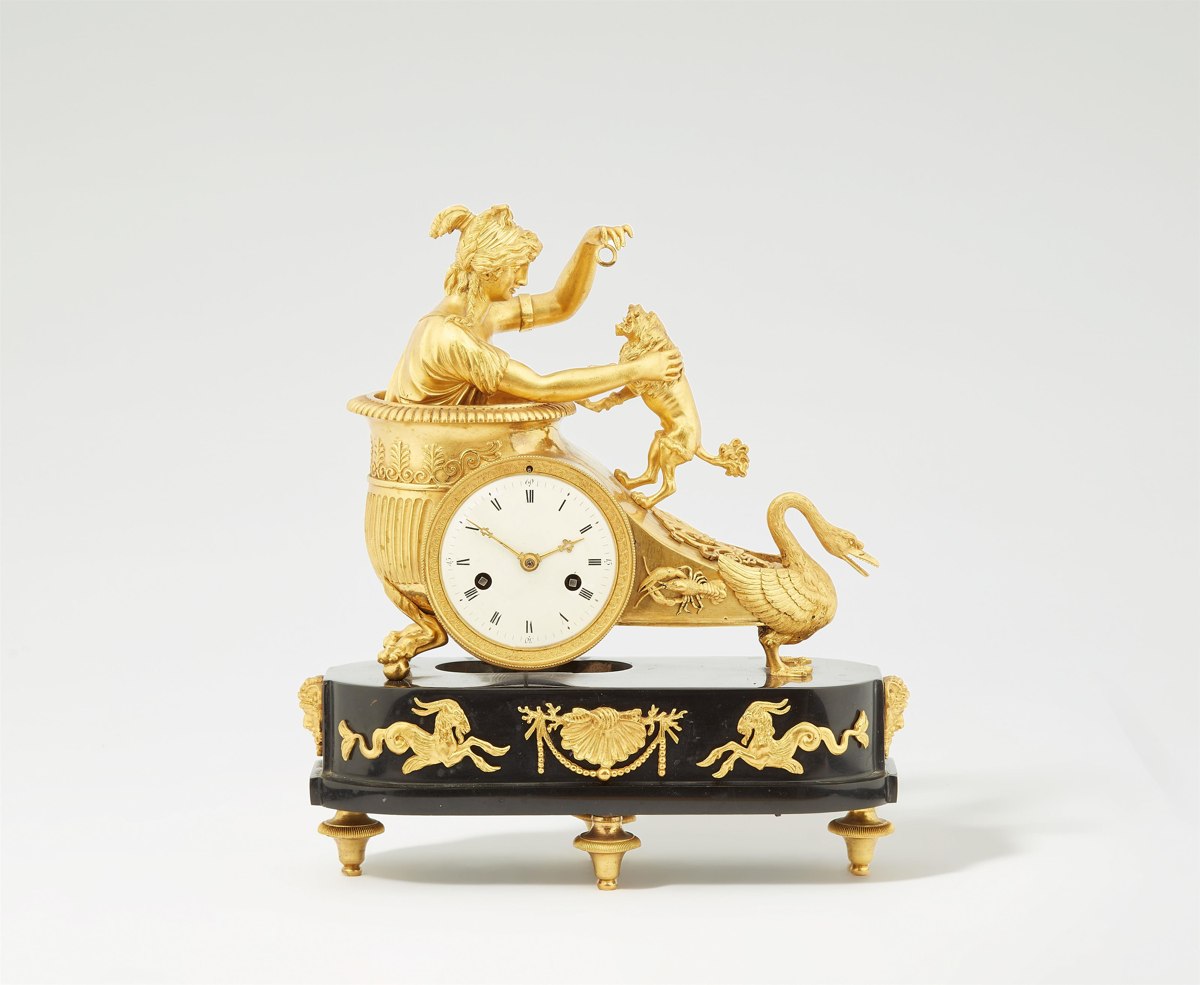
This late 18th-century French Directoire period pendulum clock 'au char' originated in Paris, featuring bronze sculptural work attributed to Jean-André Reiche. Fashioned from fire-gilt and patinated bronze, brass, wrought iron, and an enameled dial, the clock depicts a chariot composition carrying a classical figure and dog with a swan prow, seated above a dark patinated base decorated with gilt mounts. The auction house reports a presumably replaced 14-day movement configured with spring suspension and hourly strike on a bell, measuring 31 cm high, 29 cm wide, and 11.5 cm deep.

Front view of the French Directoire period chariot mantel clock
Front view of the French Directoire period chariot mantel clock — Lempertz. Rights pending — permission not yet requested. Original source

Catalogue identity

Source
www.lempertz.com
Category
Clock · Mantel clock
Maker / attribution
Jean-André Reiche (bronze attributed to)
Reference
Not recorded
Catalogue / lot identifier
617
Source-reported date
late 18th C.
Country
France

Source-reported attribution and specifications are not independent authentication. A listing does not establish present ownership, current display, availability or permission to reproduce.

Object description

Object Identity and Attribution

This Directoire period mantle clock features a sculptural chariot composition, a genre associated with French horology of the late 18th century. The bronze sculptural elements are attributed to Jean-André Reiche.

The sculpture is executed in fire-gilt and patinated bronze, depicting a chariot with a swan-form prow, carrying a classical figure accompanied by a dog.

Evidence for this section
  • “A French Directoire period pendulum clock 'au char'”
  • “the bronze attributed to Jean-André Reiche.”
  • “Fire-gilt and patinated bronze”

Dial and Mechanism

The clock features a white enamel dial, which is stated to be restored. The dial displays Roman numeral hour markers and is operated by gilt hands.

The internal mechanism is reported as a 14-day movement with spring suspension and an hourly strike on a bell. The source notes the movement is presumably replaced.

Evidence for this section
  • “white enamel dial”
  • “The enamel restored.”
  • “Presumably replaced 14-day movement with spring suspension and hourly chime on a bell.”

Structural Composition

The clock is supported by a dark patinated bronze base. Decorative elements include gilt-bronze mounts featuring sea creatures and a central shell applique, resting on turned gilt feet.

The recorded dimensions for the object are 31 cm in height, 29 cm in width, and 11.5 cm in depth.

Evidence for this section
  • “Dark patinated plinth adorned with gilt-bronze sea creature mounts and a central shell applique, resting on turned gilt feet.”
  • “H 31, W 29, D 11.5 cm.”

Open research questions

  • What specific physical indicators led to the assessment that the movement is 'presumably replaced'?
  • Does the patinated plinth show evidence of physical alteration or structural adaptation to accommodate the present movement?
  • What specific type of restoration was performed on the enamel dial?

Source evidence

Recorded claims and source quotations for French Directoire period pendulum clock 'au char'
FieldSource-reported valueSource quotation
MaterialsFire-gilt and patinated bronze, white enamel dial, brass, wrought iron“Fire-gilt and patinated bronze, white enamel dial, brass, wrought iron.”
Movement descriptionPresumably replaced 14-day movement with spring suspension and hourly chime on a bell“Presumably replaced 14-day movement with spring suspension and hourly chime on a bell.”
Condition noteThe enamel restored“The enamel restored.”
DimensionsH 31, W 29, D 11.5 cm“H 31, W 29, D 11.5 cm.”
Origin and datingParis, late 18th C.“Paris, late 18th C.”
AttributionBronze attributed to Jean-André Reiche“the bronze attributed to Jean-André Reiche.”
Attributed LiteratureNiehüser, Die französische Bronzeuhr, p. 180, fig. 293“Cf. Niehüser, Die französische Bronzeuhr. Eine Typologie der figürlichen Darstellungen, Munich 1997, p. 180, fig. 293.”

Visible details

  • Fire-gilt chariot sculpture featuring a figure holding a ring for an upright dog, with a forward swan figurehead.
  • Circular white enamel dial positioned within the chariot wheel, showing Roman numeral hours, two winding apertures, and gilt hands.
  • Dark patinated plinth adorned with gilt-bronze sea creature mounts and a central shell applique, resting on turned gilt feet.

Research qualifications

  • The source notes that the movement is presumably replaced and the dial enamel is restored.
  • Internal movement components and rear mechanism are not visible in the provided image.

Photograph identity and source facts were screened before import; rights clearance remains pending.

Consulted source

A French Directoire period pendulum clock 'au char' - Lot 617

Reviewed 2026-10-25 · Record a44800eb9e

Terms in this record

Glossary explanations for terms named in this object’s record.