
Skip to content
The Encyclopedia of Horology

Clock · Wall clock

Ferranti wall clock

Partially verified

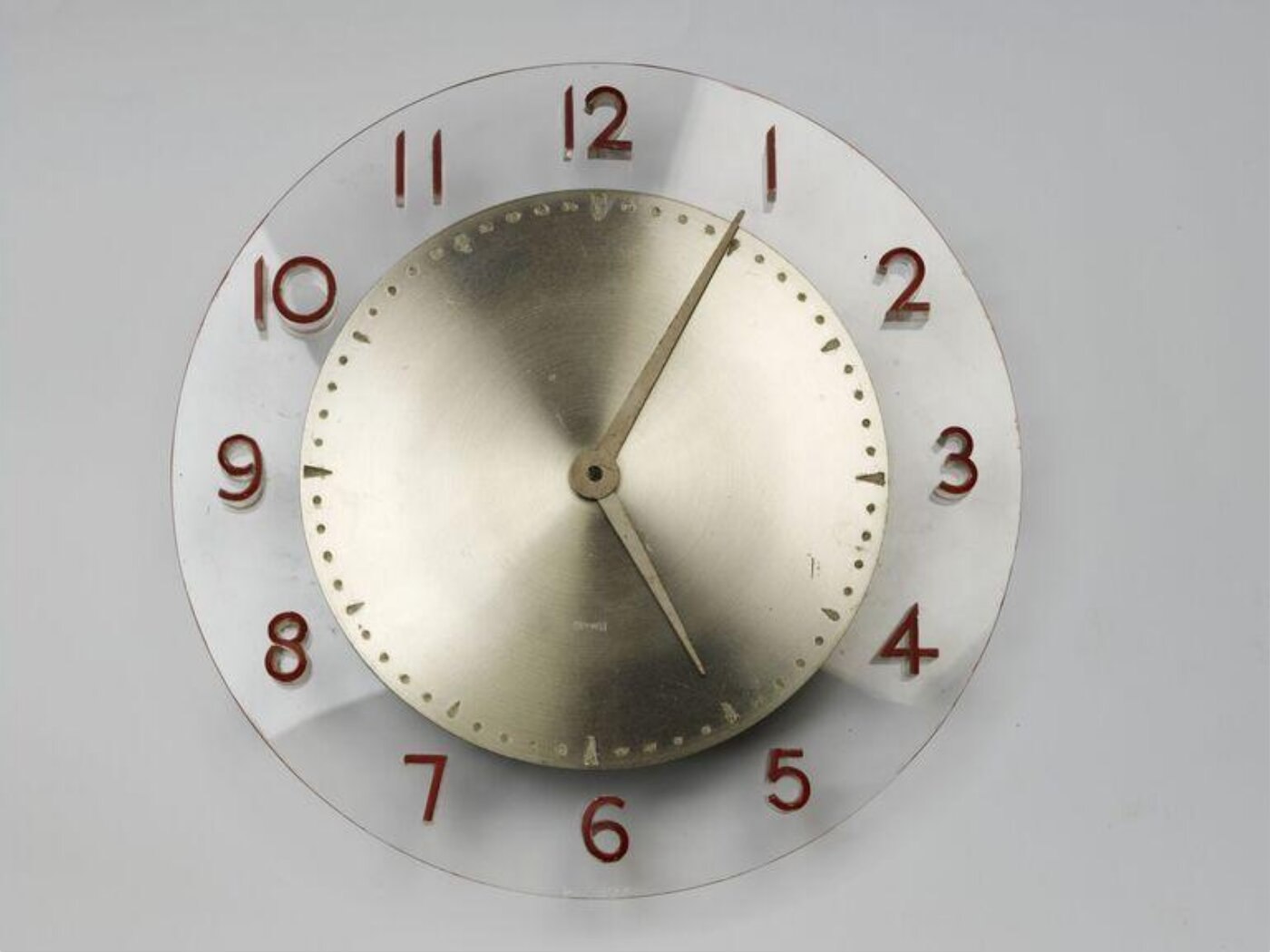
Designed by Christopher Nicholson and manufactured by Ferranti Ltd in 1946, this wall clock is composed of a circular acrylic outer ring featuring three-dimensional, red-edged acrylic numerals. The clock incorporates a standard Ferranti electric movement. Although the clock presents a machine-made aesthetic consistent with mid-century industrial design, the construction reveals hand-finished elements that suggest the item was a prototype. It was specifically commissioned for a television research engineer’s office display at the 1946 'Britain Can Make It' exhibition held at the Victoria and Albert Museum.

Wall clock designed by Christopher Nicholson, 1946, showing the acrylic numerals and metal dial.
Wall clock designed by Christopher Nicholson, 1946, showing the acrylic numerals and metal dial. — © Victoria and Albert Museum, London. Rights pending — permission not yet requested. Original source

Catalogue identity

Source
collections.vam.ac.uk
Category
Clock · Wall clock
Maker / attribution
Christopher Nicholson (designer); Ferranti Ltd (manufacturer)
Reference
Not recorded
Catalogue / lot identifier
W.4-1998
Source-reported date
1946
Source-reported place
Great Britain

Source-reported attribution and specifications are not independent authentication. A listing does not establish present ownership, current display, availability or permission to reproduce.

Object description

Construction and Design

The clock features a circular frame constructed from an acrylic, or perspex, ring measuring between 2 and 3 mm in thickness. Applied to this ring are three-dimensional numerals, which have been individually edged in red paint. The outer rim retains traces of this red finish, although it exhibits significant wear. The central section of the face is composed of a metal disc, which is secured to the acrylic structure through four pierce holes.

Despite an overall aesthetic that appears machine-manufactured, the clock displays a level of handwork consistent with the production of a prototype. The minute and hour markers situated on the metal dial have been applied via hand-stamping. The clock is powered by a standard electric movement labelled by Ferranti, which was designed for use with mains wiring.

The physical state of the dial indicates a repair or modification attempt. The inner metal face has been rotated 180 degrees, resulting in the manufacturer’s logo appearing upside down.

Evidence for this section
  • “The clock is round with an outer ring of acrylic (perspex)”
  • “The inner dial is metal (possibly aluminium) onto which the minute and hour markers appear to have been hand-stamped.”
  • “The Ferranti logo is at the bottom of the face, but is upside down as the face has been rotated 180 degrees.”
  • “the elements and construction of the wall clock show a considerable degree of handwork as though the object were a prototype.”

Exhibition History

This object was commissioned by Christopher Nicholson for the 1946 exhibition titled 'Britain Can Make It,' held at the Victoria and Albert Museum. The clock was intended to function as a prop within a stand designed to represent a television research engineer’s office.

This moniker was adopted because many of the items presented, including this wall clock, were strictly prototype models not available for commercial purchase. Consequently, the clock never reached the stage of mass production, remaining a unique or limited instance of the designer's work for Ferranti.

Evidence for this section
  • “This clock was designed by Nicholson for a stand representing a television research engineer’s office shown at the 1946 V&A exhibition ‘Britain Can Make It’.”
  • “a large number of exhibits were at the prototype stage and unavailable to the buying public.”
  • “This clock was made by Ferranti, for whom Nicholson designed radios (see W.3-1998), but was never put into production.”

Provenance and Ownership

Following the conclusion of the 1946 exhibition, the clock was moved to the personal office of Christopher Nicholson located at 110 Old Brompton Road. It remained in this location until the designer's death in 1948. After this event, ownership of the clock passed to the designer's family.

The Victoria and Albert Museum acquired the clock in 1998. The acquisition was facilitated through the designer's son, Tim Nicholson, as part of a group that included a radiogram, catalogued under the reference W.3-1998. The item serves as a record of the collaborative industrial design work between Nicholson and the manufacturer Ferranti Ltd.

Evidence for this section
  • “The wall clock remained in Nicholson’s office after the exhibition until his death in 1948.”
  • “The V&A acquired the clock in 1998 from Tim Nicholson, the designer's son, together with a radiogram, W.3-1998.”

Open research questions

  • What is the specific type of metal used for the inner dial, and why was it chosen for this prototype?
  • Are there any surviving technical drawings or design specifications for this clock in the RIBA collection or other archives?

Source evidence

Recorded claims and source quotations for Ferranti wall clock
FieldSource-reported valueSource quotation
MakerChristopher Nicholson (designer); Ferranti Ltd (manufacturer)“Nicholson, Christopher (designer); Ferranti Ltd (manufacturer)”
Accession NumberW.4-1998“W.4-1998”
MaterialsAcrylic, lacquered metal, painted“Acrylic, lacquered metal, painted”
Diameter33.5 cm“Diameter: 33.5 cm”
Exhibition originBritain Can Make It exhibition, 1946“designed by Nicholson for a stand representing a television research engineer’s office shown at the 1946 V&A exhibition ‘Britain Can Make It’.”
Movement typeElectric“The clock is fitted with a standard electric clock, labelled Ferranti”

Visible details

  • The central metal dial is rotated 180 degrees, causing the printed Ferranti logo to appear upside down.
  • The outer acrylic ring displays damage below the number 12, which necessitated the rotation of the inner dial.
  • The numerals are three-dimensional acrylic pieces with edges finished in red paint.
  • Minute and hour markers on the metal dial appear to be hand-stamped.

Research qualifications

  • The exact metal composition of the inner dial is not confirmed beyond a possible identification as aluminium.
  • The specific technical reasons for the reported damage to the top of the acrylic ring are based on observation rather than confirmed repair history.

Photograph identity and source facts were screened before import; rights clearance remains pending.

Consulted source

Wall clock

Reviewed 2026-10-26 · Record fa72f48baa

Terms in this record

Glossary explanations for terms named in this object’s record.