
Skip to content
The Encyclopedia of Horology

Tool · Pantochronometer sundial compass

English Georgian Pocket Pantochronometer Sundial Compass

Partially verified

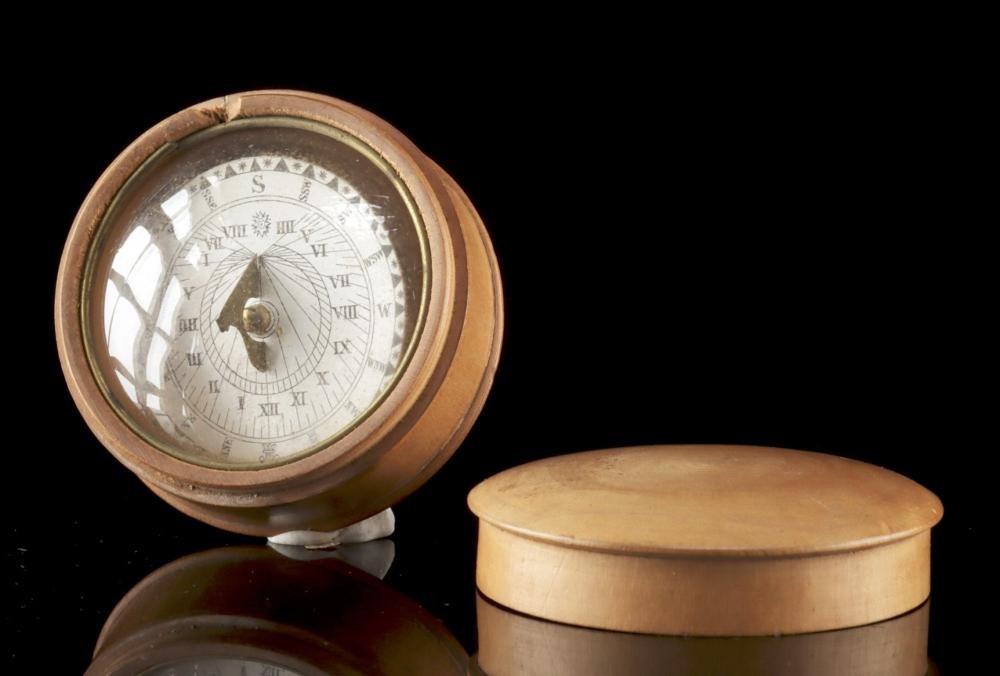
According to the auction catalog, this English pocket pantochronometer dates to the Georgian to early Victorian era (circa late 18th to early 19th century CE). Functioning as a portable floating-card sundial compass, the instrument is set within a turned wood circular case fitted with a domed glass cover. Underneath the glass, a printed paper dial features compass directions and Roman numeral hour markings, centered by an upright brass gnomon aligned to cast a shadow for solar time calculation. A separate turned wooden push-on lid accompanies the piece for travel.

Turned wood pocket pantochronometer with domed glass and paper dial, shown beside its fitted wooden lid
Turned wood pocket pantochronometer with domed glass and paper dial, shown beside its fitted wooden lid — Artemis Fine Arts. Rights pending — permission not yet requested. Original source

Catalogue identity

Source
www.invaluable.com
Category
Tool · Pantochronometer sundial compass
Maker / attribution
Not established
Reference
199327
Catalogue / lot identifier
374
Source-reported date
ca. late 18th to early 19th century CE
Country
United Kingdom

Source-reported attribution and specifications are not independent authentication. A listing does not establish present ownership, current display, availability or permission to reproduce.

Object description

Object Identity and Construction

This object is identified as a portable, pocket-sized instrument known as a pantochronometer, or floating-card sundial compass. The piece consists of a turned wood, bowl-shaped case designed to house the dial mechanism, protected by a domed glass cover. A separate turned wooden lid, which fits over the top of the bowl, is included for travel protection.

The primary structural materials recorded are brass, wood, glass, and paper. The overall size is reported as approximately 2 inches (5.1 cm) in diameter and 1 inch (2.5 cm) in height.

Evidence for this section
  • “A turned wood pocket pantochronometer, also known as a floating-card sundial compass.”
  • “The circular case contains a paper dial printed with Roman numerals for hours and directional indicators, beneath a domed glass cover.”
  • “The removable lid fits over the top for travel protection.”
  • “Size: 2" Diameter x 1" H (5.1 cm x 2.5 cm)”

Dial and Mechanism

The internal display features a printed paper dial situated beneath the glass. This dial exhibits compass directional indicators around the perimeter and Roman numeral markings for hours arranged across internal arcs. A central brass gnomon is mounted at the pivot point to cast a shadow for solar timekeeping.

The mechanism is described as a floating magnetic card intended to indicate orientation. However, the source states the card is currently wedged in place and non-functional.

Evidence for this section
  • “The circular case contains a paper dial printed with Roman numerals for hours and directional indicators, beneath a domed glass cover.”
  • “A brass gnomon rises from the center, aligning with the compass card to cast a shadow for solar timekeeping.”
  • “The floating magnetic card indicates orientation; the card is currently stuck in place.”

Condition and Provenance

The object shows signs of wear and damage, including chips to the wood rim and base. The decorative paper covering on the base is worn off, and the wood exhibits stains and discoloration.

The provenance is reported to be from a private collection in southwestern Pennsylvania, USA, with acquisition occurring prior to 2000.

Evidence for this section
  • “Chips to the wood rim and base.”
  • “Decorative paper covering the base is worn off. Stains and discoloration to wood.”
  • “Provenance private southwestern Pennsylvania, USA collection, acquired prior to 2000”

Open research questions

  • What specific archival or stylistic markers define the transition from Georgian to early Victorian in this instrument type?
  • Is the 'wedged' status of the paper dial a result of material degradation or a potential structural repair attempt?
  • Could the missing decorative paper on the base be reconstructed based on comparable period examples?

Source evidence

Recorded claims and source quotations for English Georgian Pocket Pantochronometer Sundial Compass
FieldSource-reported valueSource quotation
Instrument TypePocket pantochronometer / floating-card sundial compass“A turned wood pocket pantochronometer, also known as a floating-card sundial compass.”
MaterialsBrass, Glass, Paper, Wood“Medium Brass, Glass, Paper, Wood”
Dimensions1" H x 2" Diam (2.5 cm H x 5.1 cm Diam)“Size: 1" H x 2" Diam (2.5 cm H x 5.1 cm Diam)”
Reported ConditionPaper dial card wedged in place; chips to wood rim and base“Paper dial card is wedged in place and does not function. Chips to the wood rim and base.”
Reference Number199327“Item # 199327”
Lot Identifier374“Lot 374”

Visible details

  • Turned wooden bowl-shaped case propped upright next to its separate push-on turned lid.
  • Central triangular brass gnomon mounted on the dial pivot.
  • Notch or small chip visible along the top perimeter of the turned wooden bezel ring.
  • Printed paper dial shows compass directions around the perimeter and Roman hour numerals across internal arcs.

Research qualifications

  • No maker signature or publisher imprint is identified in the listing.
  • The listing notes the floating paper dial is stuck in place and non-functional.
  • The dating is broadly described in the overview as ca. late 18th to early 19th century CE, while the metadata fields list Ca. 1700–1900 CE.

Photograph identity and source facts were screened before import; rights clearance remains pending.

Consulted source

At Auction: English Georgian Pocket Pantochronometer, Sundial Compass

Reviewed 2026-10-25 · Record 95826d3a19

Terms in this record

Glossary explanations for terms named in this object’s record.