
Skip to content
The Encyclopedia of Horology

Tool · English equinoctial dial

English Equinoctial Dial

Partially verified

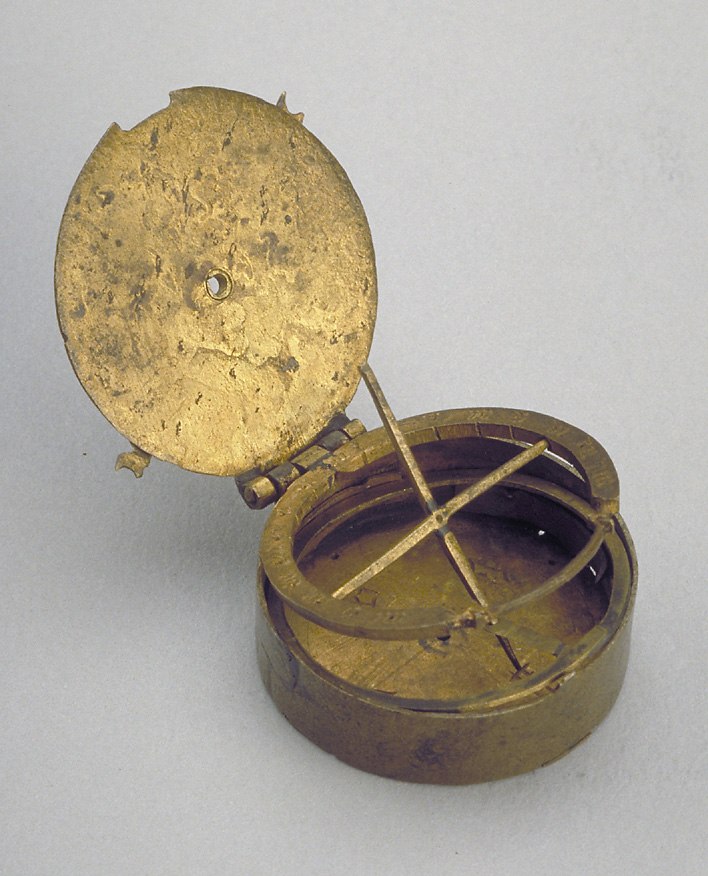
This late 15th-century English equinoctial dial is an unsigned brass instrument measuring 40 mm in diameter. Housed within a compass box—now lacking the magnetic needle—it features a hinged lid and an adjustable hour ring. The dial's design includes a pivoted cross-piece supporting the gnomon, which plugs into a small hole projecting from an internal brass band. The top of the lid incorporates a primitive nocturnal mechanism divided into twelve sections, each subdivided and engraved with letters potentially signifying months in Latin or Italian. The device is historically associated with find-site provenance in the river Crane at Isleworth and was donated to the British Museum by H. C. Pidgeon in 1853.

Side view of the brass equinoctial dial showing the internal hour ring, gnomon assembly, and open lid with nocturnal divisions.
Side view of the brass equinoctial dial showing the internal hour ring, gnomon assembly, and open lid with nocturnal divisions. — British Museum, London. Rights pending — permission not yet requested. Original source

Catalogue identity

Source
www.mhs.ox.ac.uk
Category
Tool · English equinoctial dial
Maker / attribution
Not established
Reference
Not recorded
Catalogue / lot identifier
MLA 1853, 6-18.1
Source-reported date
Late 15th century ?
Source-reported place
England

Source-reported attribution and specifications are not independent authentication. A listing does not establish present ownership, current display, availability or permission to reproduce.

Object description

Structural Design and Dial Components

The equinoctial dial consists of a circular brass compass box housing, which currently appears empty. A lid and an hour ring are mounted to the same hinge, allowing for the folding configuration of the instrument. The hour ring is engraved with Roman numerals from IIII to XII and I to VIII. It utilizes a pivoted cross-piece to which the gnomon is attached.

To deploy the dial, the gnomon is inserted into a small hole projecting into the compass box from a ring, supported by a perpendicular brass band to maintain the required height. The lid of the object functions as a primitive nocturnal. This component is divided into twelve parts, further subdivided into smaller units, with each section marked by a letter, potentially representing months in Latin or Italian. A central pivot holds a double-ended alidade.

Evidence for this section
  • “In the compass box are engraved in unusual (pseudo-Chinese) writing, letters for the initials of the cardinal points 'S', 'O', 'M', 'O'.”
  • “The hour ring is numbered from IIII to XII and from I to VIII and has a pivoted cross-piece to which is fixed the gnomon.”
  • “The top of the lid is a primitive form of nocturnal, divided into 12 parts, each subdivided in two, with further divisions into six.”

Provenance and Condition

The instrument was recovered from the river Crane at Isleworth. Following its discovery, it was acquired by the British Museum in 1853 through a donation by H. C. Pidgeon. The object is officially registered as MLA 1853, 6-18.1 and has been documented in the catalog of European scientific instruments held by the Department of Medieval and Later Antiquities.

The physical state of the dial is described as significantly worn. The surfaces exhibit extensive distress, which affects the clarity of the engravings and the overall integrity of the metal components. The internal compass remains empty, lacking the necessary needle for orientation. These factors combined indicate a long period of environmental exposure before the instrument's recovery and subsequent preservation.

Evidence for this section
  • “The instrument was found in the bed of the river Crane at Isleworth. It was presented to the Museum by H. C. Pidgeon in 1853”
  • “The surfaces of the whole instrument are badly distressed.”

Historical Attribution

The dial is attributed to England and is dated tentatively to the late 15th century, though this dating remains speculative. It is unsigned, precluding any definitive identification of its maker or workshop. Although described as a universal equinoctial dial, the current configuration suggests it was functional for only a single latitude, which remains unidentified.

The inclusion of 'pseudo-Chinese' lettering for the cardinal directions within the compass box suggests a non-traditional approach to the instrument's marking. Researchers noted that similar examples exist within the collection of the Museum of History of Science, Oxford, though no direct link between the specific manufacture of this object and other known pieces has been established.

Evidence for this section
  • “Late 15th century ?; English”
  • “It is not signed or dated, but similar examples are held in the Museum of History of Science, Oxford.”
  • “in this example there is only one possible latitude where it could be used but which is not indicated.”

Open research questions

  • What is the origin and intent of the 'pseudo-Chinese' lettering on the cardinal points?
  • To what specific latitude is the current fixed height of the gnomon calibrated?

Source evidence

Recorded claims and source quotations for English Equinoctial Dial
FieldSource-reported valueSource quotation
Inventory numberMLA 1853, 6-18.1“MLA 1853, 6-18.1”
Diameter40 mm“40 mm in diameter”
Inscription typePseudo-Chinese characters for cardinal directions“engraved in unusual (pseudo-Chinese) writing, letters for the initials of the cardinal points 'S', 'O', 'M', 'O'”
ProvenanceFound in the river Crane at Isleworth“The instrument was found in the bed of the river Crane at Isleworth.”
Nocturnal featureDivided into 12 parts for monthly indication“The top of the lid is a primitive form of nocturnal, divided into 12 parts, each subdivided in two, with further divisions into six.”

Visible details

  • Hinged brass construction featuring a compass box base and circular lid
  • Hour ring graduated with Roman numerals IIII to XII and I to VIII
  • Lid exterior serves as a primitive nocturnal with alidade attachment

Research qualifications

  • Original latitude adjustment capability is unclear as the design limits use to one unknown location
  • Inscriptions within the compass box are identified as 'pseudo-Chinese'

Photograph identity and source facts were screened before import; rights clearance remains pending.

Consulted source

Equinoctial Dial

Reviewed 2026-10-26 · Record b5e684162c

Terms in this record

Glossary explanations for terms named in this object’s record.

Other english equinoctial dial records