
Skip to content
The Encyclopedia of Horology

Tool · English equinoctial dial

Equinoctial Dial by Charles Whitwell

Partially verified

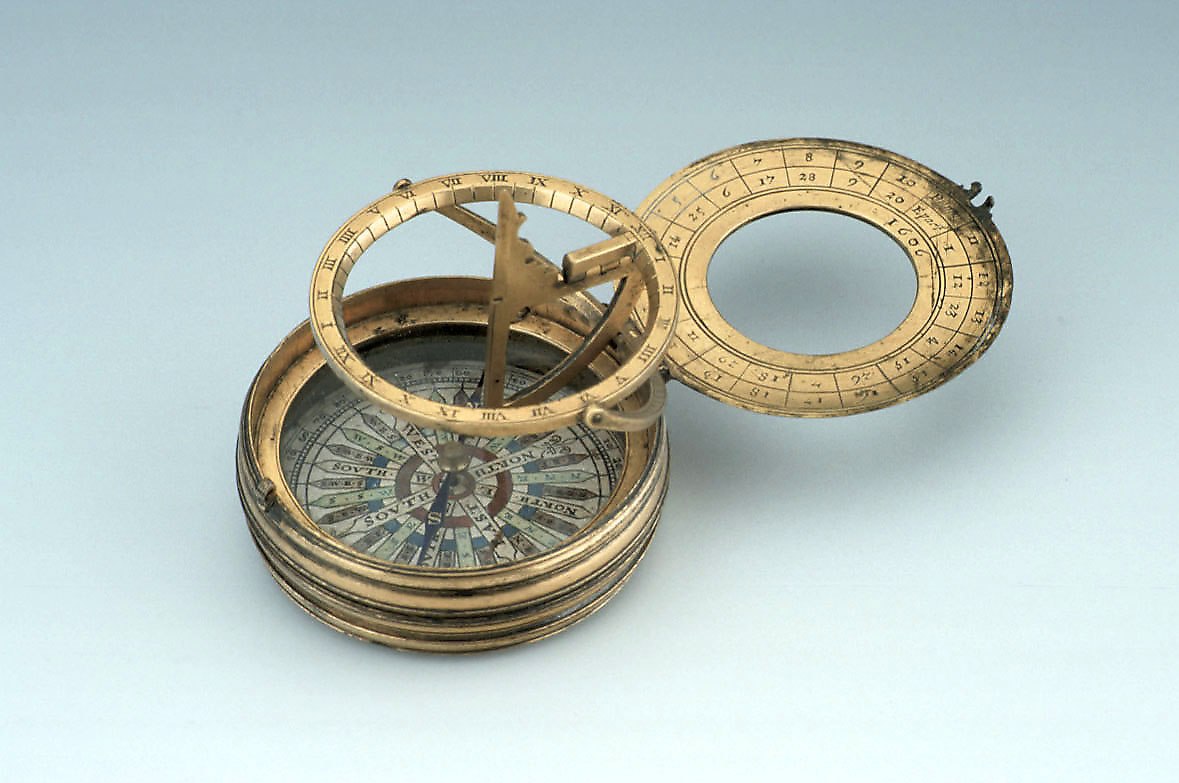
This equinoctial dial is constructed from gilt brass with a diameter of 62 mm. It was made by Charles Whitwell in London in 1606. The instrument functions as a universal equinoctial dial, incorporating a circular compass bowl with a hinged cover that features a central aperture for visibility when closed. The dial assembly, which includes a folding gnomon with an integral latitude quadrant, is secured to the same hinge as the cover. The device features multiple functional components, including a circular calendar scale on the cover exterior, a table of primes and epacts on the interior, and a lunar volvelle with an aspectarium located on the underside of the compass bowl. The compass includes a hand-coloured printed card featuring a 32-direction wind rose. The instrument was formerly part of the Lewis Evans Collection, inventory number 220, and is held by the Museum of the History of Science, Oxford.

View of the equinoctial dial with the hinged cover open, showing the internal compass card, the gnomon, and the hour ring.
View of the equinoctial dial with the hinged cover open, showing the internal compass card, the gnomon, and the hour ring. — Museum of the History of Science, Oxford. Rights pending — permission not yet requested. Original source

Catalogue identity

Source
www.mhs.ox.ac.uk
Category
Tool · English equinoctial dial
Maker / attribution
Charles Whitwell
Reference
44225
Catalogue / lot identifier
44225
Source-reported date
1606
Source-reported place
England

Source-reported attribution and specifications are not independent authentication. A listing does not establish present ownership, current display, availability or permission to reproduce.

Object description

Construction and Exterior Features

The instrument is fashioned from gilt brass and measures 62 mm in diameter. It comprises a circular compass bowl integrated with a hinged cover. The design incorporates a ring-shaped cover, which allows the user to view the internal compass even when the instrument is in the closed position. This cover is fitted with a catch to maintain closure.

The external surface of the cover is engraved with a circular calendar scale. This scale identifies each month, which is then subdivided and numbered at 10, 20, and the final day of the month, with further subdivisions provided every two days. The internal face of the cover features a table of primes and epacts along with the engraved date '1606'.

Evidence for this section
  • “Gilt brass; 62 mm in diameter”
  • “The instrument's cover is in the form of a ring to enable the compass to be seen even when the instrument is closed.”
  • “The outside of the cover has a catch and a circular calendar scale in which each month is named and is divided and numbered to 10, 20 and the last day of the month”

Dial and Navigation Components

Fixed to the main hinge is an equinoctial dial assembly that recesses into the compass housing. The upper surface of the hour ring displays hours marked I to XII twice, subdivided into half-hours. The lower face is configured for winter hours, marked VI to XII to VI, and also includes the signature 'Carolus Whitwell fecit'.

A folding gnomon is provided for setting latitude, featuring an integral quadrant graduated from 10 to 90 degrees. While a hole for a plumb bob is present, the bob itself is missing. The compass itself contains a hand-coloured, printed card displaying a wind rose with 32 directions and an outer degree scale marked 0 to 90.

Evidence for this section
  • “Fixed to the same hinge as the cover is the equinoctial dial, which is held by a decorated support and recesses into the compass housing.”
  • “The folding gnomon has an integral quadrant to set the latitude, running from 10 to 90?”
  • “In the vacant half of this lower face is the signature 'Carolus Whitwell fecit'.”

Lunar Volvelle and Provenance

The underside of the compass bowl serves as a mount for a lunar volvelle. This assembly includes two fixed outer scales, one representing hours I to XII, I to XII, and the other a wind rose identifying 32 directions, with the 16 primary directions denoted by letters.

Two rotating discs with pointers are mounted here. The larger disc displays a scale for the age of the moon, ranging from 1 to 29 1/2 days. The smaller disc contains an aspectarium featuring symbols for trine, quadrature, and sextile, along with an aperture designed to display the phases of the moon. The instrument entered the museum's collection through the Lewis Evans Collection, specifically item number 220.

Evidence for this section
  • “On the underside of the compass bowl is a lunar volvelle.”
  • “There are two rotating discs with pointers: the larger has a scale for the age of the moon 1 to 291/2; the smaller has an aspectarium with symbols for trine, quadrature and sextile”
  • “Provenance: Lewis Evans Collection 220.”

Open research questions

  • What specific methods of hand-colouring were applied to the engraved compass card?
  • Could the missing plumb bob be recovered from other historical pieces in the Lewis Evans collection?

Source evidence

Recorded claims and source quotations for Equinoctial Dial by Charles Whitwell
FieldSource-reported valueSource quotation
MakerCharles Whitwell“Signed by Charles Whitwell”
Date1606“Dated 1606”
MaterialGilt brass“Gilt brass”
Diameter62 mm“62 mm in diameter”
Compass needleModern replacement“The blued needle appears to be a modern replacement.”
Inventory number44225“Inventory number 44225”
ProvenanceLewis Evans Collection 220“Provenance: Lewis Evans Collection 220.”

Visible details

  • The hour ring features both summer hours (I-XII, I-XII) and winter hours (VI-XII-VI).
  • The compass card is hand-coloured and features 32 wind directions.
  • The lunar volvelle on the underside includes a moon phase aperture and aspectarium symbols.
  • The signature 'Carolus Whitwell fecit' is engraved on the lower face of the hour ring.

Research qualifications

  • The blued compass needle is described as a possible modern replacement.
  • A plumb bob is missing from the attachment point on the latitude quadrant.

Photograph identity and source facts were screened before import; rights clearance remains pending.

Consulted source

Equinoctial Dial

Reviewed 2026-10-26 · Record 2e2679450d

Terms in this record

Glossary explanations for terms named in this object’s record.

Other english equinoctial dial records