
Skip to content
The Encyclopedia of Horology

Clock · Mantel clock

Empire 'Garde à vous' mantel clock by Claude-François Rabiat and Lesieur

Partially verified

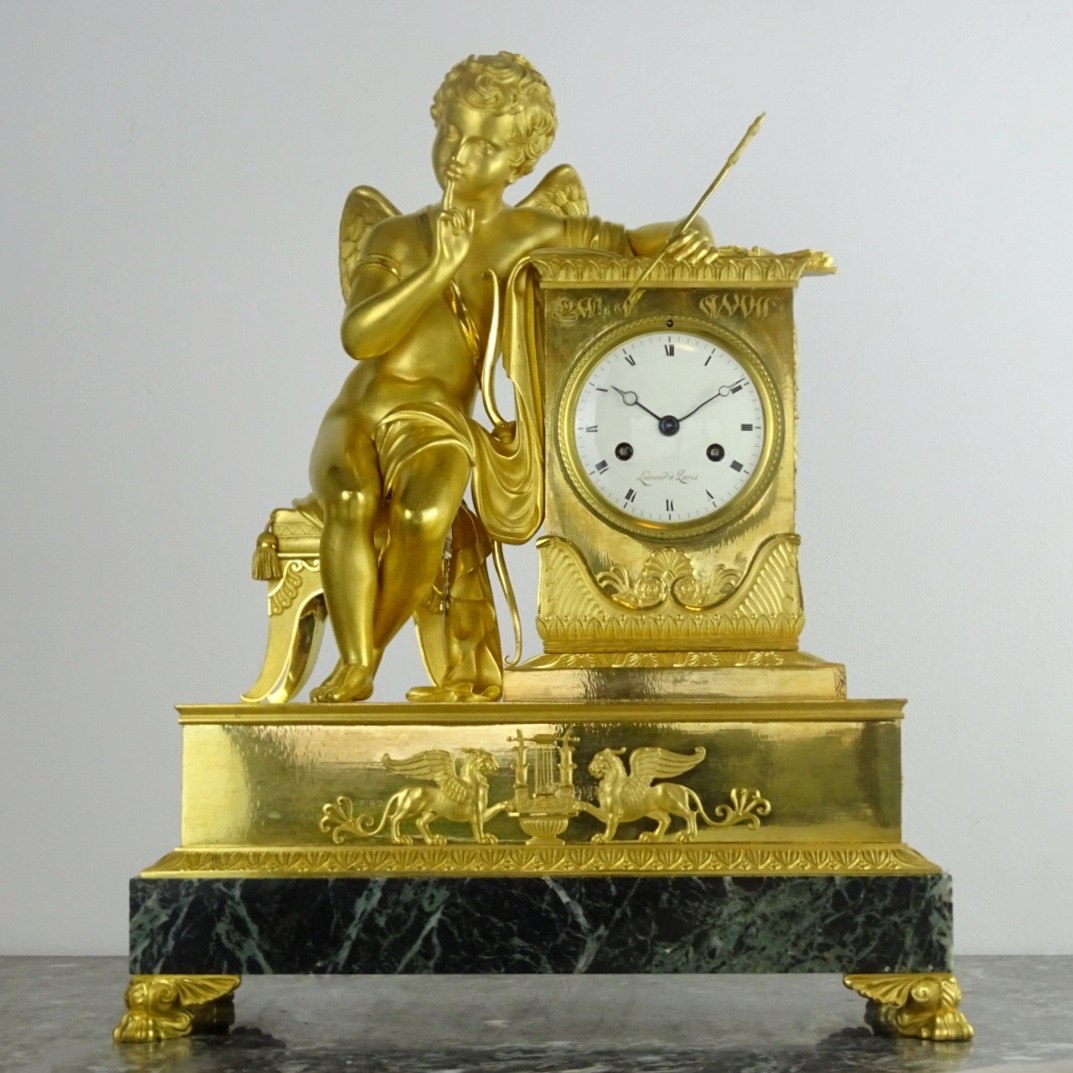
This French First Empire mantel clock, known as 'Garde à vous' or 'Le Silence', is executed in chased and mercury-gilded bronze mounted on a vert de mer marble plinth. The case design is dominated by a sculpted figure of Cupid resting beside the architectural clock housing, raising his index finger to his lips while holding an arrow with a bow and quiver beside him. The white enamel dial features Roman numerals and dual winding apertures, signed for Parisian clockmaker Lesieur, while the bronzes bear the stamp of founder Claude-François Rabiat on the reverse. Source reports the movement incorporates a knife-edge suspension.

Front view of the gilt bronze and vert de mer marble 'Garde à vous' mantel clock
Front view of the gilt bronze and vert de mer marble 'Garde à vous' mantel clock — Antiquités Sir James / Proantic. Rights pending — permission not yet requested. Original source

Catalogue identity

Source
www.proantic.com
Category
Clock · Mantel clock
Maker / attribution
Claude-François Rabiat (bronzier) and Lesieur (horloger)
Reference
1806708
Catalogue / lot identifier
Source URL identifies the listing
Source-reported date
circa 1809–1810
Source-reported place
France

Source-reported attribution and specifications are not independent authentication. A listing does not establish present ownership, current display, availability or permission to reproduce.

Object description

Composition and Iconography

This Empire-period mantel clock features a sculptural figure of Cupid seated beside an architectural clock housing. The figure is depicted gesturing for silence by raising an index finger to his lips, accompanied by a bow, arrow, and quiver.

The clock housing is mounted on a vert de mer marble plinth, which is supported by four gilt bronze winged claw feet. The front terrace is decorated with a frieze of two winged griffins flanking a central lyre.

Evidence for this section
  • “The composition is dominated by a spectacular figure of Cupid , seated beside the architectural case housing the movement.”
  • “The front of the terrace is embellished with a fine composition of two winged griffins flanking a lyre”
  • “It is supported by four finely modelled and chased winged claw feet in gilt bronze”

Dial and Mechanism

The white enamel dial displays Roman numeral hour markers and is signed 'Lesieur à Paris' below the central arbor. The movement is fitted with a knife-edge suspension.

The motto banner located above the dial is missing two applied letters, resulting in the current inscription reading 'GARE À VOU' instead of 'GARDE À VOUS'.

Evidence for this section
  • “The dial and movement are both signed “Lesieur à Paris””
  • “The movement is fitted with a knife-edge suspension”
  • “Two applied letters are now missing, the D and the S , so that the inscription currently reads “GARE À VOU.””

Maker Attributions

The bronzes are signed 'Claude-François Rabiat' twice on the reverse, identifying the founder involved in the casting and chasing of the metalwork. The movement is signed by the clockmaker Lesieur.

The clock features mercury-gilded bronze surfaces and is decorated on all sides, a design choice noted as being less common than on clocks intended solely for frontal display.

Evidence for this section
  • “it bears the signature of Claude-François Rabiat (1756–1815) twice on the reverse of the bronzes”
  • “The dial and movement are both signed “Lesieur à Paris””
  • “Both the sides of the architectural case and those of the base are embellished with their own ornaments.”

Open research questions

  • Are there specific archival records that confirm the manufacture date of this specific serial or inventory-marked object as 1809–1810?
  • Does the internal movement contain additional markings or serial numbers to verify its provenance alongside the Rabiat-stamped case?
  • Are there extant attachment points on the motto banner sufficient to facilitate the restoration of the missing 'D' and 'S' letters?

Source evidence

Recorded claims and source quotations for Empire 'Garde à vous' mantel clock by Claude-François Rabiat and Lesieur
FieldSource-reported valueSource quotation
Bronzier MarkClaude-François Rabiat twice on the reverse“bears the signature of Claude-François Rabiat (1756–1815) twice on the reverse of the bronzes”
Clockmaker SignatureLesieur à Paris“The dial and movement are both signed “Lesieur à Paris””
Suspension TypeKnife-edge suspension“The movement is fitted with a knife-edge suspension”
Height46 cm“At 46 cm high , the clock is already of substantial size.”
Width39 cm“Width: 39 cm”

Visible details

  • A sculpted gilt bronze winged Cupid sits adjacent to the clock movement case, resting his right index finger on his lips and holding an arrow aloft in his left hand.
  • The white enamel dial features black Roman hour numerals, two winding apertures, and dark Breguet-style hands, signed 'Lesieur à Paris' beneath the arbor.
  • The frieze of the gilt bronze terrace depicts two winged griffins flanking a classical lyre.
  • The dark green veined marble base is supported on four gilt bronze winged claw feet.
  • Above the dial, the motto shows missing applied letters, reading 'GARE À VOU'.

Research qualifications

  • The movement interior and reverse stamps by Rabiat are not visible in the provided primary front photograph.
  • Two applied metal letters are missing from the motto banner above the dial.

Photograph identity and source facts were screened before import; rights clearance remains pending.

Consulted source

Proantic: Claude-françois Rabiat - Silence, Attention - Exceptional Em

Reviewed 2026-10-22 · Record 6d0d3dfc57

Terms in this record

Glossary explanations for terms named in this object’s record.