
Skip to content
The Encyclopedia of Horology

Pocket watch · Egg-type watch

Egg-Type Watch

Partially verified

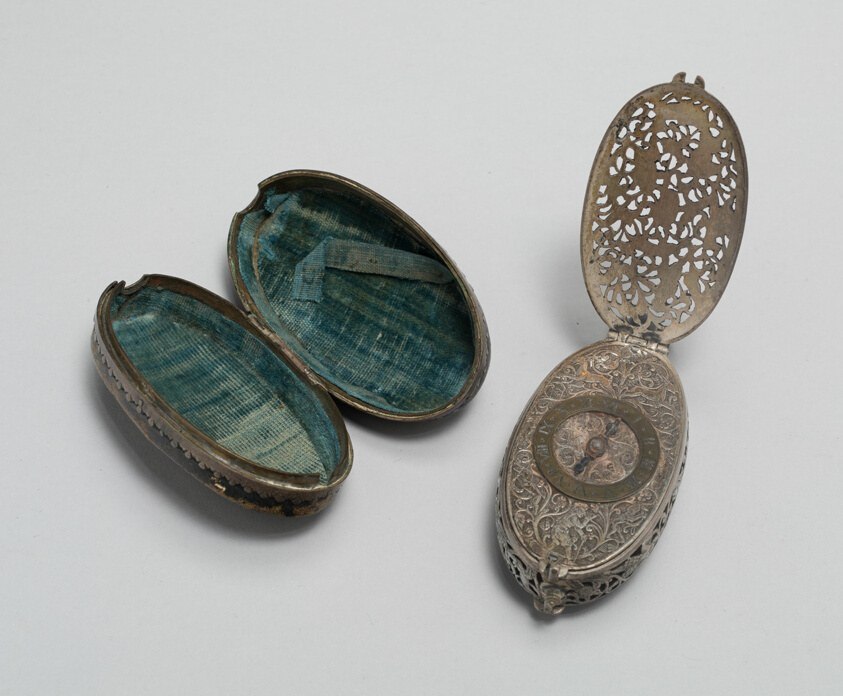
This egg-type watch is an oval timekeeping instrument held in the collection of the Art Institute of Chicago, accession number 8375. The museum catalogue attributes the creation of the piece to the German maker Nicklaus Rugend, who lived from 1585 to 1658 and was based in Augsburg. However, the same museum documentation dates the object to approximately 1740, creating a chronological discrepancy between the life dates of the attributed maker and the suggested date of manufacture. The watch is constructed using silver, brass, leather, and various metals, measuring 8.1 by 4.5 by 3.3 cm. It features a hinged, pierced outer case cover and a corresponding storage container lined with fabric. The dial surface exhibits engraved detailing, with numerals and a hand positioned centrally on the watch body. The piece reflects the characteristic ovoid form associated with early portable watches, though the stated manufacturing date remains a subject of institutional attribution.

The egg-type watch shown open, revealing the central dial, alongside its matching fabric-lined carrying case.
The egg-type watch shown open, revealing the central dial, alongside its matching fabric-lined carrying case. — Art Institute of Chicago. Rights pending — permission not yet requested. Original source

Catalogue identity

Source
orbiscollectibles.com
Category
Pocket watch · Egg-type watch
Maker / attribution
Nicklaus Rugend
Reference
Not recorded
Catalogue / lot identifier
8375
Source-reported date
c. 1740
Source-reported place
Germany

Source-reported attribution and specifications are not independent authentication. A listing does not establish present ownership, current display, availability or permission to reproduce.

Object description

Physical Composition and Appearance

The object is defined by its distinctive ovoid form, commonly referred to as an egg-type watch. The primary structure is fabricated from silver and brass, with metal and leather elements incorporated into its assembly. The watch is accompanied by an auxiliary oval receptacle, which is fitted internally with blue fabric lining to protect the watch when not in use.

The watch body is heavily decorated with detailed engraving, which extends across the visible surfaces surrounding the central dial. The hinged cover is fashioned as a fine, open-work lattice of foliage or floral patterns, allowing for partial visibility when closed. A central hand is positioned over the dial, which is marked with numerals along its perimeter.

Evidence for this section
  • “Silver, brass, leather, and metal”
  • “8.1 × 4.5 × 3.3 cm”

Attribution and Chronological Context

The museum attribution identifies the maker as Nicklaus Rugend, an Augsburg-based craftsman active during the late 16th and early 17th centuries. However, the record provides a manufacturing date of circa 1740, which falls nearly a century after the reported death of the attributed maker in 1658.

This chronological inconsistency suggests that either the maker identification, the dating, or the relationship between the two requires further investigation. The record notes that these details are derived solely from the museum’s internal catalogue entry and have not been confirmed through external research or expert verification.

Evidence for this section
  • “Nicklaus Rugend German, 1585-1658 Augsburg, Germany”
  • “dated c. 1740”
  • “Details beyond the museum's own catalogue entry have not been independently verified.”

Provenance and Documentation

The watch is currently held in the collection of the Art Institute of Chicago under the accession number 8375. The documentation provided for this record relies exclusively on the museum's own published object information.

There are no additional catalogue references provided for this item, and the museum has indicated that its status concerning copyright is currently pending review. All information presented in this record is restricted to what is contained within the official institutional data.

Evidence for this section
  • “Held by Art Institute of Chicago (object no. 8375).”
  • “All details come from the object's own museum catalogue record”

Open research questions

  • What explains the discrepancy between the maker's death in 1658 and the assigned date of 1740?
  • Does the internal movement of the watch bear hallmarks or signatures consistent with 18th-century production?

Source evidence

Recorded claims and source quotations for Egg-Type Watch
FieldSource-reported valueSource quotation
MakerNicklaus Rugend“Nicklaus Rugend German, 1585-1658 Augsburg, Germany”
Datec. 1740“dated c. 1740”
Dimensions8.1 × 4.5 × 3.3 cm“8.1 × 4.5 × 3.3 cm”
MaterialsSilver, brass, leather, and metal“Silver, brass, leather, and metal”
Accession Number8375“object no. 8375”
LocationArt Institute of Chicago“Held by Art Institute of Chicago”

Visible details

  • Hinged outer cover with pierced, foliage-inspired ornamentation
  • Oval watch body with a central dial and single hand
  • Separate oval carrying container lined with blue fabric
  • Intricate floral engraving across the watch surface

Research qualifications

  • Discrepancy between attributed maker's life dates (1585-1658) and the dating (c. 1740)
  • Museum attribution details have not been independently verified

Photograph identity and source facts were screened before import; rights clearance remains pending.

Consulted source

Egg-Type Watch

Reviewed 2026-11-02 · Record 438699aec0

Terms in this record

Glossary explanations for terms named in this object’s record.