
Skip to content
The Encyclopedia of Horology

Clock · Skeleton clock

Early Victorian Double Fusee Skeleton Clock

Partially verified

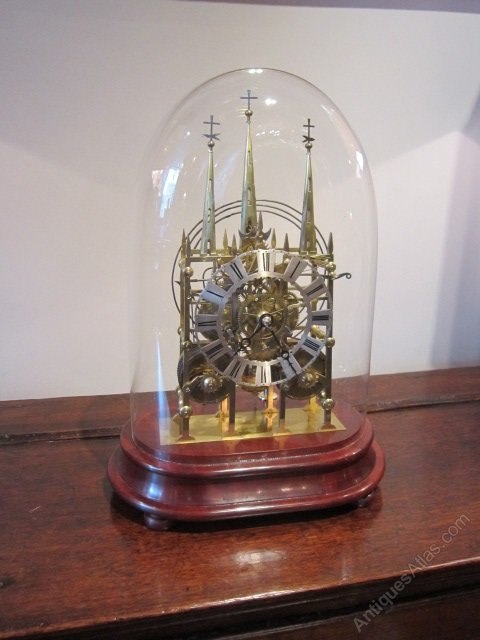
This early Victorian English double fusee skeleton clock, dated to circa 1840 by the dealer, features an open brass architectural framework modeled on the design of Lichfield Cathedral with three spires capped by crosses. It displays time via a silvered, engraved pierced dial ring with Roman numerals and openwork hands. According to the seller, it is powered by an original chain drive connected to a six-pillar movement that strikes the hour on a gong. The clock rests on an oval polished mahogany wooden base fitted under an oval clear glass dome.

Early Victorian Lichfield Cathedral design double fusee skeleton clock under glass dome on mahogany plinth
Early Victorian Lichfield Cathedral design double fusee skeleton clock under glass dome on mahogany plinth — Sturmans Antiques Ltd / Antiques Atlas. Rights pending — permission not yet requested. Original source

Catalogue identity

Source
antiques-atlas.com
Category
Clock · Skeleton clock
Maker / attribution
Not established
Reference
as521a1612
Catalogue / lot identifier
Source URL identifies the listing
Source-reported date
circa 1840
Country
United Kingdom

Source-reported attribution and specifications are not independent authentication. A listing does not establish present ownership, current display, availability or permission to reproduce.

Object description

Architectural Design and Construction

The clock features an architectural framework described as a 'Lichfield Cathedral' design. The brass structure includes three tall spires, each topped with a cross finial.

The movement is mounted on an oval, polished mahogany base. The entire assembly is enclosed under a glass dome.

Evidence for this section
  • “'Lichfield Cathedral' design with three tall spires to the top.”
  • “Sat on a polished mahogany oval shaped base with the original glass dome.”

Dial and Timekeeping Mechanism

The time is displayed on a silvered, engraved pierced dial ring featuring Roman numerals. The hands are of a pierced design.

The clock is powered by a six-pillar movement with an original chain drive. It is noted to strike the hour on a gong.

Evidence for this section
  • “Silvered engraved pierced dial.”
  • “Original chain drive to the six pillar movement.”
  • “Strikes on a gong to the hour.”

Provenance and Physical Specifications

The clock is identified by the dealer as early Victorian, circa 1840. The specific maker of the clock is not recorded in the source material.

The dimensions of the item are 12 inches wide, 7.5 inches deep, and 17 inches high.

Evidence for this section
  • “An Impressive Early Victorian double fuse skeleton antique clock .c.1840.”
  • “Measures 12" x 7.5" x 17"high.”

Open research questions

  • What defines the 'Lichfield Cathedral' style in 19th-century skeleton clock manufacturing?
  • Are there diagnostic features for verifying the age or originality of glass domes on 1840s skeleton clocks?
  • To what extent does the absence of a signature on a six-pillar, double-fusee movement from this period typically align with known workshop practices?

Source evidence

Recorded claims and source quotations for Early Victorian Double Fusee Skeleton Clock
FieldSource-reported valueSource quotation
Design motifLichfield Cathedral design with three tall spires“'Lichfield Cathedral' design with three tall spires to the top.”
Dial descriptionSilvered engraved pierced dial“Silvered engraved pierced dial.”
Drive mechanismChain drive to six pillar movement“Original chain drive to the six pillar movement.”
Striking workStrikes on a gong to the hour“Strikes on a gong to the hour.”
Base and domePolished mahogany oval shaped base with original glass dome“Sat on a polished mahogany oval shaped base with the original glass dome.”
Dimensions12" x 7.5" x 17" high“Measures 12" x 7.5" x 17"high.”
Condition StatusFull working order“Full working order.”

Visible details

  • Brass architectural framework features three prominent spires surmounted by cross finials.
  • Central silvered pierced chapter ring displays Roman numerals and open pierced hands.
  • Movement is mounted on brass feet upon an oval polished mahogany base.
  • A tall domed glass cover encloses the entire skeleton mechanism.

Research qualifications

  • Maker is not recorded in the source documentation.
  • Specific train details and chain-driven fusees are largely obscured or partially visible behind the front framing.

Photograph identity and source facts were screened before import; rights clearance remains pending.

Terms in this record

Glossary explanations for terms named in this object’s record.