
Skip to content
The Encyclopedia of Horology

Clock · Table clock

Dutton & Co. Table Clock

Partially verified

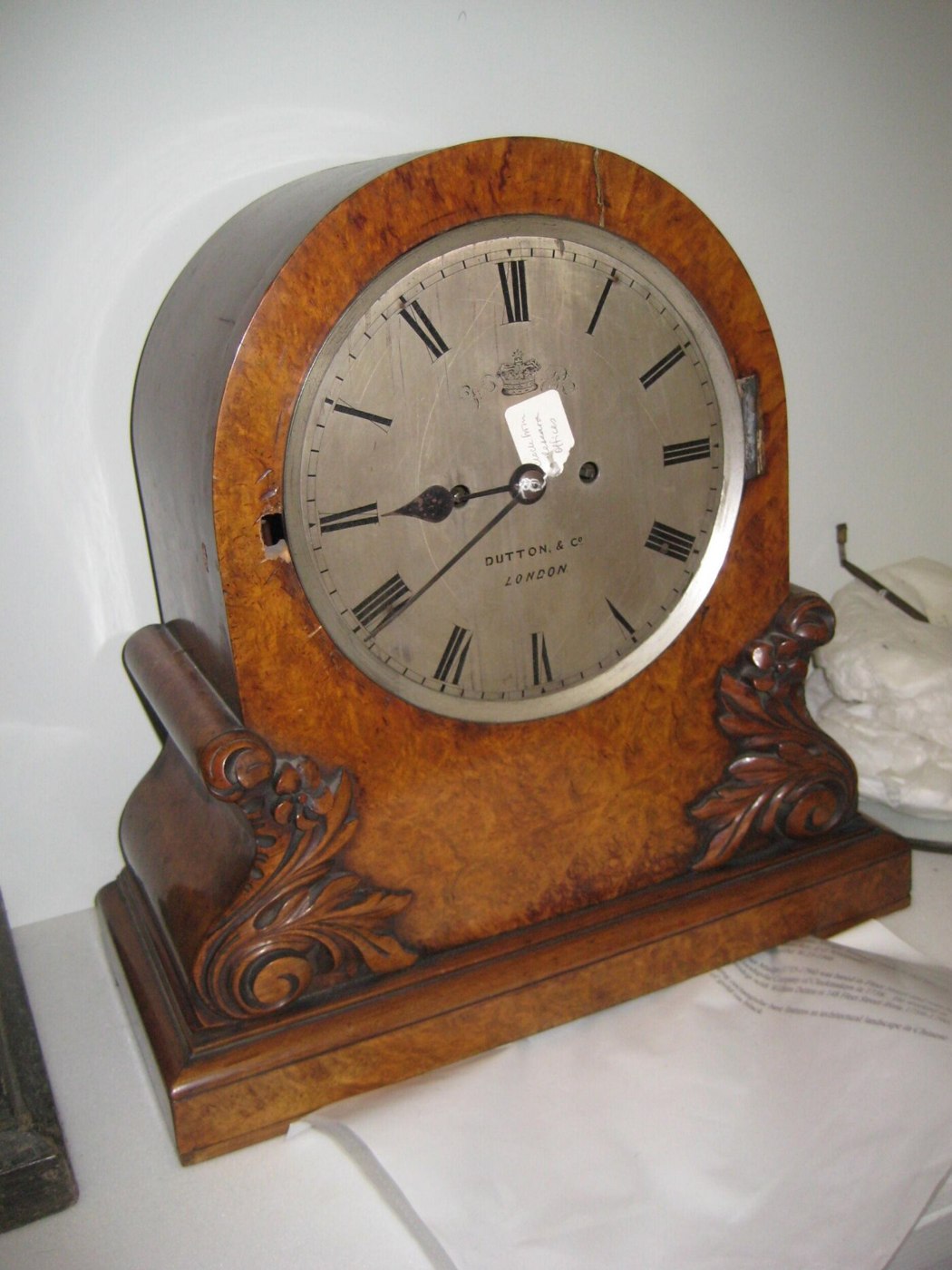
This table clock, attributed to the date range of 1850-1900, is a functional timepiece acquired by the Victoria and Albert Museum (formerly the South Kensington Museum) for use within its administrative offices. The clock features an arched case finished in burr walnut veneer, supported by a rectangular plinth. The decorative scheme incorporates side brackets carved from solid walnut, displaying acanthus leaf motifs and daisy carvings. A silvered face displays Roman numerals and is marked with the initials 'VR' beneath a crown, confirming its production for institutional use during the reign of Queen Victoria. The dial also bears the signature 'Dutton & Co, London'. Internally, the clock includes a paper label from the retailer C. Sansom, located at 2 Montpelier Street, Brompton Road, who served as clockmakers to the Department of Science and the South Kensington Museum. The case assembly includes mahogany-veneered framework with a brass grill and red baize backing.

Front view of the Dutton & Co. table clock showing the silvered dial, VR cipher, and burr walnut case.
Front view of the Dutton & Co. table clock showing the silvered dial, VR cipher, and burr walnut case. — Victoria and Albert Museum. Rights pending — permission not yet requested. Original source

Catalogue identity

Source
collections.vam.ac.uk
Category
Clock · Table clock
Maker / attribution
Dutton & Co
Reference
Not recorded
Catalogue / lot identifier
W.3-2004
Source-reported date
1850-1900
Source-reported place
London

Source-reported attribution and specifications are not independent authentication. A listing does not establish present ownership, current display, availability or permission to reproduce.

Object description

Case Construction and Design

The table clock is constructed with an arched case veneered in burr walnut. This housing sits atop a stable rectangular plinth. The aesthetic design is characterized by solid walnut brackets on either side, which are carved with scrolling acanthus leaves and a daisy motif. The framework is composed of mahogany veneer and is designed with an arched door at the rear providing access to the internal mechanism.

The back of the case is fitted with a metal grill, described as tarnished brass, which is backed with red baize. Physical inspection of the exterior indicates the presence of minor structural age, specifically noted as cracks within the veneer on the arched top and an older filled crack positioned directly above the clock face, which is attributed to natural material fatigue or historical repair.

Evidence for this section
  • “At the sides, two scrolling brackets carved in solid walnut with scrolling acanthus leaves and a deaisy.”
  • “With mahogany veneered framework filled with a metal grill of tarnished brass, back with red baize.”
  • “Some cracks in the veneer of the arched top and an old filled crack above the clock face.”

Dial and Institutional Markings

The clock face is constructed of silvered metal and features Roman numerals for timekeeping. Centrally positioned above the hands is a crown emblem and the initials 'VR', standing for Victoria Regina. This signifies that the piece was produced for official government or institutional use during Queen Victoria’s reign. The signature 'Dutton & Co, London' is engraved directly onto the lower portion of the silvered dial.

A paper label found inside the clock provides information on the supply chain. It identifies C. Sansom, a watch and clock maker located at 2 Montpelier Street, Brompton Road, as the retailer. The label also confirms Sansom’s professional role as 'Clock Makers to the Department of Science and the South Kensington Museum', highlighting the shop's proximity and direct supply relationship with the institution that eventually accessioned the clock into its permanent collection.

Evidence for this section
  • “Roman numerals.”
  • “On the clock face are a crown and the initials VR (Victoria Regina), indicating that it was made for official use during the reign of Queen Victoria.”
  • “Dutton & Co (maker)”
  • “inside the clock is a paper label: 'C. Sansom, Watch and Clock Makers, 2 Montpelier Street Brompton Road, Clock Makers to the Department of Science and the South Kensington Museum'”

Historical Context and Acquisition

The clock serves as an illustrative example of the standardized, durable furnishings procured for the staff offices of the South Kensington Museum during the 19th century. Its inclusion in the museum's permanent collection is intended to preserve a record of the functional equipment used by the institution's personnel during the Victorian era.

Because the museum was known as the South Kensington Museum in the 19th century, the clock represents part of the earliest administrative furnishings of the site. It was selected for retention by the museum as a representative item of public office supply, documenting the professional relationship between the museum and the local firm of C. Sansom, which provided several such timepieces for daily staff operations.

Evidence for this section
  • “This clock was purchased for use in the offices of the Victoria and Albert Museum, known in the 19th century as the South Kensington Museum.”
  • “This and other selected items of museum furniture have been taken into the permanent collections as illustrations of the kind of plain, good quality furnishings supplied for public offices during the reign of Victoria.”

Open research questions

  • What specific caliber or movement type is housed within this case?
  • Are there any maker's marks or date stamps on the internal movement plates?

Source evidence

Recorded claims and source quotations for Dutton & Co. Table Clock
FieldSource-reported valueSource quotation
MakerDutton & Co“Dutton & Co (maker)”
RetailerC. Sansom“It was retailed by C. Sansom”
MaterialBurr walnut veneer“Burr walnut veneer with silvered face”
Dimensions38 cm x 38 cm x 17.5 cm“Height: 38 cm; Width: 38 cm; Depth: 17.5 cm”
Accession numberW.3-2004“W.3-2004”
InscriptionVR cipher“On the clock face are a crown and the initials VR (Victoria Regina)”
ProvenancePurchased for South Kensington Museum offices“This clock was purchased for use in the offices of the Victoria and Albert Museum, known in the 19th century as the South Kensington Museum.”

Visible details

  • Arched case with burr walnut veneer
  • Silvered dial with Roman numerals
  • Carved walnut side brackets with acanthus leaves
  • Crown and VR cipher on dial

Research qualifications

  • The internal movement condition is not described
  • The exact production year within the 1850-1900 window remains unverified

Photograph identity and source facts were screened before import; rights clearance remains pending.

Consulted source

Clock

Reviewed 2026-10-26 · Record 7164cc9c45

Terms in this record

Glossary explanations for terms named in this object’s record.