
Skip to content
The Encyclopedia of Horology

Pocket watch · Open-face pocket watch

Doxa pocket watch

Partially verified

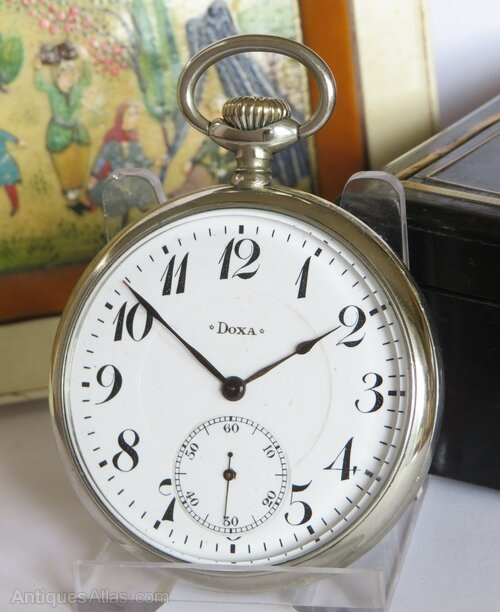
This early 20th-century Swiss open-face pocket watch by Doxa features a 15-jewel stem-winding movement housed in a 53 mm nickel case. According to the seller, the movement is signed with the Doxa brand name and protected by an inner cuvette bearing details of Doxa's gold medal won in Milan in 1906 and participation in the 1905 Liège exhibition. The white dial is signed 'DOXA' flanked by stars and displays stylized black Arabic numerals, an outer track, and a subsidiary seconds dial at the 6 o'clock position.

Dial and case front of the Doxa open-face pocket watch
Dial and case front of the Doxa open-face pocket watch — The Vintage Wrist Watch Company / Antiques Atlas. Rights pending — permission not yet requested. Original source

Catalogue identity

Source
www.antiques-atlas.com
Category
Pocket watch · Open-face pocket watch
Maker / attribution
Doxa
Reference
Not recorded
Catalogue / lot identifier
as170a14602
Source-reported date
Early 20th Century
Source-reported place
Switzerland

Source-reported attribution and specifications are not independent authentication. A listing does not establish present ownership, current display, availability or permission to reproduce.

Object description

Dial and Display

The pocket watch features a white dial with stylized black Arabic numerals and an outer minute track. The dial is signed 'DOXA' flanked by small stars beneath the 12 o'clock position, with a subsidiary seconds register positioned at 6 o'clock bearing black markings.

According to the seller, the dial has three faint hairlines that are difficult to see with the naked eye. The dial is protected by a glass lens, which the seller describes as being in 'lovely condition'.

Evidence for this section
  • “White dial with stylized black Arabic numerals and outer minute track.”
  • “Dial signed 'DOXA' flanked by small stars below 12 o'clock.”
  • “Subsidiary seconds register positioned at 6 o'clock with black numerals and markings.”
  • “The signed dial has three faint hairlines but they are difficult to see with the naked eye.”
  • “The glass lens is in lovely condition.”

Case Construction

The watch features a polished nickel open-face case fitted with a fluted winding crown and a rounded bow at 12 o'clock. The seller records the case diameter as 53 mm excluding the winding stem and loop.

The seller describes the nickel case as being in good condition with light surface marking. An inner cuvette (inner cover) protects the movement, and the seller notes that this inner cover has scratches from past opening.

Evidence for this section
  • “Polished nickel open-face case with fluted winding crown and rounded bow at 12 o'clock.”
  • “The watch measures 53mm diameter excluding the winding stem and the loop.”
  • “The case is nickel and it is in good condition, just light surface marking, nothing serious at all.”
  • “This inner cover has some scratches where it has been opened in the past.”

Movement and Seller-Reported Details

The seller reports that the watch contains a 15-jewel stem-winding movement signed with the Doxa name, described as working nicely. However, the movement and inner markings are not visible in the supplied single dial photograph and cannot be verified directly.

Additionally, the seller states that the inner cuvette features details commemorating Doxa's gold medal won in Milan in 1906 and participation in the Liège exhibition of 1905. The listing assigns the piece to the Early 20th Century period with Swiss origin.

Evidence for this section
  • “The watch has a 15-jewel stem-winding movement which is working nicely.”
  • “The movement is signed with the Doxa name and it is all protected by an inner cover which has details of Doxa’s gold medal won in Milan in 1906, and their participation in the Liege exhibition of 1905.”
  • “Origin Swiss”
  • “Period Early 20th Century Antiques”

Open research questions

  • What movement caliber and bridge configuration are present beneath the inner cover?
  • What specific serial numbers or hallmarks are stamped on the movement or inside the nickel case back?
  • Where are the three faint hairline cracks located on the dial surface?

Source evidence

Recorded claims and source quotations for Doxa pocket watch
FieldSource-reported valueSource quotation
Movement jewel count15 jewels“The watch has a 15-jewel stem-winding movement which is working nicely.”
Case diameter53mm“The watch measures 53mm diameter excluding the winding stem and the loop.”
Case materialNickel“The case is nickel and it is in good condition”
OriginSwiss“Origin Swiss”
Lens conditionGlass in lovely condition (seller-reported)“The glass lens is in lovely condition.”
AccessoriesNew presentation box“The watch comes in a new presentation box.”
Inner cuvette inscription detailsGold medal won in Milan in 1906 and Liège exhibition of 1905“details of Doxa’s gold medal won in Milan in 1906, and their participation in the Liege exhibition of 1905.”

Visible details

  • White dial with stylized black Arabic numerals and outer minute track.
  • Dial signed 'DOXA' flanked by small stars below 12 o'clock.
  • Subsidiary seconds register positioned at 6 o'clock with black numerals and markings.
  • Polished nickel open-face case with fluted winding crown and rounded bow at 12 o'clock.

Research qualifications

  • The seller reports three faint hairlines on the dial that are difficult to see with the naked eye.
  • The seller notes scratches on the inner cuvette from past opening.
  • The movement and inner cuvette inscriptions are not visible in the supplied single dial photograph.

Photograph identity and source facts were screened before import; rights clearance remains pending.

Consulted source

Antiques Atlas - Antique Doxa Pocket Watch as170a14602

Reviewed 2026-10-21 · Record 76a47b3eb9

Terms in this record

Glossary explanations for terms named in this object’s record.