
Skip to content
The Encyclopedia of Horology

Component · Dial

Dial from an astronomical instrument

Partially verified

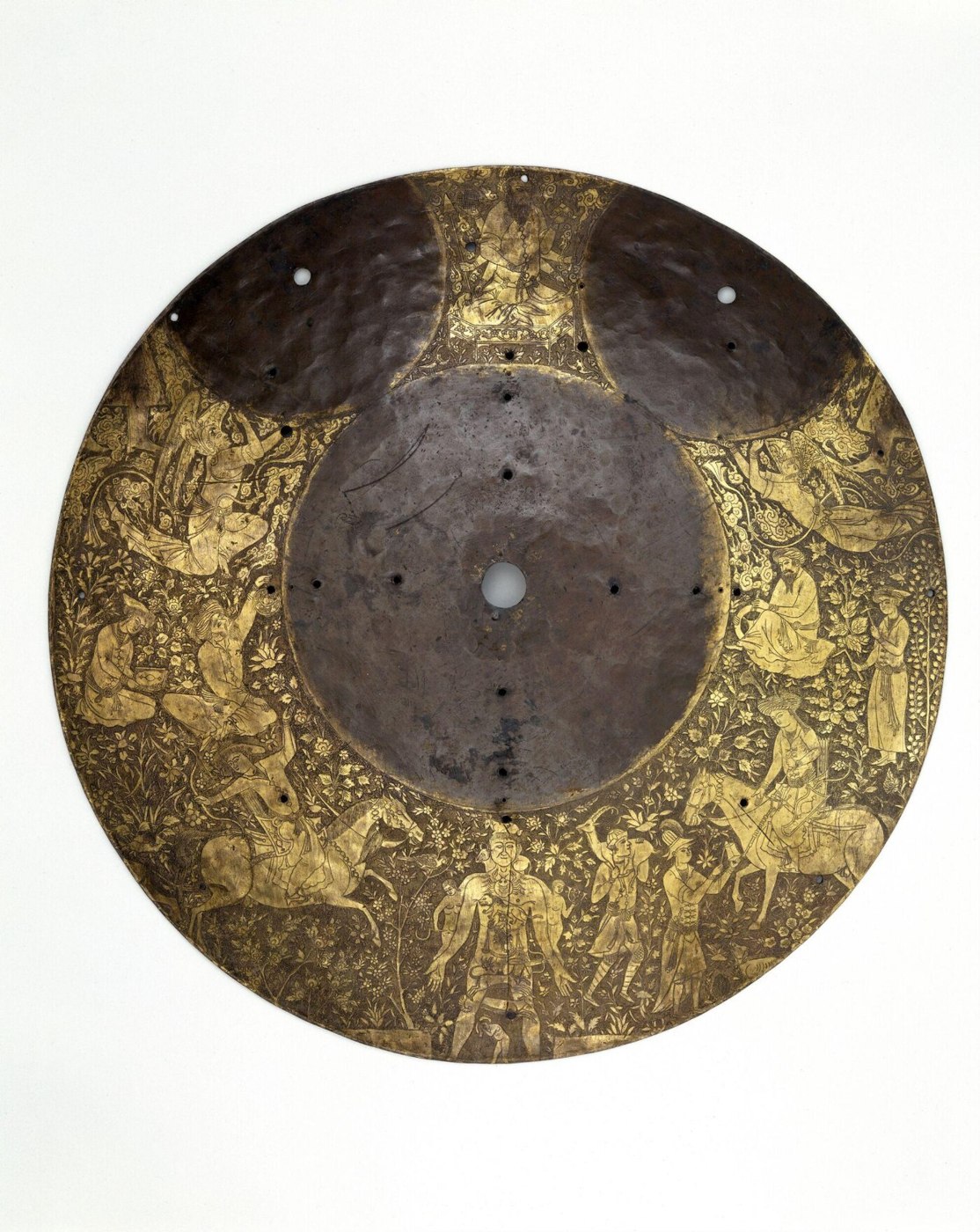
This object is a convex, gilt copper dial disc, believed to be a component from a complex astronomical or astrological clock. The disc was originally cut from a flat, rectangular base plate, which accounts for its current convex shape and the irregular circular voids where three smaller dials were once positioned. The surface is extensively decorated with engraved and ringmatted figures set against floral, tree, and cloud motifs. These figures include personifications of Saturn, angels, courtly huntsmen, and scholars using scientific instruments such as astrolabes. The piece reflects complex metalworking techniques involving engraving, punching, and gilding, with evidence of later modifications, including additional screw holes, suggesting it was adapted for a secondary, unknown purpose after the original instrument was dismantled.

The copper disc, featuring the central blank dial space, the Saturn figure at the top, and various scholarly and courtly figures in the decorated registers.
The copper disc, featuring the central blank dial space, the Saturn figure at the top, and various scholarly and courtly figures in the decorated registers. — © Victoria and Albert Museum, London. Rights pending — permission not yet requested. Original source

Catalogue identity

Source
collections.vam.ac.uk
Category
Component · Dial
Maker / attribution
Not established
Reference
Not recorded
Catalogue / lot identifier
1577-1904
Source-reported date
17th century
Source-reported place
Iran

Source-reported attribution and specifications are not independent authentication. A listing does not establish present ownership, current display, availability or permission to reproduce.

Object description

Structural Analysis

The object is a convex, circular copper disc, measuring 80.5 cm in diameter. It possesses three blank, circular spaces that were originally intended to accommodate smaller dials. The structural evidence suggests these spaces were once part of a flat, rectangular base plate before the disc was cut and beaten into its present convex form.

The center of each blank area features a large hole for dial attachment, complemented by numerous smaller holes across the plate used for fastening additional internal components of the original instrument. Some later screw holes suggest the disc was repurpsed after its initial removal, potentially mounted on a surface, indicated by green paint remnants found along the lower edge.

Evidence for this section
  • “The surviving figures, from the top, are a personification of Saturn; two angels, which originally supported the two upper dials”
  • “Its current convex, circular shape would appear to be the result of the reworking of the base plate for another use after the instrument was dismantled.”

Iconography and Decoration

The surface decoration is divided into celestial and terrestrial registers. The upper section features a personification of Saturn with seven arms, each holding a distinct attribute. Below this, two angels are depicted in flight. The central area depicts two scientists with assistants, one utilizing a mariner's astrolabe and the other a planispheric astrolabe. Further down, Safavid courtly figures are shown engaged in hunting, including a horseman shooting a lion.

At the base, a Zodiac Man diagram represents the astrological belief in the influence of zodiac signs on human anatomy. This motif is derived from the Venetian Fasciculus medicinae of 1493. Notably, the engraving is set against a ringmatted ground and gilded, with floral plants occupying the lower terrestrial zone and swirling clouds filling the upper registers. Some areas remain blank or incomplete due to the cutting process. A Zodiac Man motif, influenced by European 15th-century prints, appears at the base.

Evidence for this section
  • “The decoration is divided by the choice of motifs and of background ornament into terrestrial and celestial zones”

Historical Interpretation

First brought to modern attention in the 1931 International Exhibition of Persian Art, the object was initially catalogued simply as a part of an astronomical instrument. Ralph Harari, in 1939, described it as a unique, mutilated, and incomplete dial, theorizing its association with a large astronomical clock. This assessment remains the prevailing expert opinion on the item's origin.

While the figures and imagery clearly draw from a mix of Persian courtly culture and European anatomical tradition, the exact configuration of the original instrument is lost. The survival of such a large copper disc, despite its modification and secondary use, provides insight into 17th-century Iranian metalwork and the integration of scientific and astrological motifs in luxury horological objects of the period.

Evidence for this section
  • “the disc was referred to as 'Astronomical Instrument {part)'”
  • “'A huge, convex, gilt copper dial (Pl.1404), mutilated and incomplete, but exquisitely engraved with figures in late seventeenth century style, is probably unique. It may have belonged to some great astronomical clock.'”

Open research questions

  • What is the nature of the secondary mount to which the disc was attached, as evidenced by the green paint?
  • Are there any other surviving components from the same original astronomical clock in other global collections?

Source evidence

Recorded claims and source quotations for Dial from an astronomical instrument
FieldSource-reported valueSource quotation
Materialcopper, engraved, punched and gilded“copper, engraved, punched and gilded”
Dimensions80.5 cm diameter, 8 cm height“Diameter: 80.5 cm; Height: 8 cm”
OriginIran, probably Isfahan“Iran (made); Isfahan (made)”
ProvenanceExhibited at the International Exhibition of Persian Art, 1931“Catalogue of the International Exhibition of Persian Art (Royal Academy of Arts, London, 1931, p.134, cat.no.209)”
ModificationSecondary screw holes added“a number around the edge appear to be screw holes added at a later date”

Visible details

  • Three blank, circular areas once intended for dials
  • Engraved figurative scenes of hunters, angels, and scholars
  • Ringmatted background with floral and cloud decorations
  • Central and peripheral holes for attachment

Research qualifications

  • Original function as part of an astronomical clock is presumed but not confirmed
  • The exact nature of its secondary use after dismantling remains unidentified

Photograph identity and source facts were screened before import; rights clearance remains pending.

Consulted source

Dial

Reviewed 2026-10-26 · Record 15c304127f

Terms in this record

Glossary explanations for terms named in this object’s record.