
Skip to content
The Encyclopedia of Horology

Clock · Desk clock

Desk clock of nephrite, gold, enamel, and diamonds

Partially verified

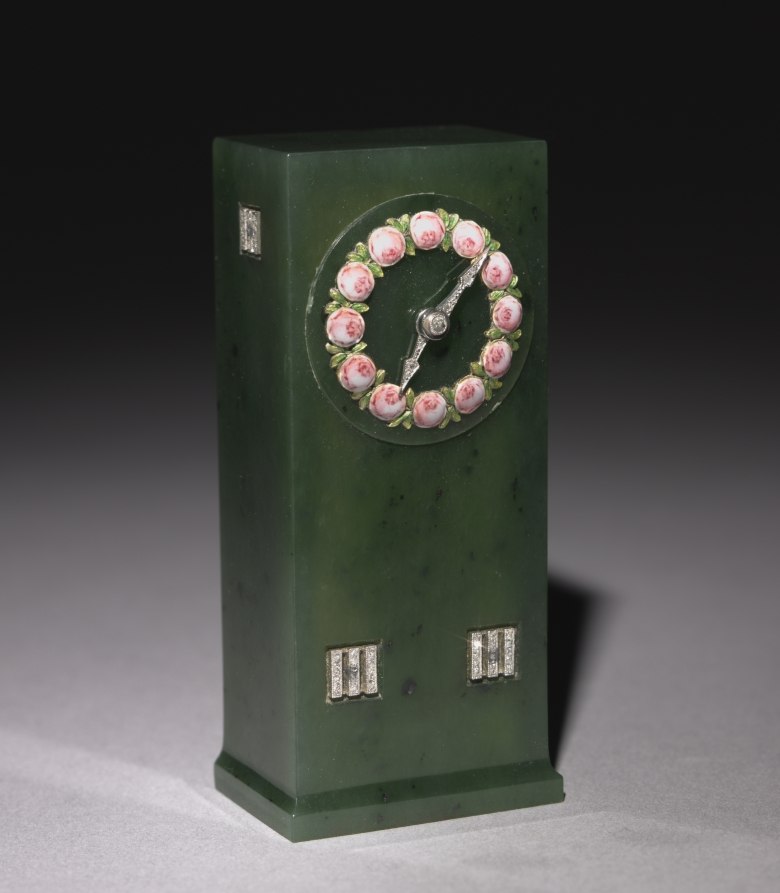
This desk clock is attributed to the House of Fabergé, specifically workmaster Henrik Wigström. Created in St. Petersburg between 1908 and 1917, the piece is constructed from a block of nephrite, a mineral sourced from the region surrounding the Ural Mountains. The clock body incorporates gold, enamel, and diamonds. The dial is notable for its absence of traditional numerals; instead, it features a series of pink enameled roses arranged in a circular pattern, with hour and minute hands adorned with diamonds. The clock is signed by Fabergé and bears the initials of Henrik Wigström. It was acquired by the Cleveland Museum of Art and is identified by accession number 1966.475. The object measures approximately 7.9 by 3.4 by 2.5 centimeters.

Front view of the nephrite desk clock showing the enameled rose dial and diamond-set hands.
Front view of the nephrite desk clock showing the enameled rose dial and diamond-set hands. — Cleveland Museum of Art, The India Early Minshall Collection. Rights pending — permission not yet requested. Original source

Catalogue identity

Source
orbiscollectibles.com
Category
Clock · Desk clock
Maker / attribution
Henrik Wigström, House of Fabergé
Reference
Not recorded
Catalogue / lot identifier
1966.475
Source-reported date
1908–17
Source-reported place
Russia
Source-reported serial
22681

Source-reported attribution and specifications are not independent authentication. A listing does not establish present ownership, current display, availability or permission to reproduce.

Object description

Construction and Design

The desk clock is constructed primarily from nephrite, a hardstone used by the House of Fabergé for luxurious objects. The mineral, often sourced from the Ural Mountains, forms the rectangular body of the timepiece. The design incorporates decorative elements of gold, enamel, and diamonds.

The clock face is distinct in its lack of numerical indices. In their place, a sequence of tiny pink enameled roses encircles the center. The hour and minute hands are set with diamonds, and the overall dimensions of the object are recorded as 7.9 by 3.4 by 2.5 centimeters.

Evidence for this section
  • “Nephrite, gold, enamel, diamonds”
  • “The face of this small luxurious desk clock features tiny pink enameled roses in place of the customary numbers along with hour and minute hands paved in diamonds.”

Signatures and Marks

The object carries several inscriptions that assist in its identification and dating. It is marked with the name Fabergé and the initials of the workmaster Henrik Wigström.

Additionally, the clock bears an assay mark for St. Petersburg, consisting of a Kokoshnik and a lower case alpha, indicating a production date within the 1908-1926 range. Scratched inventory or identification numbers, specifically 22681 and NS/15P, are also present on the object.

Evidence for this section
  • “Inscribed: 72, Kokoshnik, lower case alpha in script [assay mark for St. Petersburg, 1908-26]; 72; Fabergé; H.W. [initials of workmaster Henrik Wigström]; 22681 scratched; NS/15P scratched.”

Provenance and Documentation

The clock is part of the India Early Minshall Collection held by the Cleveland Museum of Art. It was published in multiple scholarly references, including 'Fabergé and His Contemporaries' by Henry H. Hawley and 'Fabergé in America' by Géza von Habsburg and David Park Curry.

The museum maintains the object under accession number 1966.475. The institution provides documentation regarding its physical attributes and its historical placement within the House of Fabergé's production of precious stone accessories.

Evidence for this section
  • “Cleveland Museum of Art object 1966.475: Clock, 1908–17.”
  • “Mentioned: p. 36, cat. 14; reproduced in color, p. 37”

Open research questions

  • What is the specific type of movement housed within the nephrite case?
  • Are there extant drawings or archival records specifically matching serial number 22681 to this design?

Source evidence

Recorded claims and source quotations for Desk clock of nephrite, gold, enamel, and diamonds
FieldSource-reported valueSource quotation
MakerHenrik Wigström, House of Fabergé“Henrik Wigström (Russian, 1862–1923), House of Fabergé (Russian, 1842–1918).”
Date1908–17“Clock, 1908–17.”
Materialsnephrite, gold, enamel, diamonds“Nephrite, gold, enamel, diamonds”
Dimensions7.9 x 3.4 x 2.5 cm“overall: 7.9 x 3.4 x 2.5 cm (3 1/8 x 1 5/16 x 1 in.).”
Inscriptions72, Kokoshnik, Fabergé, H.W., 22681, NS/15P“Inscribed: 72, Kokoshnik, lower case alpha in script [assay mark for St. Petersburg, 1908-26]; 72; Fabergé; H.W. [initials of workmaster Henrik Wigström]; 22681 scratched; NS/15P scratched.”
Museum Number1966.475“Cleveland Museum of Art object 1966.475”

Visible details

  • Dial features pink enameled roses replacing numerals
  • Hands are paved with diamonds
  • Case is made of nephrite
  • Inscribed with '72' and 'Fabergé'
  • Inscribed with workmaster initials 'H.W.'

Research qualifications

  • The exact horological function and internal movement details are not described in the source
  • The source notes that the wider type representation has not been independently verified beyond this museum object

Photograph identity and source facts were screened before import; rights clearance remains pending.

Consulted source

Clock (Cleveland Museum of Art 1966.475)

Reviewed 2026-11-02 · Record fd1fb88eaa

Terms in this record

Glossary explanations for terms named in this object’s record.