
Skip to content
The Encyclopedia of Horology

Tool · German crucifix dial

Crucifix Dial by Melchior Reichle

Partially verified

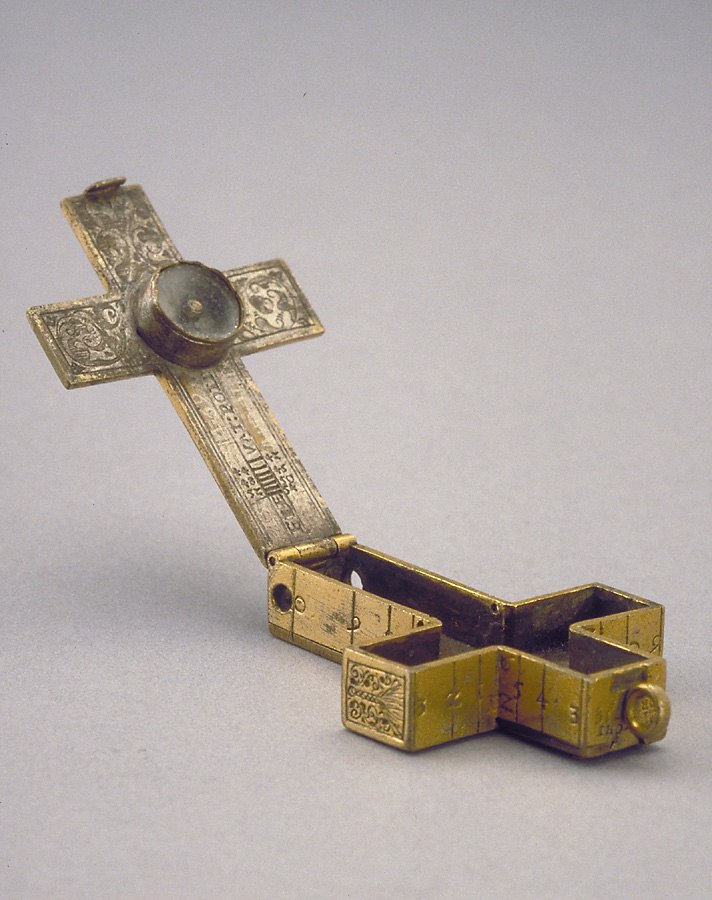
This crucifix dial, manufactured in 1569 and signed by Melchior Reichle, is an instrument constructed from gilt brass measuring 56 x 37 x 10 mm. It is a cross-shaped portable device featuring a hinged lid engraved with a Crucifixion scene and the 'INRI' monogram. Internally, the lid houses a compass with magnetic deviation markings and cardinal point abbreviations. The main box assembly features outer sides engraved with hour lines, foliate patterns, and the signature of the maker. A notable mechanical feature consists of two sliding rulers on the exterior of the box, calibrated for the conversion between Italian and common hours. The instrument also includes a latitude scale on the vertical arm and is equipped with a suspension ring for portability. The device currently lacks the original support intended for setting latitude, and its interior compartment is empty.

Gilt brass crucifix dial by Melchior Reichle, dated 1569.
Gilt brass crucifix dial by Melchior Reichle, dated 1569. — British Museum, London. Rights pending — permission not yet requested. Original source

Catalogue identity

Source
www.mhs.ox.ac.uk
Category
Tool · German crucifix dial
Maker / attribution
Melchior Reichle
Reference
Not recorded
Catalogue / lot identifier
MLA 1874, 7-27.3
Source-reported date
1569
Source-reported place
Germany

Source-reported attribution and specifications are not independent authentication. A listing does not establish present ownership, current display, availability or permission to reproduce.

Object description

Construction and Exterior Features

The object is a cross-shaped dial formed from gilt brass, with dimensions of 56 x 37 x 10 mm. The exterior surfaces are finished with detailed engravings, including foliate decorations, linear patterns, and specific hour sequences ranging from 6 to 10 and 12 to 3. A skull is depicted at the foot of the cross, and a suspension ring is attached to the upper portion.

The exterior of the box component incorporates a unique mechanical feature: two sliding rulers numbered from 1 to 12 and 13 to 24. These rulers are positioned alongside two columns of digits arranged from 8 to 12 to 8. This system is designed to facilitate the conversion between common and Italian hour formats. An inscription is present on the arms of the cross, providing text in German.

Evidence for this section
  • “Gilt brass; 56 x 37 x 10 mm”
  • “The outer sides of the cross are engraved, respectively, with the hour lines”
  • “The outside of the cross shaped main box has two sliding rulers”
  • “On the arms of the cross is the inscription 'HIC FINI ESTV GANZ LAVTER VND KLAR [star] AVS DEN TEITSCHEN STVNDE: D: WEL: ZWAR [star]'”

Internal Components and Calibration

The lid, hinged at the top of the vertical arm, is engraved on the exterior with a depiction of a Crucifixion and the 'INRI' monogram. Upon opening the lid, a compass is revealed, which includes markings for magnetic deviation and abbreviated cardinal points represented as 'M', 'OR', 'OC', 'S'.

The bottom vertical arm of the cross features an engraved latitude scale labeled 'ELEVAT<IO> POLI', which spans from 42 to 54 degrees in increments of two. The interior of the main box remains empty, and the specific support required for the adjustment of the latitude setting is currently absent from the device.

Evidence for this section
  • “The inside of the lid has a small compass with magnetic deviation indicated”
  • “The bottom of the vertical arm of the cross has an unequal scale of latitudes, engraved 'ELEVAT<IO> POLI', from 42 to 54 by two”
  • “The support for setting the latitude is missing.”

Provenance and Documentation

This instrument is identified as one of only two known dials signed by Melchior Reichle, with the second example being an item classified as a compendium. The object was formally presented by A.W. Franks in 1874 and is held within the British Museum in London.

The dial has been subject to institutional cataloguing, specifically appearing in the 1981 publication by F. A. B. Ward, titled 'A Catalogue of European Scientific Instruments in the Department of Medieval and Later Antiquities of the British Museum'.

Evidence for this section
  • “This crucifix dial is one of the two known instruments signed by Melchior Reichle”
  • “The instrument was presented by A.W. Franks in 1874”
  • “is described in F. A. B. Ward, A Catalogue of European Scientific Instruments in the Department of Medieval and Later Antiquities of the British Museum (London, 1981), p. 34, no.73.”

Open research questions

  • What is the exact function of the two holes located on the sides of the box near the suspension ring?
  • What are the origins and significance of the traces of engraving found underneath the latitude scale?

Source evidence

Recorded claims and source quotations for Crucifix Dial by Melchior Reichle
FieldSource-reported valueSource quotation
MakerMelchior Reichle“Signed by Melchior Reichle”
MaterialGilt brass“Gilt brass”
Dimensions56 x 37 x 10 mm“56 x 37 x 10 mm”
Date1569“Dated 1569”
OriginGerman“German”
Inventory numberMLA 1874, 7-27.3“Registration no. MLA 1874, 7-27.3”
ProvenanceA.W. Franks“The instrument was presented by A.W. Franks in 1874”

Visible details

  • Engraved hour scales on the outer vertical box sides
  • Visible skull motif at the foot of the cross
  • Compass needle and degree scale located inside the lid

Research qualifications

  • The original support for latitude setting is missing
  • Traces of unidentified previous engraving exist beneath the latitude scale

Photograph identity and source facts were screened before import; rights clearance remains pending.

Consulted source

Crucifix Dial

Reviewed 2026-10-26 · Record 937460120a

Terms in this record

Glossary explanations for terms named in this object’s record.

Other german crucifix dial records