
Skip to content
The Encyclopedia of Horology

Tool · German crucifix dial

Crucifix Dial

Partially verified

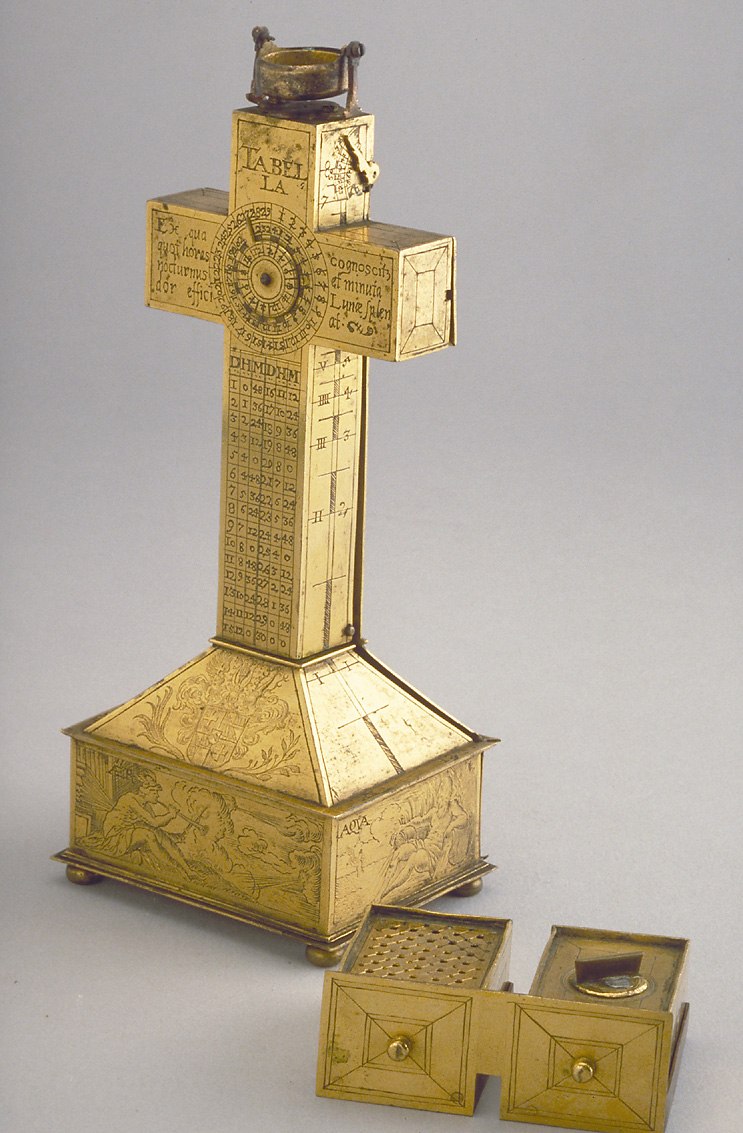
This crucifix dial is an unsigned instrument constructed of gilt brass, measuring 250 x 80 x 63 mm. Attributed to the late 16th century and of German origin, the cross stands on a rectangular plinth with four bun feet. The base features engraved personifications of the four elements (IGNIS, TERRA, AER, AQVA). The front of the cross features a hinged panel opening to reveal two rectangular drawers with geometric decoration, which might have functioned as an inkpot and pounce pot. The device incorporates multiple timekeeping features, including hour lines on the sides of the cross, a volvelle for converting Italian hours, and a lunar volvelle on the reverse side. The top bears a compass case, currently lacking needle and glass. A table for planetary hours and a latitude scale are also engraved on the object.

The crucifix dial showing the open internal drawers and the lunar volvelle on the vertical arm.
The crucifix dial showing the open internal drawers and the lunar volvelle on the vertical arm. — British Museum, London. Rights pending — permission not yet requested. Original source

Catalogue identity

Source
www.mhs.ox.ac.uk
Category
Tool · German crucifix dial
Maker / attribution
Not established
Reference
Not recorded
Catalogue / lot identifier
MLA 1922, 7-5.4
Source-reported date
Late 16th century ?
Source-reported place
Germany

Source-reported attribution and specifications are not independent authentication. A listing does not establish present ownership, current display, availability or permission to reproduce.

Object description

Construction and Design

The crucifix dial is crafted from gilt brass and stands upon a rectangular plinth supported by four bun feet. The plinth's sides are decorated with engravings representing the four elements: Ignis, Terra, Aer, and Aqua, each identified by specific attributes such as a hammer and cannon, a plough, a trumpet, and vases.

The cross itself is mounted atop this base. The front surface is hinged, allowing it to open to display an interior cavity containing two small rectangular drawers. These drawers are finished with geometric patterns and are believed to have served as receptacles for an inkpot and a pounce pot.

Evidence for this section
  • “The cross is mounted on a base with four sloping sides resting on a rectangular plinth, itself on four bun feet.”
  • “The sides of the plinth are engraved with personifications of the four elements”
  • “Inside the cross, on the opening side of the cross, are two rectangular drawers lined with geometrical decoration.”

Horological Features

The instrument serves as a complex multifunctional sundial. It includes hour lines inscribed on the sides of the cross, facilitating timekeeping through the positioning of shadows. A latitude scale, numbered from 35 to 59, is engraved at the top of the cross, accompanied by a movable arm, although it lacks an internal mechanism to adjust for latitude.

On the reverse, the dial includes a lunar volvelle and a table designed to calculate the difference between lunar and solar time based on the age of the moon. Additionally, the base features a table titled 'TABVLA DOMINII PLANETARVM' which provides hours of the day and night alongside their corresponding ruling planets.

Evidence for this section
  • “The top is engraved with a scrollwork and a scale of latitudes, numbered from 35 to 59 by three.”
  • “The back side of the cross is inscribed 'TABELLA Ex qua cognoscit[?] quot horas et minuta nocturnus Lunae splendor efficiat' and a lunar volvelle.”
  • “The bottom of the cross is inscribed with a table, 'TABVLA DOMINII PLANETARVM'”

History and Condition

The object was bequeathed by Maurice Rosenheim in 1922 and is now held by the British Museum. It is referenced in F. A. B. Ward's catalogue of scientific instruments.

Currently, the instrument shows signs of wear, specifically regarding the compass case located at the top of the cross. The case is described as slightly broken and missing its needle and glass. The attribution remains a subject of inquiry, with the date tentatively placed in the late 16th century.

Evidence for this section
  • “The instrument was bequeathed by Maurice Rosenheim in 1922”
  • “On the top of the cross is a hinged round compass case, now slightly broken and with needle and glass missing.”
  • “Late 16th century ?”

Open research questions

  • What is the identity of the coat-of-arms engraved on the base of the cross?
  • Was the missing compass needle originally fixed or magnetic?

Source evidence

Recorded claims and source quotations for Crucifix Dial
FieldSource-reported valueSource quotation
Dimensions250 x 80 x 63 mm“250 x 80 x 63 mm”
MaterialsGilt brass“Gilt brass”
Inventory NumberMLA 1922, 7-5.4“MLA 1922, 7-5.4”
Compass conditionNeedle and glass missing“now slightly broken and with needle and glass missing”
DateLate 16th century“Late 16th century ?”
Base engravingsPersonifications of four elements“The sides of the plinth are engraved with personifications of the four elements”
InscriptionsPlanetary hours table“The bottom of the cross is inscribed with a table, 'TABVLA DOMINII PLANETARVM'”

Visible details

  • Engraved personifications of the four elements on the plinth sides.
  • Hinged front panel revealing two small internal drawers.
  • Integrated lunar volvelle with lunar day scale.
  • Hinged round compass case at the top of the cross.

Research qualifications

  • Dating is qualified with a question mark by the source.
  • Internal compartments are identified as an inkpot and pounce pot tentatively.
  • Needle and glass for the compass are missing.

Photograph identity and source facts were screened before import; rights clearance remains pending.

Consulted source

Crucifix Dial

Reviewed 2026-10-26 · Record 87e8d45767

Terms in this record

Glossary explanations for terms named in this object’s record.

Other german crucifix dial records