
Skip to content
The Encyclopedia of Horology

Tool · German crucifix dial

Crucifix Dial

Partially verified

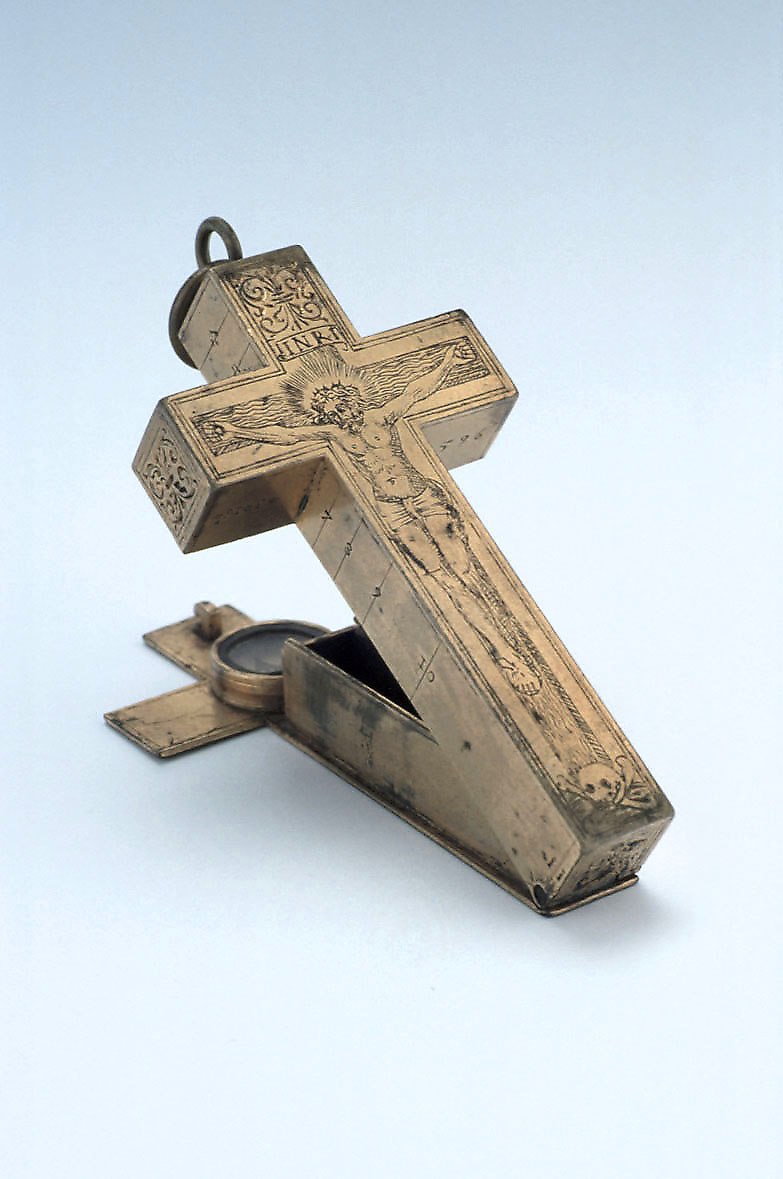
This crucifix sundial, inventory number 37133 at the Museum of the History of Science, Oxford, is constructed from gilt brass and measures 90 mm in length. Attributed to the maker Markus Purmann and dated 1596, the device functions as both a devotional object and a polar sundial. The dial comprises a base plate featuring a glazed magnetic compass and a hinged upper cross-shaped box. The instrument uses the edges of the upper cross section to cast shadows onto hour lines engraved on six rectangular faces. A graduated scale on the base plate allows the user to adjust the angle of the upper section to the appropriate latitude. The exterior features religious imagery including Christ at Calvary and the brazen serpent, alongside decorative engravings. A ring and shackle at the top indicate the instrument was designed for wear as a pendant.

A gilt brass crucifix sundial featuring a hinged upper cross, latitude scale, and magnetic compass, dated 1596 and signed by Markus Purmann.
A gilt brass crucifix sundial featuring a hinged upper cross, latitude scale, and magnetic compass, dated 1596 and signed by Markus Purmann. — Museum of the History of Science, Oxford. Rights pending — permission not yet requested. Original source

Catalogue identity

Source
www.mhs.ox.ac.uk
Category
Tool · German crucifix dial
Maker / attribution
Markus Purmann
Reference
Not recorded
Catalogue / lot identifier
37133
Source-reported date
1596
Source-reported place
Germany

Source-reported attribution and specifications are not independent authentication. A listing does not establish present ownership, current display, availability or permission to reproduce.

Object description

Construction and Design

The object is a crucifix-shaped sundial consisting of two primary components: a flat base plate and a hinged, cross-shaped upper box. The base plate contains a small, integrated, glazed magnetic compass, which serves as a navigational tool to orient the instrument for accurate timekeeping. A raised box section on the base is marked with a latitude scale ranging from 10 to 85 degrees, divided into 5-degree increments up to 60 degrees, and 1-degree increments from 60 to 85. This scale allows the user to incline the upper cross section to the correct angle based on the user's geographic location.

The upper section functions as a polar dial. Six rectangular faces of the cross feature hour lines, and the shadows are cast by the edges of the top part of the cross. The hours are engraved in a counter-clockwise sequence around these faces, starting from 1 through 6, 9 through 12, 6 through 9, 3 through 6, 12 through 3, and 6 through 11.

Evidence for this section
  • “The cross has two components: a base plate with a raised box section, and an upper cross-shaped box hinged to the base.”
  • “The base plate has a small, glazed magnetic compass, and one side of the box section has a scale on two sides”
  • “The upper section carries the hour lines of a polar dial, where the shadows are cast by the six edges of the top part of the cross on to lines on six rectangular faces.”

Iconography and Significance

The surfaces of the crucifix are decorated with symbolic imagery. The front side displays an engraving of Christ at Calvary, surmounted by the inscription 'INRI', and features a depiction of a skull and cross-bones at the base.

The object is considered a polyhedral dial with devotional significance. The presence of the imagery is intended to link the practical use of the dial to theological reflection, suggesting that the user might find spiritual healing through the act of faith, paralleling the medical symbolism associated with the brazen serpent.

Evidence for this section
  • “the front surface of the cross has an engraved image of Christ at Calvary”
  • “The back has the less common image of the brazen serpent”
  • “it was probably included on the dial to make a theological point: the Christian is healed spiritually by looking in faith at the sacrifice of Christ on the cross.”

Signatures and Internal Features

The dial is signed 'M P' with stars, and dated '1596', which are visible on the rectangular faces of the upper section. The instrument includes an attachment point consisting of a ring and shackle at the top, which would have allowed the object to be worn around the neck.

The internal construction includes box sections that appear intended for storage. Specifically, one part of the box has been configured into a small internal compartment. It is suggested that this area may have been intended for housing relics, although the cover for this section is no longer present.

Evidence for this section
  • “the two remaining rectangular ones the signature '[star]M[star]P[star]' and the date '1596'.”
  • “There is a ring and shackle at the top for wearing the dial around the neck.”
  • “Parts of the box sections could have been used to house relics and one part has been made into a small compartment, possibly for this purpose, though the cover is missing.”

Open research questions

  • What is the historical evidence for relics being stored in similar crucifix dials?
  • Are there other known dials by Markus Purmann with similar internal compartment configurations?

Source evidence

Recorded claims and source quotations for Crucifix Dial
FieldSource-reported valueSource quotation
MakerMarkus Purmann“Signed by Markus Purmann”
Date1596“Dated 1596”
MaterialGilt brass“Gilt brass”
Length90 mm“90 mm in length”
Latitude Scale10 to 85 degrees“marked 'GRADVS ELEVATIONIS POLI', 10 to 85 degrees”
ProvenanceMuseum of the History of Science, Oxford“Museum of the History of Science, Oxford”

Visible details

  • Glazed magnetic compass on base plate
  • Latitude adjustment scale marked GRADVS ELEVATIONIS POLI
  • Engraved Christ figure with INRI inscription
  • Skull and cross-bones engraving at the base

Research qualifications

  • Purpose of the internal compartment remains speculative
  • Missing cover for the internal compartment

Photograph identity and source facts were screened before import; rights clearance remains pending.

Consulted source

Crucifix Dial

Reviewed 2026-10-26 · Record 7222600b18

Terms in this record

Glossary explanations for terms named in this object’s record.

Other german crucifix dial records