
Skip to content
The Encyclopedia of Horology

Tool · Crucifix sundial

Crucifix Dial by Adriaan Zeelst

Partially verified

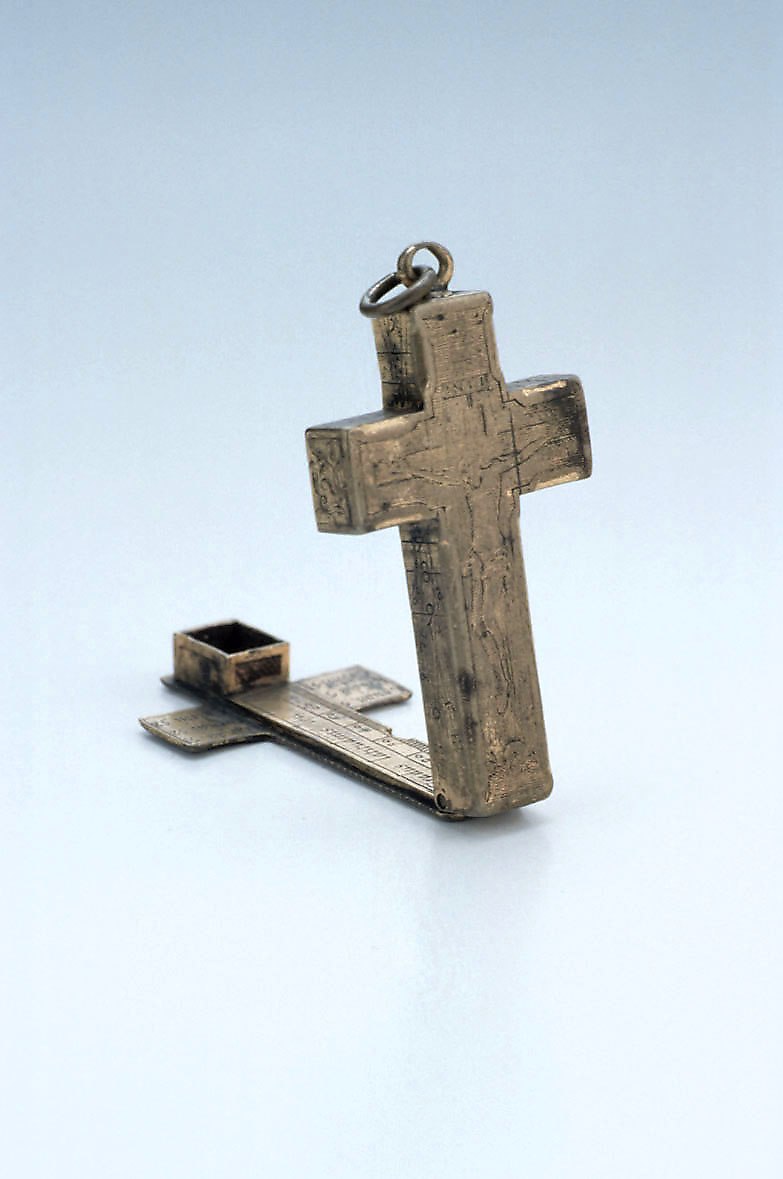
This gilt brass crucifix dial, measuring 7 x 32 x 54 mm, is an instrument designed to tell time through solar measurement. Signed by Adriaan Zeelst and dated 1588, the device features a depiction of the Crucifixion on one side. The cross arms are engraved with hour lines, symbols of the zodiacal signs used to indicate solar declination, and additional arabesque decoration. A brass index arm is included for the adjustment of latitude. The instrument is held in the collection of the Museum of the History of Science, Oxford. The exterior features scales for latitude and shadow, alongside an engraved coat of arms and the motto 'Nil admirari'. This portable instrument combines religious iconography with functional horological and cartographic scales for use across different geographic locations, reflecting the work of a maker known for technical treatises on the astrolabe.

A side-profile view of the gilt brass crucifix dial showing the cross structure and the internal scales.
A side-profile view of the gilt brass crucifix dial showing the cross structure and the internal scales. — Museum of the History of Science, Oxford. Rights pending — permission not yet requested. Original source

Catalogue identity

Source
www.mhs.ox.ac.uk
Category
Tool · Crucifix sundial
Maker / attribution
Adriaan Zeelst
Reference
Not recorded
Catalogue / lot identifier
49469
Source-reported date
1588
Source-reported place
Louvain

Source-reported attribution and specifications are not independent authentication. A listing does not establish present ownership, current display, availability or permission to reproduce.

Object description

Construction and Exterior

The crucifix dial is constructed from gilt brass and measures 7 x 32 x 54 mm. One side of the cross presents a figurative illustration of the Crucifixion. The outer side displays decorative and functional elements, including an engraved coat of arms and the Latin motto 'Nil admirari', translating to 'nothing is to be desired'.

The reverse side incorporates multiple scales for calculation. An equal scale marked 0 to 25 is present, labeled 'Partes umbrae', alongside an unequal altitude scale marked 10 to 70 labeled 'Gradus altitudinis'. Arabesque patterns further decorate the surfaces of the cross.

Evidence for this section
  • “Gilt brass; 7 x 32 x 54 mm”
  • “On one side of the cross is an illustration of the Crucifixion.”
  • “The other, outer side of the cross has an engraved coat of arms and the motto 'Nil admirari'”

Horological and Latitude Scales

Functionally, the instrument serves as a portable sundial. Hour lines and zodiacal symbols are engraved on the arms of the cross to indicate solar declination. The inner portion of the cross features an unequal scale of latitudes ranging from 0 to 80, explicitly identified as 'Gradus latitudinis loci'.

Additional latitude information is provided for six specific locations, which are inscribed on the short arms of the cross and on a dedicated plate. A brass index arm is integrated into the instrument, which the user adjusts to align with the latitude of their current location to ensure accurate timekeeping.

Evidence for this section
  • “On the cross arms are the hour lines and the symbols of the zodiacal signs indicating the declination of the sun”
  • “inner part of this side of the cross has an unequal scale of latitudes marked [0] to [80] by 1”
  • “brass index arm for adjusting the latitude.”

Signature and Identification

The instrument is explicitly attributed to Adriaan Zeelst. The signature 'A. Zeelsti faciebat Louanij' is found on the plate containing the list of latitudes.

The object is catalogued by the Museum of the History of Science in Oxford under inventory number 49469. It is documented as a product of Louvain and remains dated to 1588, providing a precise point of origin for this specific piece.

Evidence for this section
  • “Signed by Adriaan Zeelst”
  • “Dated 1588; Louvain”
  • “signature 'A. Zeelsti faciebat Louanij'”

Open research questions

  • Which specific six locations correspond to the latitude values inscribed on the cross?
  • To whom does the unidentified coat of arms engraved on the outer side belong?

Source evidence

Recorded claims and source quotations for Crucifix Dial by Adriaan Zeelst
FieldSource-reported valueSource quotation
MakerAdriaan Zeelst“Signed by Adriaan Zeelst”
Date1588“Dated 1588”
LocationLouvain“Louvain”
MaterialGilt brass“Gilt brass”
Dimensions7 x 32 x 54 mm“7 x 32 x 54 mm”
SignatureA. Zeelsti faciebat Louanij“signature 'A. Zeelsti faciebat Louanij'”
Inventory Number49469“Inventory number 49469”

Visible details

  • Gilt brass construction
  • Features a Crucifixion illustration on the cross body
  • Equipped with a brass index arm for latitude adjustment
  • Includes an equal shadow scale and an unequal altitude scale

Research qualifications

  • The coat of arms engraved on the cross remains unidentified
  • The exact intended geographic usage of the listed locations is not specified beyond their latitude values

Photograph identity and source facts were screened before import; rights clearance remains pending.

Consulted source

Crucifix Dial

Reviewed 2026-10-26 · Record 52d3de9f2e

Terms in this record

Glossary explanations for terms named in this object’s record.