
Skip to content
The Encyclopedia of Horology

Clock · Table clock

Clock with Father Time

Partially verified

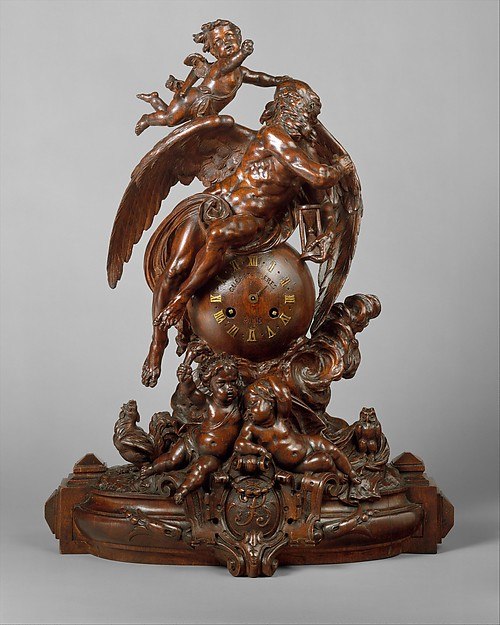
This clock, catalogued by The Metropolitan Museum of Art under the title "Clock with Father Time" and accession number 1991.261, is attributed to the French sculptor Albert-Ernest Carrier-Belleuse. Dated to 1863, the horological object is constructed from walnut, glass, bronze, and steel. It measures 20 3/4 inches in height, 16 1/4 inches in width, and 8 inches in depth. The design features figurative sculpture, including the personification of Father Time as a bearded, winged man holding an hourglass, accompanied by putti, an owl, and a rooster. The clock face is integrated into the central sculptural composition. This piece is part of the museum's European Sculpture and Decorative Arts collection, and the documentation classifies it within the discipline of horology.

Clock with Father Time, 1863, featuring carved walnut figures of Father Time and putti.
Clock with Father Time, 1863, featuring carved walnut figures of Father Time and putti. — The Metropolitan Museum of Art, New York. Rights pending — permission not yet requested. Original source

Catalogue identity

Source
orbiscollectibles.com
Category
Clock · Table clock
Maker / attribution
Albert-Ernest Carrier-Belleuse
Reference
Not recorded
Catalogue / lot identifier
1991.261
Source-reported date
1863
Source-reported place
France

Source-reported attribution and specifications are not independent authentication. A listing does not establish present ownership, current display, availability or permission to reproduce.

Object description

Composition and Iconography

The sculptural composition of the clock focuses on the figure of Father Time, represented as a bearded man with wings holding an hourglass. This figure is centrally integrated with a spherical clock face upon which the hours are marked. The surrounding base incorporates further narrative elements, specifically two putti resting on the lower structure, along with an owl and a rooster, which are visible in the primary documentation.

The overall arrangement of these figures is housed within the specified dimensions of approximately 52.7 by 41.3 by 20.3 centimeters.

Evidence for this section
  • “The piece incorporates the figure and subject of Father Time, a personification representing the progression of history and the approach of death.”
  • “elements such as wings and hourglasses added during the Renaissance.”

Materials and Construction

The physical construction of the timepiece utilizes a combination of walnut, glass, bronze, and steel. The visible structure is largely dominated by the carved walnut frame which supports the central clock face and the associated figures. These materials are consistent with the mid-19th-century origin of the object.

The clock is catalogued under the European Sculpture and Decorative Arts department.

Evidence for this section
  • “The museum records the medium as Walnut, glass, bronze, and steel”
  • “This clock is dated to 1863 and is attributed to the French sculptor Albert-Ernest Carrier-Belleuse”

Attribution and Documentation

The object is attributed to the French sculptor Albert-Ernest Carrier-Belleuse, who was born in 1824 and died in 1887. The attribution is recorded by The Metropolitan Museum of Art, where the clock is currently held. The museum record provides the accession number 1991.261 for the piece.

The record for the clock is sourced from the museum's open-access data. While the metadata identifies the maker and dates the piece to 1863, the source notes that the details have been transcribed from the museum record and that further verification of the object as a wider collectible type is required.

Evidence for this section
  • “Clock in The Metropolitan Museum of Art, New York (accession 1991.261)”
  • “attributed to Albert-Ernest Carrier-Belleuse (French, Anizy-le-Château 1824–1887 Sèvres).”

Open research questions

  • What type of movement is contained within the central sphere?
  • Are there known examples of other clocks featuring this specific sculpture by Carrier-Belleuse?

Source evidence

Recorded claims and source quotations for Clock with Father Time
FieldSource-reported valueSource quotation
Accession number1991.261“1991.261”
Attributed makerAlbert-Ernest Carrier-Belleuse“attributed to Albert-Ernest Carrier-Belleuse”
MaterialsWalnut, glass, bronze, and steel“Walnut, glass, bronze, and steel”
Overall dimensions20 3/4 × 16 1/4 × 8 in.“20 3/4 × 16 1/4 × 8 in. (52.7 × 41.3 × 20.3 cm)”
Subject tagsMen, Putti, Owls, Roosters“Men, Putti, Owls, Roosters”

Visible details

  • The dial bears the signature 'GUERET FRERES'
  • The figure of Father Time is depicted with large wings and an hourglass
  • Two putti are positioned at the base of the clock
  • The base features an ornate monogram or cartouche at the front

Research qualifications

  • The classification of the clock as a wider collectible type has not been independently verified beyond the museum record
  • Specific technical details regarding the movement mechanism are not provided in the source

Photograph identity and source facts were screened before import; rights clearance remains pending.

Consulted source

Clock with Father Time, 1863

Reviewed 2026-11-02 · Record 121019d140

Terms in this record

Glossary explanations for terms named in this object’s record.