
Skip to content
The Encyclopedia of Horology

Clock · Table clock

Clock with case veneered in tortoiseshell and brass

Partially verified

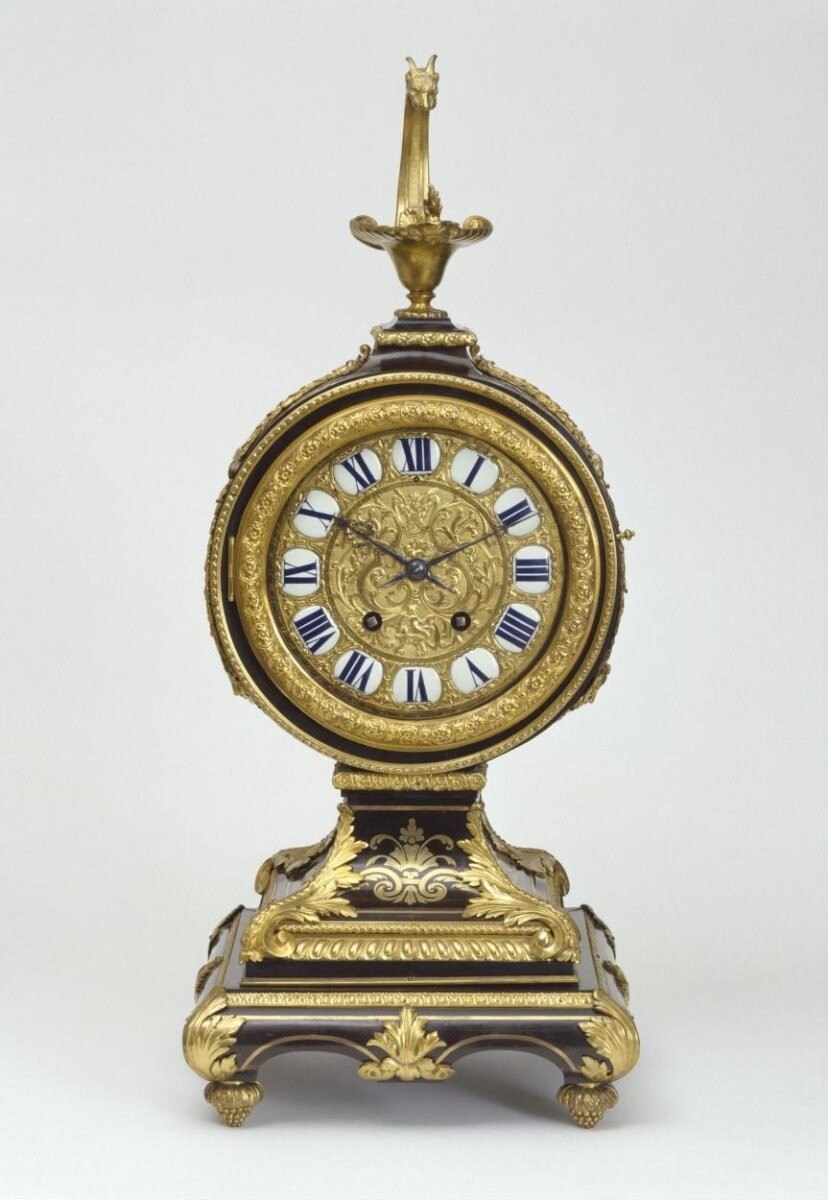
This table clock, created in Paris between 1870 and 1900, features a circular body mounted on a rectangular pedestal. The case is constructed with an oak foundation, veneered in tortoiseshell and ebony, and decorated with engraved brass inlay and chased brass mounts. The ormolu dial is adorned with relief strapwork and foliage, incorporating a figure of Time at the base and a cherub's head at the summit. The Roman numerals are enamelled in blue on a white ground, complemented by blued steel hands. The clock is topped by an ormolu ornament shaped like a lamp with a handle terminating in a goat's head. Front access is provided by a glass door, with additional glass panels framed by laurel wreaths on the sides. The mechanism is signed by the maker, Chevillier Fnt à Paris. The item was gifted to the collection by J. R. Bryant.

Front view of the French clock, showing the ormolu dial, blue enamel numerals, and the lamp-shaped finial.
Front view of the French clock, showing the ormolu dial, blue enamel numerals, and the lamp-shaped finial. — Victoria and Albert Museum, London. Rights pending — permission not yet requested. Original source

Catalogue identity

Source
collections.vam.ac.uk
Category
Clock · Table clock
Maker / attribution
Chevillier
Reference
Not recorded
Catalogue / lot identifier
3A-1903
Source-reported date
1870-1900
Source-reported place
France

Source-reported attribution and specifications are not independent authentication. A listing does not establish present ownership, current display, availability or permission to reproduce.

Object description

Case Construction and Ornamentation

The clock is built upon an oak foundation, finished with a veneer of tortoiseshell and ebony. This dark surface is extensively decorated with engraved brass inlays and various chased brass mounts. The central circular body is supported by a substantial pedestal, which sits upon four feet enriched with acanthus foliage mouldings.

The top of the clock features an ornamental ormolu lamp, which incorporates a handle terminating in a goat's head. A duplicate of this ornament is included as a separate component. The side panels of the clock body are glazed and set within laurel wreath frames, each featuring a mask ornament at the base.

Evidence for this section
  • “The foundation of the whole is oak.”
  • “The body of the clock is circular, with an ormolu face decorated in relief with strapwork and foliage”
  • “It rises from a pedestal standing on four feet and decorated with enriched mouldigs of corner mounts of acanthus foliage.”
  • “With it is a duplicate of the ormolu lamp on the top”

Dial and Timekeeping

The clock face is crafted from ormolu and features relief ornamentation. The design includes strapwork and foliage, with a figure representing Time situated below the center and a cherub's head located above. The numeral track consists of blue enamel Roman numerals set against a white background.

Time is indicated by blued steel hands. Access to the face is provided by a glass door mounted at the front of the circular clock body. The mechanism is signed by the maker, Chevillier, indicating his establishment in Paris.

Evidence for this section
  • “an ormolu face decorated in relief with strapwork and foliage”
  • “The numerals are enamelled in blue on white, and the hands are of blued steel.”
  • “There is a glass door in front”
  • “Mechanism signed 'Chevillier Fnt à Paris'”

Provenance and Documentation

The object was accessioned by the collection in 1903, referenced by the number 3A-1903. The primary documentation for the clock consists of a register entry dated to that year, which details the materials and decorative elements of the piece.

The item was donated to the collection by J. R. Bryant. The geographical origin of the clock is attributed to France, specifically Paris, based on the provided maker's signature and registration records.

Evidence for this section
  • “The following descriptio is taken from the register of 1903”
  • “Given by J R Bryant”
  • “French (Paris)”

Open research questions

  • What is the full name or trade history of the maker 'Chevillier'?
  • Does the duplicate ormolu lamp exhibit any wear or construction differences compared to the one currently mounted on the clock?

Source evidence

Recorded claims and source quotations for Clock with case veneered in tortoiseshell and brass
FieldSource-reported valueSource quotation
MakerChevillier“Mechanism signed 'Chevillier Fnt à Paris'”
Date1870-1900“French (Paris), 1870-1900”
Accession Number3A-1903“3A-1903”
FoundationOak“The foundation of the whole is oak.”
Dial featuresOrmolu with strapwork and foliage“an ormolu face decorated in relief with strapwork and foliage enclosing a figure of Time below, and a cherub head above.”
OriginFrance“French (Paris)”

Visible details

  • Blue enamel Roman numerals on a white ground.
  • Ormolu lamp-shaped finial with a goat's head handle.
  • Four feet decorated with acanthus leaf mouldings.

Research qualifications

  • The specific role or identity of 'Chevillier' remains unverified beyond the provided signature.
  • The description relies on a register entry from 1903 regarding internal construction details not visible in photographs.

Photograph identity and source facts were screened before import; rights clearance remains pending.

Consulted source

Clock with case veneered in tortoiseshell and brass

Reviewed 2026-11-02 · Record f7bf474490

Terms in this record

Glossary explanations for terms named in this object’s record.